TKW Site Map         Tom Wukitsch bio         TKWFace.jpg               
               Also visit
SMATCH (Scientific Methodologies Applied to Cultural Heritage)
  scrollyhd.jpg
ALRILogo.gifA L R I -- the Arlington Learning in Retirement Institute
The ALRI LOGO and Initials and this line of text link to the ALRI Home Page
                             (for information on other ALRI courses, etc.)


Ancient History Courses -- Spring Semester 2008:  Ancient Egypt

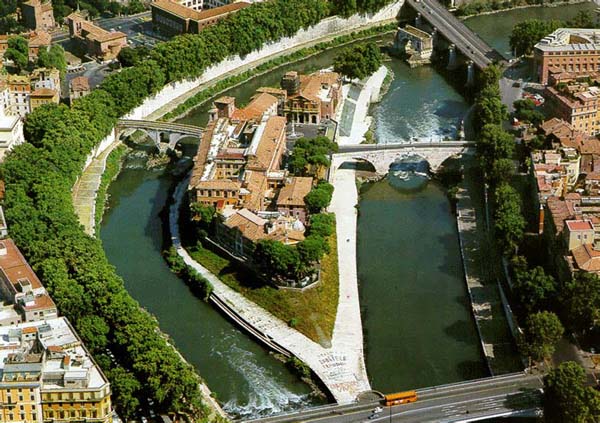
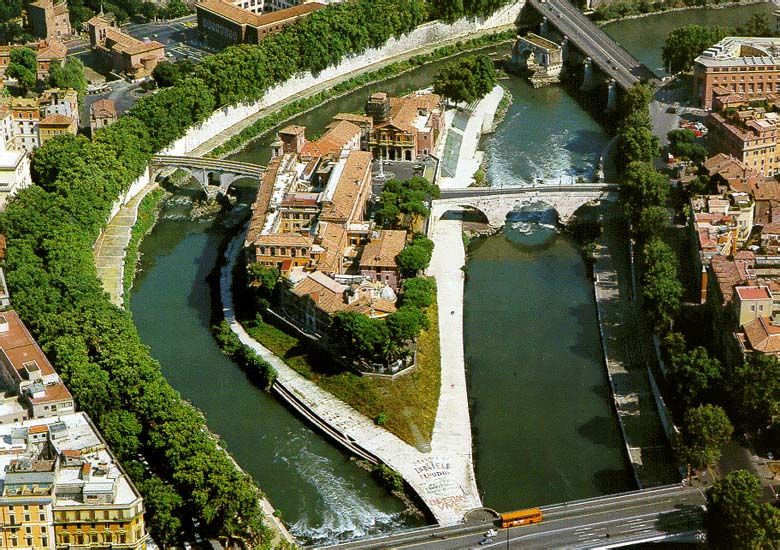
Tiber Island in Rome -- the site of the earliest known habitation in the city
  (Photo source: http://catholic-resources.org/AncientRome/tbr0-1.jpg ,
Part of a major Rome Internet image resource at
http://catholic-resources.org/AncientRome/index.html
by Prof. Felix Just, S.J.)

Rome Surveys, Ancient Rome in the Movies, Pompeii/Vesuvius, Carthage/North Africa, Ancient Egypt, and other diversions

Instructor: Tom Wukitsch, SMATCH Board member 

Current course:
Spring of 2008:  Ancient Egypt

(
Course information is hereIndividual course units are here.)
(Ancient Egypt study trip pix -- November 23 through December 7, 2007)
The Funerary Temple of Queen Hatshepsut.

The Temple of Deir El-Bahri is one of the more amazing temples in the whole of Egypt, due to its design and decorations. It was built of limestone, not sandstone like most of the other funerary temples of the New Kingdom period.

It is thought that Senimut, the genius architect who built this Temple, was inspired in his design by the plan of the neighboring mortuary Temple of the 12th Dynasty King, Neb-Hept-Re. The Temple was built for the great Queen Hatshepsut (18th Dynasty), to commemorate her achievements and to serve as a funerary Temple for her, as well as a sanctuary of the God, Amon Ra.

The Temple was seriously damaged and defaced, after Queen Hatshepsut's mysterious death, by the followers of Thutmoses III, her successor.  Reconstruction work by 20th / 21st century archeology teams continues.

Course information:
Ten two hour sessions covering Egypt from prehistoric times through the Roman period.

Thursdays, 9:30 to 11:30 AM, March 6 through May 8, 2008.

Classes will be held in the Monticello Room of The Jefferson, 900 North Taylor Street, Arlington Virginia.  The Ballston-MU Metro stop on the subway Orange Line is on North Stuart Street, about two blocks from The Jefferson.  Maps, driving instructions, and parking information can be found at http://www.arlingtonlri.org/MapsAndDirections.aspx. (A more detailed neighborhood map is at http://www.mmdtkw.org/BallstonMUMetroArea.jpg.)

Course description:  Egypt is now in its seventh millennium, but we will only cover the first 55 hundred or so years (plus a few thousand more years of "prehistory".)  We are all familiar with the pyramids, the great sphinx, King Tut (and a few other "pharaohs"), and, if we watch television, we've seen films about ancient Egypt.  This course will try to get a little deeper into the thicket of reeds along the Nile.  For example, the reason the word "pharaohs" is in quotation marks in the previous sentence is that it started as a slang word in ancient Egypt.  The hieroglyphic signs that represent the sounds of "p" and "r" really mean "house" and a determinative hieroglyph is added to indicate "big".  From the 14th Dynasty onward, the ruler might be referred to as "paraoh" -- the "ph" (=f) at the beginning was a Greek corruption.  The 14th Dynasty ruled for about 100 years (ca. 1700 BC) during the dissolution of the Middle Kingdom.  It apparently wasn't until the 19th Dynasty that someone had the nerve to send a letter to Amenhotep IV (Akhenaten) using the word as a form of direct address.  (More on the etymology of "pharaoh" is at http://en.wikipedia.org/wiki/Pharaoh#Etymology)

We will NOT study all the Pharaohs (there are just too many -- see http://www.phouka.com/pharaoh/pharaoh/pharaohs.html), but we will look at the major periods, a few important dynasties, some notable kings and queens, some aspects of the art, architecture, history, and culture, and, yes, those pyramids, and the great sphynx, and King Tut. 

No textbook is necessary:  the usual copious handouts will be provided and the internet links provided here and in the handouts will more than suffice.  If you really feel the need to hold physical books on Ancient Egypt, links to hundreds of scholarly reviews of Ancient Egypt books are available at this link (Bryn Mawr Classical Review).  My own favorite book on Ancient Egypt is the Oxford History of Ancient History by Ian Shaw, which is available on the internet for as little as $7.50, used, or $11, new -- click on this link for information.


Keep up with developments in Egyptian Archeology at these two links: 
http://egyptology.blogspot.com/ and http://www.egyptologyblog.co.uk/

*  *  *  *  *  *  *  *  *  *  *  *  *  *  *  *  *  *  *  *  *  *  *  *
The Past -- earlier presentations and classes:
National Building Museum Tour
Wednesday July 13, 2005 at 10:30 AM
ALRI members joined Bobby Gladstein for a look at this historic example of late 19th century public institutions.  We explored one of the most beautiful and architecturally interesting buildings in D.C., built after the Civil War to house the Pensions Bureau.  After the building tour, the group met with Mr. Don Alexander Hawkins, curator of the current exhibition Washington:  Symbol and City, for a discussion of the meaning of the District of Columbia not only as the nation's capital, but also as home to many culturally diverse people.

Briefly captioned pictures taken during the tour are available at http://www.mmdtkw.org/NBM-ALRItkw.html

An article about the Museum is available at http://www.mmdtkw.org/VNatBuildMus.html

ALRI Travel Club Presentations are available at
http://www.mmdtkw.org/ALRITravelClub.html

Rome Surveys:
Ancient Egypt -- Fall Semester 2007 course completed.   Repeated Spring Semester 2008

Ancient Egypt study trip -- November 23 through December 7, 2007:  Cairo, Luxor, Edfu, Kom Ombo, Aswan, Cairo

Ancient Rome in the Movies (click for info) -- Spring Semester 2007 -- Course has been completed


Carthage and Ancient North Africa
-- Fall Semester 2006 -- Course has been completed

Vesuvius -- The Destruction of Pompeii, Herculaneum, and surrounding areas
-- Fall Semester 2005 and repeated Spring Semester 2006 -- Courses have been completed

Medieval Rome -- Spring Semester 2005 -- Course has been completed


Renaissance Rome -- Fall Semester 2004 -- Course has been completed

Ancient Rome Study Trip -- September 2004 -- Trip to Rome has been completed  -- For links to papers that were prepared for the trip and for pictures of the trip, click here

Ancient Rome -- Spring Semester 2004 -- Course has been completed

Medieval Rome -- Fall Semester 2003 -- Course has been completed

Ancient Rome -- Spring Semester 2003 -- Course has been completed


Textbooks -- none are needed
But, if you feel that you simply must have a book or three,

For the Rome/Movies course,
the usual  handouts will be provided for each unit, but if you really think you must have a book, try one of these:

Big Screen Rome, by Monica Silveira Cyrino or
Imperial Projections: Ancient Rome in Modern Popular Culture, by Sandra B. Joshel et al.  or
Projecting the Past: Ancient Rome, Cinema, and History, by Maria Wyke

For the Carthage/North Africa course, visit this page.

For the
Vesuvius/Pompeii course, visit this page.

For the
Medieval Rome course, you could get yourself a copy of Rome, Profile of a City, 312 -- 1308 by Richard Krautheimer.  It has history, architecture, profuse illustrations, etc., and the late Professor was long acknowledged as the the "world's foremost authority".  Almost everything we know is based on his research and that of his students.   (Once again available, now in large format paperback, $35 at Scholar's Bookshelf on the internet  and more expensive elsewhere.)  The 1854 History of the City of Rome in the Middle Ages by Ferdinand Gregorovius is also available for sale on the internet at http://www.italicapress.com/index165.html, but it costs $285 for the eight volume set (in 13 paperbacks) or $225 for the CD-ROM.

For the Renaissance Rome course (again, only if you feel you must have a book) there are:  (1) The Renaissance in Rome,  by Charles L. Stinger (about $18 from Amazon.com);  (2) Renaissance Rome 1500 - 1559, A portrait of a Society, by Peter Partner ($20);  and (3) The Art of Renaissance Rome, by Loren Partridge ($12).  The full text of Jacob Burckhardt's classic, The Civilization of the Renaissance in Italy, is available on the internet at http://www.boisestate.edu/courses/hy309/docs/burckhardt/burckhardt.html

For the Ancient Rome course, Richardson's A New Topographical Dictionary of Ancient Rome is a great source, but it costs about $80 through on line booksellers.  It was published in 1992, so it does not include the excavations of Rome's Imperial Forums which were accomplished after that time.  Large parts of the "old" -- 1929 -- topo dictionary, which Richardson revised and updated, are available free on the Internet at http://penelope.uchicago.edu/Thayer/E/Gazetteer/Places/Europe/Italy/Lazio/Roma/Rome/
_Texts/PLATOP*/home*.html.  Also for the Ancient Rome couse, Cary and Scullard's A History of Rome Down to the Reign of Constantine is the textbook of choice for many university courses (about $70 on the Internet),  and one of the great book bargains on the internet is the Oxford Archeological Guide to Rome (for only $14).  The most commonly used book on how Romans lived is Daily Life of the Ancient Romans by David Matz (about $50 from online booksellers), but I prefer the older -- and free! -- The Private Life of the Romans by the Johnstons, on the Internet at http://www.forumromanum.org/life/johnston.html .


Copyright, "Fair Use", and Plagiarism
This is not a course which involves student writing or multi-media projects, but everyone involved should be aware of the rules about copyright, "fair use" and plagiarism.  Attribution has become a particularly thorny problem in the Internet age: as unattributed copies of the same information/pages appear on multiple sites, it becomes increasingly difficult to find the owner of intellectual property.  (I've seen some of my own stuff presented as original material on other web sites.)  Complicating an already difficult situation is the fact that copyright laws and federal regulations have not yet been updated to address current issues.  There have been numerous court cases but the decisions have been inconsistent.

And then there is the problem of "unconscious plagiarism":  certain phrases and ways of writing  about subject matter have become engrained in the literature.  After long years of reading and study on any particular subject, apt phraseology, which might well have originated in the writings of others, will almost certainly pop back into your head as "original" thoughts.  For me, fifty years of notes and sometimes-unsorted and unsourced note cards, some of which date back to my early teens, have also been a problem.  Sometimes I frankly don't know whether "what is written" is original thought or cribbed from some "source".  I've tried not to let plagiarism creep onto these pages, but if you do see it, let me know at 
mmd.tkw@verizon.net

Use the three links immediately below to find more information on
Copyright, "Fair Use", and Plagiarism.

GMU Copyright/Fair Use pages  http://mason.gmu.edu/~montecin/cpyrght.htm
"Fair Use", Copyright, Plagiarism (Stanford U)  http://fairuse.stanford.edu/
US Code on Copyright:  Title 17, Chapter 1 
(Section 107 covers "Fair Use") 
http://www4.law.cornell.edu/uscode/17/ch1.html


The following contains links to pages that are available on the Internet.
Please note that links on the Internet are notoriously volatile.  I can not  predict or prevent "broken links" due to changes in other folks'  Internet sites.  If you don't find what the link calls for, you can always search using Google or some othe search engine.


Ancient Egypt


A note on spelling of ancient Egyptian names and words:
All Egyptian names and words are transliterations from
ancient Egyptian phonetic scripts.  So modern spellings are
dependent on how we think the ancient word sounded.
This can lead to different spellings, and there is no "correct"
way to spell any Egyptian word or name.  One tries for
consistency,
but some variation is inevitable.  Please patiently
accept the
sometimes variant spelling of Egyptian names
and words you
may find in the Egyptian section of the
this Internet site. 

Unit 1:  Introduction, Pre- and Proto-Dynastic Egypt
http://www.mmdtkw.org/EGtkw0100Unit1IntroPrehistPredyn.html
(Outline and images from slide lecture)(more links can be found in this page)
Unit 2:  Late Proto-Dynastic to the Late Period, plus CD:  Mystery of the Rosetta Stone (Egypt – Rediscovering a Lost World)
http://www.mmdtkw.org/EGtkw0200-Unit2ProtoDynastictoLatePeriod.html
(Outline and images from slide lecture)(more links can be found in this page)
http://www.bbc.co.uk/pressoffice/pressreleases/stories/2005/10_october/17/egypt_champ_eps.shtml
(CD synopsis from BBC)
Unit 3:  Egyptian Writing, plus CD:  Secrets of the Hieroglyphs (Egypt – Rediscovering a Lost World)
http://www.mmdtkw.org/EGtkw0300-Unit3EgyptianWriting.html
(Outline and images from slide lecture)(more links can be found in this page)
http://www.bbc.co.uk/pressoffice/pressreleases/stories/2005/10_october/17/egypt_champ_eps.shtml
(CD synopsis from BBC)

Unit 4:  Pharaohs and Pharaohesses

http://www.mmdtkw.org/EGtkw0500-Rulers.html
(Outline and images from slide lecture) (more links can be found in this page)
Unit 5:  CD:  Belzoni – The Pharaoh and the Showman / The Temple of the Sands  (Egypt – Rediscovering a Lost World) http://www.mnsu.edu/emuseum/information/biography/abcde/belzoni_giovanni.html
(Belzoni Bio)
http://www.bbc.co.uk/pressoffice/pressreleases/stories/2005/10_october/17/egypt_belzoni_eps.shtml
(CD Synopsis from BBC)
Unit 6:  Religion and Death Rites

http://www.mmdtkw.org/EGtkw0400-ReligionDeathRites.html
(Outline and images from slide lecture)(more links can be found in this page)
Unit 7:  Pyramids, plus CD:  Pyramid (Macauley)
http://www.mmdtkw.org/EGtkw0600-Pyramids.html
(Outline and images from slide lecture)(more links can be found in this page)
Unit 8:  Theban Tombs -- Valley of the Kings, plus CD:  Journey through the Valley of the Kings
http://www.mmdtkw.org/EGtkw0700-ThebanTombs.html
(Outline and images from slide lecture)(more links can be found in this page)
Unit 9:  Other Egyptian Archeological sites
http://www.mmdtkw.org/EGtkw0800-OtherEgyptianPlaces.html
(Outline and images from slide lecture)(more links can be found in this page)
Unit 10:  Ptolemies and Romans

http://www.mmdtkw.org/EGtkw0900AlexandrinesPtolemiesRomans.html
(Outline and images from slide lecture)(more links can be found in this page)


Ancient Rome in the Movies:  Course Units
Ancient Rome in the Movies --
            The Films:

Note that some of the links below are from Wikipedia, "the free
encyclopedia that
anyone can edit".  Like much other information on the
Internet, what appears in Wikipedia should be taken cum grano salis.
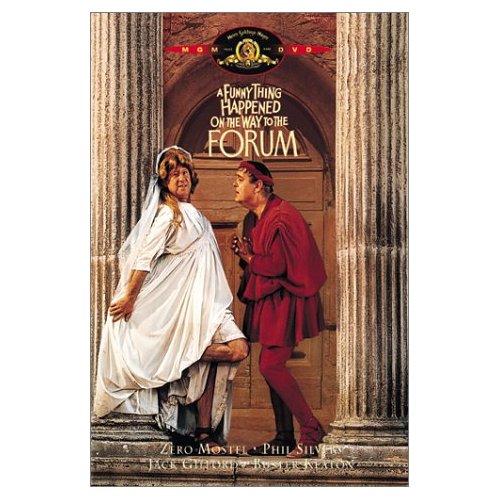
1.  A Funny Thing Happened on the Way to the Forum (1966)
http://www.mmdtkw.org/ARMov1FunnyForum_.jpgClick for larger image
97 Minutes
A movie based on a broadway musical, which was based on
three plays that Plautus (ca. 200 bc) may have copied from
the Greek stage.  The broad comedy of Zero Mostel made the
movie and the Broadway musical a success, and he was also
the force behind bringing other previously blacklisted actors
and staff into the production.
http://en.wikipedia.org/wiki/A_Funny_Thing_Happened_on_the_Way_to_
    the_Forum
http://en.wikipedia.org/wiki/Plautus
http://en.wikipedia.org/wiki/Zero_Mostel
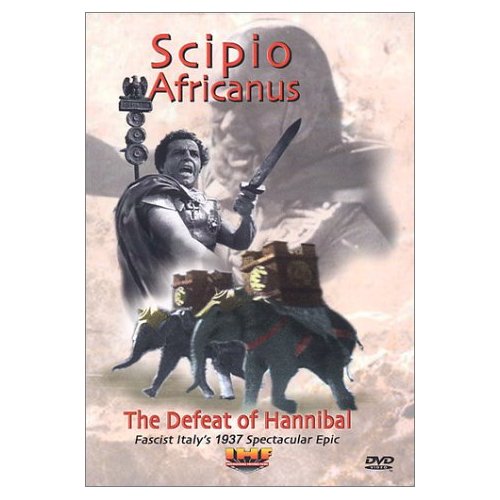
2.  Scipio Africanus -- The Defeat of Hannibal (1937)
http://www.mmdtkw.org/ARMov2Scipio.jpgClick for larger image
93 Minutes
Made by Mussolini's brother in 1937, the year of the Italian Trans-Libyan
Highway and Italy's invasion of Ethiopia, this film won the Venice Film
Festival prize for that year.  It's clearly a propaganda piece glorifying Italian
imperialism, but it is, nonetheless, surprisingly accurate. It's climax is the
Battle of Zama (in modern Tunisia) in 202 BC, which ended the Second
Punic War between Rome and Carthage.
http://www.ihffilm.com/scipafdefofh.html
http://www.roman-empire.net/army/zama.html
http://en.wikipedia.org/wiki/Benito_Mussolini
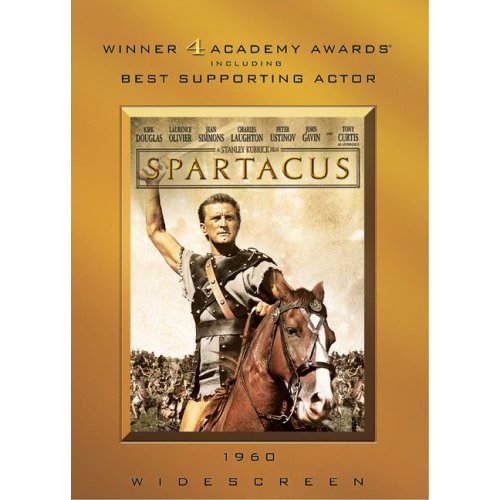
3.  Spartacus (1960)
http://www.mmdtkw.org/ARMov3Spartacus.jpgClick for larger image
198 Minutes
A very ficticious story of Rome's Third Servile War (73 - 70 BC),
this is the movie that really broke the Hollywood blacklist.  Kirk Douglas,
producer as well as star of the epic, brought in the blacklisted screen-
writer Dalton Trumbo and insisted that he be credited with the authorship
of the screenplay.   Trumbo drew his story from Howard Fast's 1951 novel
and, like fast, portrayed Spartacus as a popular revolutionary.  Many
scholars disagree saying that Spartacus was just a wily escapee with no
grand revolutionary agenda.  It's impossible to say who was right:  the
historical evidence is extremely sketchy.
http://en.wikipedia.org/wiki/Spartacus
http://www.vroma.org/~bmcmanus/spartacus.html
http://www.historyinfilm.com/spart/
http://en.wikipedia.org/wiki/Howard_Fast
http://en.wikipedia.org/wiki/Dalton_Trumbo
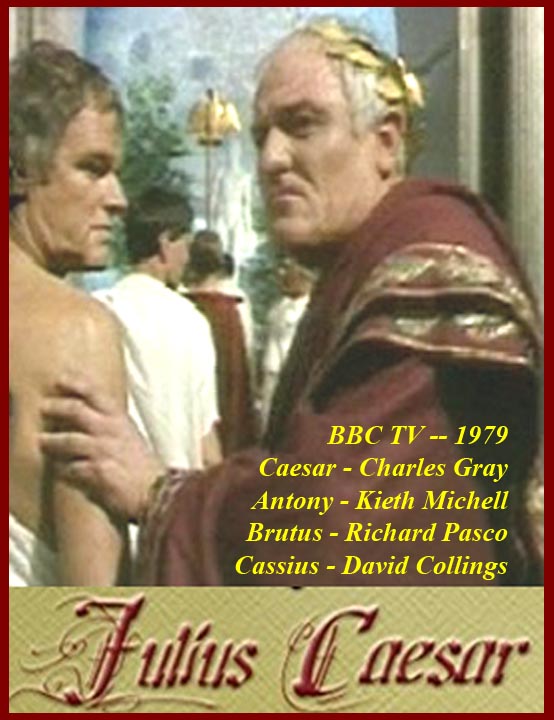
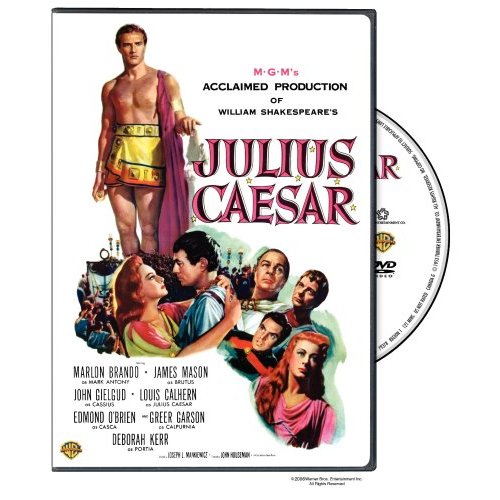
4.  Julius Caesar (1953)
http://www.mmdtkw.org/ARMov4JuliusCaesar.jpgClick for larger image
121 Minutes
Julius Caesar  is the name of the production, but he dies early on.
Shakespeare's story is really about Marc Antony's destruction of the
liberatori
  who had assassinated Caesar. 
This film is recognized as one of
Brando's greatest performances, and it is acclaimed by Shakespeare
specialists as well as by the Hollywood crowd.  Time period covered is
44 and 43
BC.
http://www.sparknotes.com/shakespeare/juliuscaesar/
http://www-tech.mit.edu/Shakespeare/julius_caesar/index.html
    part of http://www-tech.mit.edu/Shakespeare/
http://en.wikipedia.org/wiki/Julius_Caesar_(1953_film)
http://movies2.nytimes.com/mem/movies/review.html?_r=3&title1=Julius
    %20Caesar&title2=&reviewer=BOSLEY%20CROWTHER
http://dir.yahoo.com/Arts/Humanities/History/By_Time_Period/Ancient_
    History/Roman/People/Caesar__Gaius_Julius__100_44_BCE_/
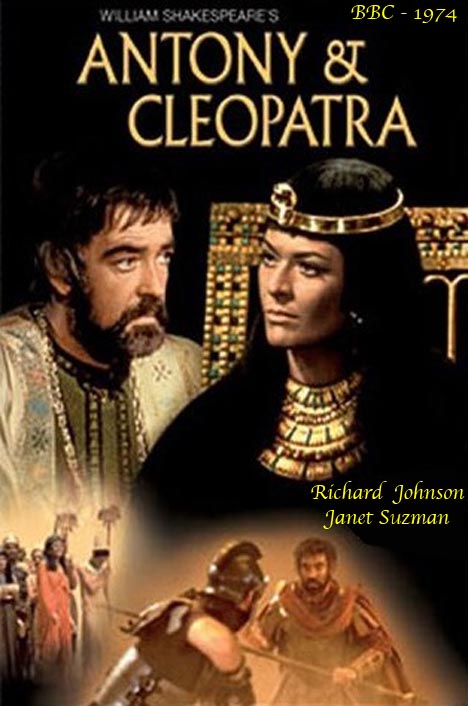
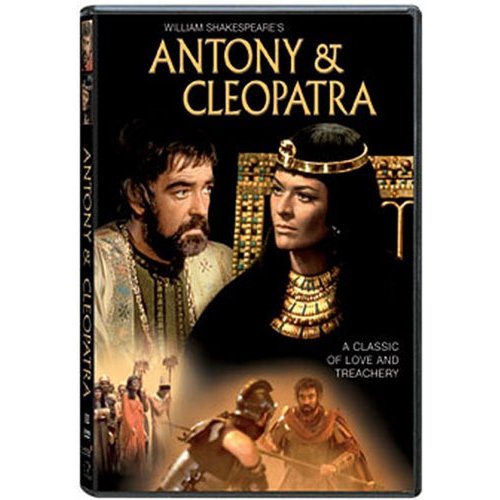
5.  Antony and Cleopatra (1974)
http://www.mmdtkw.org/ARMov5AntonyCleopatraShakespeare.jpgClick for larger image
161 Minutes
Not Elizabeth Taylor and Richard Burton.  It is an ITV television production
of
Trevor Nunn's stage version performed by London's Royal
Shakespeare Company, which was shown in the
United States to great
acclaim in
1975Most critics agree that it's the best mass media A and C
ever produced. The time period is from 41 BC through 29 BC, but the
action is much compressed by Shakespeare.

http://www.sparknotes.com/shakespeare/antony/
http://en.wikipedia.org/wiki/Antony_and_Cleopatra
http://www-tech.mit.edu/Shakespeare/cleopatra/
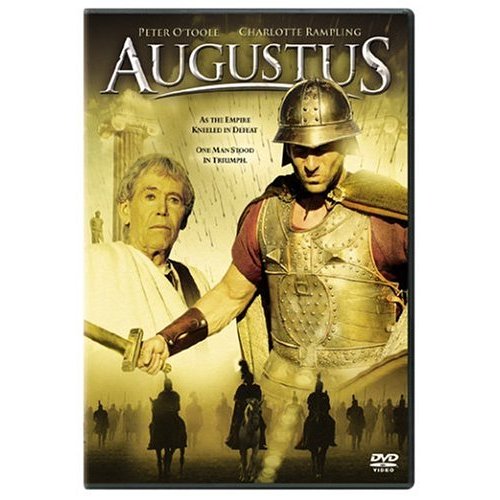
6.  Augustus (2003)
http://www.mmdtkw.org/ARMov6Augustus.jpgClick for larger image
178 Minutes
"....equal parts history lesson and soap opera, and thoroughly engaging
at all levels".  
Peter O'toole is Augustus on his death bed and
remembering/retelling his life.  The film is surprisingly accurate, and also,
surprisingly, the multiple flashback (and even flashbacks within flashbacks)
form holds the film together.  The only really jarring note is the gratuitous
inclusion of Jesus in the last words of the film, supposedly spoken by the
(ghost of?) Augustus in what appears to be a parody of his Res Gestae Divi
Augusti (= Deeds of the Divine Augustus).  The movie covers the life of
Augustus from 45 BC until his death in 14 AD.
http://en.wikipedia.org/wiki/Imperium:_Augustus
http://www.roman-emperors.org/auggie.htm
http://www.virgil.org/augustus/
http://classics.mit.edu/Augustus/deeds.html
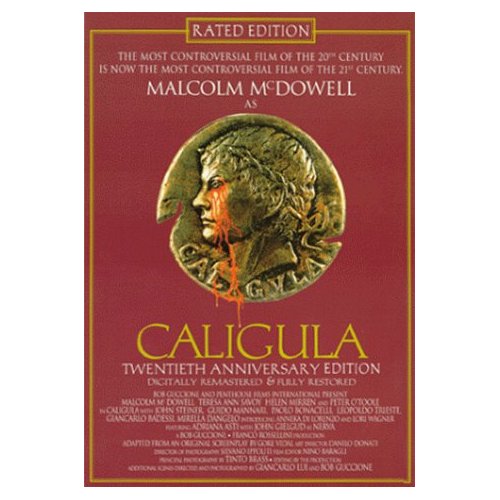
7.  Caligula (1979, reworked several times, ours is essentially the R rated 1981 version.)
http://www.mmdtkw.org/ARMov7CaligulaR.jpgClick for larger image
101 Minutes
This is an attempt to return to the Gore Vidal Caligula screenplay.  Penthouse
Magazine operatives had inserted almost an hour of gratuitous explicit sex
and gore, which was removed for this
"R" rated (cleaned up) version of the
notorious Penthouse production.  Caligula was undoubtedly evil and
perhaps insane, but most of what we "know" about him was written by
"historians" in the pay of his enemies
after his assassination, and most of
that is suspiciously similar to what had been written about previous tyrants
in the ancient world.  The action takes place between 31 AD when Caligula
was summoned to the Villa of Tiberius in Capri and Caligula's death in 41 AD.
http://www.roman-emperors.org/gaius.htm
http://en.wikipedia.org/wiki/Caligula_%28film%29
http://en.wikipedia.org/wiki/Caligula
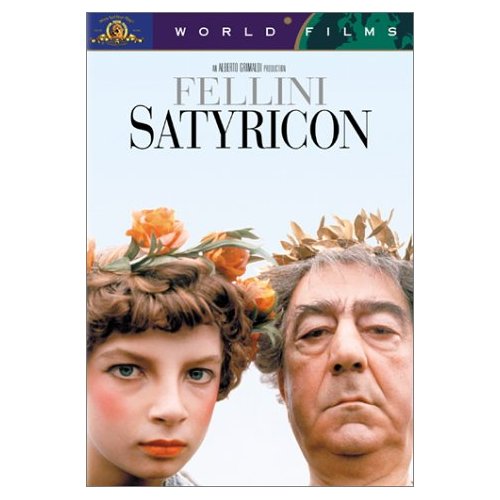
8.  Satyricon (1969)
http://www.mmdtkw.org/ARMov8Satyricon.jpgClick for larger image
129 Minutes
Satyricon (Fellini Satyricon) is a 1969 film by Federico Fellini that is loosely
based on the
Petronius novel Satyricon, a series of bawdy and satirical
episodes written during the reign of the emperor
Nero and set in imperial
Rome.  Many literature "experts" call the Petronius work the world's first novel.
The original text survives only in large fragments, and instead of trying to
connect the fragments which survived, Fellini presented the material in a series
of somewhat disjointed and dislocated scenes.  Petronius, usually identified
with Petronius Arbiter, is thought to have been Nero's "master of the revels".
The date of the "events" in the Satyricon is unclear, but the work most likely
dates from Nero's reign 54 - 68 AD
http://en.wikipedia.org/wiki/Satyricon_%28film%29
http://en.wikipedia.org/wiki/Satyricon
http://en.wikipedia.org/wiki/Petronius
http://en.wikipedia.org/wiki/Federico_Fellini
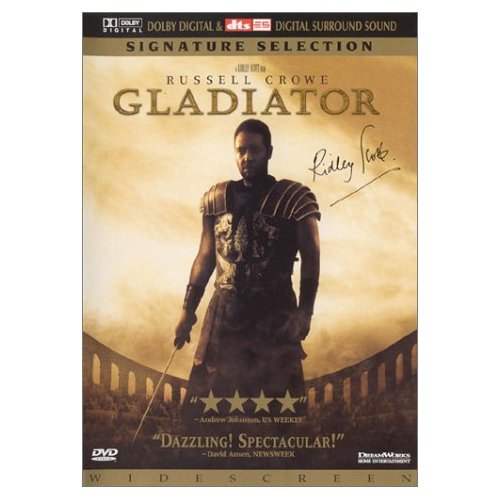
9.  Gladiator (2000)
http://www.mmdtkw.org/ARMov9Gladiator.jpgClick for larger image
155 Minutes
A fiction set in the reign of Commodus, the film, nonetheless, is very good
on Roman architecture, costume, life style, and general ambiance -- good
enough for the film to become a staple of university
ancient history and
archeology
courses.  The history of Commodus, like that of Caligula
120 years before him, was written by historians in the pay of his erstwhile
enemies.  Commodus was named Caesar
by his father, Marcus Aurelius,
at age 5 in 166 AD and was  made co-Augustus , in 178 AD. He reigned alone
from his father's death in 180 AD until 192 when he was assassinated -- he
was not killed in the arena as shown in the movie.
http://www.mmdtkw.org/VCommodus.html
http://abacus.bates.edu/~mimber/Rciv/gladiator.htm
http://www.vroma.org/~bmcmanus/arena.html
http://www.exovedate.com/the_real_gladiator_one.html
http://ablemedia.com/ctcweb/consortium/gladiators.html
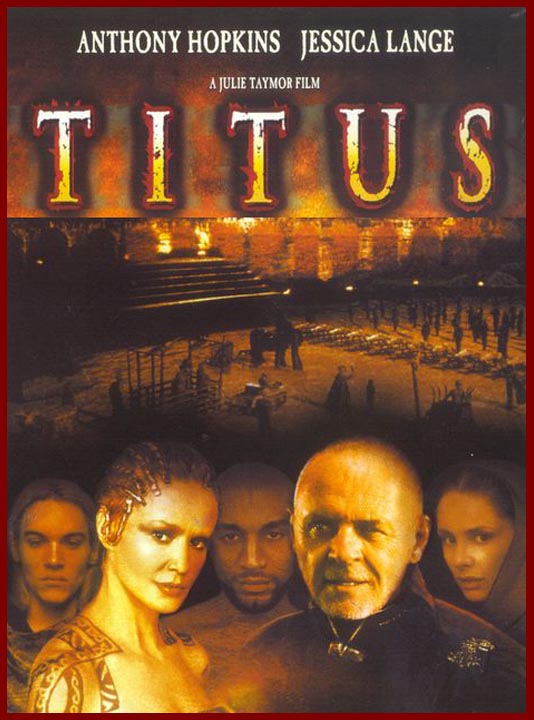
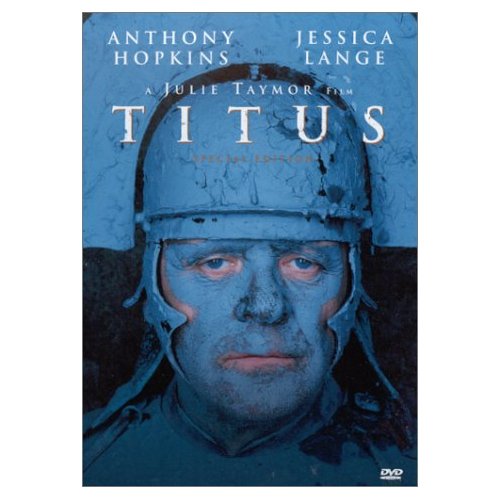
10.  Titus (1999)
http://www.mmdtkw.org/ARMov10Titus.jpgClick for larger image
162 Minutes
Titus Andronicus, one of Shakespeare's earliest plays, is certainly his most
violent.  It was written,
before Shakespeare found his own more mellow style,
for an Elizabethan audience already inured to violent "revenge plays"
modeled after the nine Senecan tragedies
.  Our movie is Julie Taymor's
production, in which she fearlessly shows all of Shakespeare's violence.
It is set in the period of "military anarchy" beginning with Maximus Thrax
and ending with the formation of the Tetrarchy by Diocletian (235 - 285 AD)
during the reign of a fictional Emperor Saturninus.  Shakespeare's and
Taymor's bloody story accurately reflects the violence of that time.  Something
to consider:  Who commits the first violent act that provokes revenge?
Taymor had staged Titus in New york in 1995 before her Lion King success
and returned to it for her first movie.
http://www.geocities.com/hopkinsfanatic/titusnyt.htm
http://www.culturekiosque.com/nouveau/cinema/rhevideo2.html
http://www.findarticles.com/p/articles/mi_qa3768/is_200401/ai_n9394382
http://www.findarticles.com/p/articles/mi_qa3768/is_200201/ai_n9057295
http://www-tech.mit.edu/Shakespeare/titus/index.html
http://www.answers.com/topic/senecan-tragedy


Carthage and Ancient North Africa

1.  Geology, Prehistory, and Historiography
(images and outline of the slide lecture)
http://www.mmdtkw.org/CNAf001GeologyPrehistoryHistroriography.html
2.  Phoenicians
(images and outline of the slide lecture)
http://www.mmdtkw.org/CNAf002PhoeniciansCarthaginians.html
3.  First Punic War
(images and outline of the slide lecture)
http://www.mmdtkw.org/CNAf003FirstPunicWar.html
4.  Mercenary War and Barcid Spain
(images and outline of the slide lecture)
http://www.mmdtkw.org/CNAf004MercenaryWarBarcidSpain.html
5.  Second Punic War
(images and outline of the slide lecture)
http://www.mmdtkw.org/CNAf005SecondPunicWar.html
6.  Scipio Africanus:  The Defeat of Hannibal -- 1937 Fascist Epic Film
http://www.ihffilm.com/scipafdefofh.html
7.  Third Punic War
(images and outline of the slide lecture)
http://www.mmdtkw.org/CNAf007ThirdPunicWar.html
8.  Roman Carthage
(images and outline of the slide lecture)
http://www.mmdtkw.org/CNAf0008RomanCarthage.html
9.  Christian Carthage
(images and outline of the slide lecture)
http://www.mmdtkw.org/CNAf009ChristianCarthage.html
10. Jupiter's Darling -- Esther Williams saves Rome from Hannibal in 1955
http://www.imdb.com/title/tt0048239/
http://members.aol.com/mgmfan3/jupiter.html


Vesuvius, Pompeii, Herculaneum, and environs
1.  Pompeii, the Last DayIntroduction http://www.mmdtkw.org/ALRItkwVes01IntroBurial.html
http://www.mmdtkw.org/ALRItkwVesUnit01Images.html
2.  Volcanism, Seismology, Geology http://www.mmdtkw.org/ALRItkwVesUnit01Geology.html
http://www.mmdtkw.org/ALRItkwVesUnit01Images.html
3.  Excavation History  http://www.mmdtkw.org/ALRItkwVes02Excavations.html
http://www.mmdtkw.org/ALRItkwVesUnit02Images.html
4.  Art and Architecture
(images and outline of the slide lecture)
http://www.mmdtkw.org/ALRItkwVes07ArchitectureArt.html
5.  Pompeii
(images and outline of the slide lecture)
http://www.mmdtkw.org/ALRItkwVes03Pompeii.html
6.  Herculaneum
(images and outline of the slide lecture)
http://www.mmdtkw.org/ALRItkwVes04Herculaneum.html
7.  Villa of the Mysteries
(images and outline of the slide lecture)
http://www.mmdtkw.org/ALRItkwVes05VillaMysteries.html
8.  Villae Rusticae
(images and outline of the slide lecture)
http://www.mmdtkw.org/ALRItkwVes06VillaeRusticae.html
9a. Campi Flegrei / Baiae Bay
(images and outline of the slide lecture)
http://www.mmdtkw.org/ALRItkwVes08CampiFlegrei.html
9b. American super-calderas
(images and outline of the slide lecture)
http://www.mmdtkw.org/ALRItkwVes09SuperVolcano.html
10. SuperVolcano

-- Additional Links for Vesuvius, Pompeii, Herculaneum, and environs
---- Volcanism, Seismology, Geology
---- Vesuvius
---- Pompeii and Villa of the Mysteries
---- The Four "Pompeian" painting styles
---- Art and Architecture (all sites)
---- Herculaneum
---- Oplontis
---- Campi Flegrei
---- Puteoli
---- Baiae
---- Stabiae
---- The American super calderas
---- Miscelaneous

Ancient Rome 
1. Approaching Ancient Rome http://www.mmdtkw.org/ALRItkwRom101oneHandout.html
http://www.mmdtkw.org/ALRItkwRom101HighLowlights.html
http://www.mmdtkw.org/ALRItkwRom101BasicTopo.html
http://www.mmdtkw.org/ALRIAncRomUnit1Slides.html
2. Roots, Foundation Myths, Kings of Rome http://www.mmdtkw.org/ALRItkwRom101RootMythKing.html
http://www.mmdtkw.org/ALRIAncRomUnit2Slides.html
3. Republican Rome http://www.mmdtkw.org/ALRItkwRom101EarlyRepublic.html
http://www.mmdtkw.org/ALRIAncRomUnit3Slides.html
4, Carthage and the Punic Wars http://www.mmdtkw.org/ALRItkwRom101PunicWars.html
http://www.mmdtkw.org/ALRIAncRomUnit4Slides.html
5. Disintegration of the Republic http://www.mmdtkw.org/ALRItkwRom101RepubDisint.html
http://www.mmdtkw.org/ALRIAncRomUnit5Slides.html
6. Augustus Principate and Julio Claudians (27 BC - 68 AD)  http://www.mmdtkw.org/ALRItkwRom101AugJulioClaud.html
http://www.mmdtkw.org/ALRIAncRomUnit6Slides.html
7. Flavians (69 - 96), Antonines -- Five Good Emperors and Commodus (96 -192) http://www.mmdtkw.org/ALRItkwRom101Flavians.html
http://www.mmdtkw.org/ALRItkwRom101Antonines.html
http://www.mmdtkw.org/ALRIAncRomUnit7Slides.html#Flavians
http://www.mmdtkw.org/ALRIAncRomUnit7Slides.html#Antonines
8. Long decline -- Severans and Soldier Emperors (193 - 284)
Diocletian, Constantine  (285 - 337)
Barbarians take over the West (337 - 476)
http://www.mmdtkw.org/ALRItkwRom101Decline.html
http://www.mmdtkw.org/ALRIAncRomUnit8Slides.html
9.  Everyday life in Rome http://www.mmdtkw.org/ALRItkwRom101DailyLife.html
http://www.mmdtkw.org/ALRIAncRomUnit9Slides.html
10.  Western Civ -- Our Roman Heritage http://www.mmdtkw.org/ALRItkwRom101RomeHeritage.html
http://www.mmdtkw.org/ALRIAncRomUnit10Slides.html
-- Additional Links for Ancient Rome
---- Basics
---- People
---- Miscellaneous

Medieval Rome 
1. Medieval Timeline and Constantine's Legacy http://www.mmdtkw.org/ALRItkwRom303_1IntroConst.html
http://www.mmdtkw.org/MedRomUnit0100-0PixList.html
2. Barbarians -- Huns, Goths, Vandals, et al http://www.mmdtkw.org/ALRItkwRom303_2Barbarians.html
http://www.mmdtkw.org/MedRomUnit0200-0PixList.html
3. Gregory and other Popes http://www.mmdtkw.org/ALRItkwRom303_3GregChrist.html
http://www.mmdtkw.org/MedRomUnit0300-0PixList.html
4. Exarchs and Other Eastern Influences http://www.mmdtkw.org/ALRItkwRom303_4EastExarchs.html
http://www.mmdtkw.org/MedRomUnit0400-0PixList.html
5. Benedict and later monks -- monasteries http://www.mmdtkw.org/ALRItkwRom303_5Monastics.html
http://www.mmdtkw.org/MedRomUnit0500-0PixList.html
6. Franks and Holy Romans http://www.mmdtkw.org/ALRItkwRom303_6FranksHRE.html
http://www.mmdtkw.org/MedRomUnit0600-0PixList.html
7. Economic evolution/devolution http://www.mmdtkw.org/ALRItkwRom303_7Economy.html
http://www.mmdtkw.org/MedRomUnit0700-0PixList.html
8. Late medieval -- Architecture http://www.mmdtkw.org/ALRItkwRom303_8LateArchit.html
http://www.mmdtkw.org/MedRomUnit0800-0PixList.html
9. Late medieval -- Writers and Artists http://www.mmdtkw.org/ALRItkwRom303_9ArtsLetters.html
http://www.mmdtkw.org/MedRomUnit0900-0PixList.html
10.  Late medieval -- Cola, Plagues, and other opportunities http://www.mmdtkw.org/ALRItkwRom303_10RienPlague.html
http://www.mmdtkw.org/MedRomUnit1000-0PixList.html
-- Additional Links for Medieval Rome
---- Basics
---- People
---- Miscellaneous

Renaissance Rome
1. Medieval Legacy http://www.mmdtkw.org/RenRomUnit01MedievalLegacy.html
http://www.mmdtkw.org/RenRomUnit0100-0PixList.html
2. Florence and Rome http://www.mmdtkw.org/RenRomUnit02RomeFlorence.html
http://www.mmdtkw.org/RenRomUnit0200-0PixList.html
3. Scholasticism yields to Humanism http://www.mmdtkw.org/RenRomUnit03Humanism.html
http://www.mmdtkw.org/RenRomUnit0300-0PixList.html
4. The Church and the popes -- patrons and rulers http://www.mmdtkw.org/RenRomUnit04PapacyChurch.html
http://www.mmdtkw.org/RenRomUnit0400-0PixList.html
5. Roman Renaissance literature http://www.mmdtkw.org/RenRomUnit05Literature.html
http://www.mmdtkw.org/RenRomUnit0500-0PixList.html
6. Architecture -- churches and palaces http://www.mmdtkw.org/RenRom0600-ArchitectIntro.html
http://www.mmdtkw.org/RenRomUnit0600-0PixList.html
7. Art and Artists http://www.mmdtkw.org/RenRom0700-ArtArtistsIntro.html
http://www.mmdtkw.org/RenRomUnit0700-0PixList.html
8. Sack of Rome 1527 -- end of the Roman Renaissance? http://www.mmdtkw.org/RenRom0800-Sack1527Intro.html
http://www.mmdtkw.org/RenRomUnit0800-0PixList.html
9. Historians and diarists and acuracy http://www.mmdtkw.org/RenRom0900-HistoriogrIntro.html
http://www.mmdtkw.org/RenRomUnit0900-0PixList.html
10. Controversies:  Copernicus, Bruno, Galileo, Borgias, "DaVinci Code" http://www.mmdtkw.org/RenRom1000-Controversies.html
http://www.mmdtkw.org/RenRomUnit1000-0PixList.html
-- Additional Links for Renaissance Rome
---- Basics
---- People
---- Miscellaneous

Ancient Rome Links
Ancient Basics
-----------------------------------------------------
Theodor Mommsen's History of Rome http://ancienthistory.about.com/od/romehistorians/a/mommsencontents.htm
Dictionary of Ancient Rome (about.com) http://ancienthistory.about.com/cs/rome/
University of Pennsylvania Museum -- Roman and Etruscan galleries in Philadelphia Reopened http://www.museum.upenn.edu/new/worlds_intertwined/main.shtml
Highlights and Lowlights of Ancient Roman History http://www.mmdtkw.org/ALRItkwRom101HighLowlights.html
Rome -- Basic Topography:  Hills and Valleys http://www.mmdtkw.org/ALRItkwRom101BasicTopo.html
Roman Chronology http://www.mmdtkw.org/ALRItkwRom101RomanChron.html
Roman Kings http://www.mmdtkw.org/VRomanKings.html
Chron List of Roman Emperors from DIR http://www.roman-emperors.org/impindex.htm
Marcus Vitruvius Polio's ten books, De Archutectura (about 40 BC) (worked for Julius Caesar and Caesar Augustus) http://penelope.uchicago.edu/Thayer/L/Roman/Texts/Vitruvius/home.html
and http://www.perseus.tufts.edu/cgi-bin/ptext?doc=Perseus%3Atext%3A1999.02.0073&layout=&loc=1.preface%201&query=toc
and -- in Latin -- http://www.perseus.tufts.edu/cgi-bin/ptext?doc=Perseus%3Atext%3A1999.02.0072&layout=&loc=1.preface%201&query=toc
Cesare Cesariano's illustrations for De Architectura (1521) http://rubens.anu.edu.au/htdocs/bytype/arch.sources/vitruvius/
Andrea Palladio's Four Books on Architecture (1570) http://andrea.gsd.harvard.edu/palladio/qlibri.html
Antoine Babuty Desgodetz, Illustrations from Les Edifices antiques de Rome (1682 -- 1779 Edition) http://rubens.anu.edu.au/htdocs/bytype/arch.sources/desgodetz/index.html
Sebastiano Serlio Bolognese, Images from De Architectura Libri Quinque (16th century) http://rubens.anu.edu.au/htdocs/bytype/arch.sources/serlio/
Sextus Julius Frontinus on the Water Supply of Rome (De Aquis urbis Romae) (end of 1st century AD) (water commissioner under Nerva and Trajan) http://penelope.uchicago.edu/Thayer/E/Roman/Texts/Frontinus/De_Aquis/text*.html
and -- in Latin -- http://penelope.uchicago.edu/Thayer/L/Roman/Texts/Frontinus/De_Aquis/text*.html
Lacus Curtius - Roman Antiquities (Thayer) http://penelope.uchicago.edu/Thayer/E/Roman/home.html
Smith Dictionary of Greek and Roman Antiquities (Thayer) http://penelope.uchicago.edu/Thayer/E/Roman/Texts/secondary/SMIGRA*/home*.html
Smith Dictionary of Greek and Roman Antiquities (Perseus) http://www.perseus.tufts.edu/cgi-bin/ptext?doc=Perseus%3Atext%3A1999.04.0063
Smith Dictionary of Greek and Roman Geography (Perseus) http://www.perseus.tufts.edu/cgi-bin/ptext?doc=Perseus%3Atext%3A1999.04.0064
Platner Topographic Dictionary of Ancient Rome http://penelope.uchicago.edu/Thayer/E/Gazetteer/Places/Europe/Italy/Lazio/Roma/Rome/_Texts/PLATOP*/home*.html
or   http://www.perseus.tufts.edu/PR/platner.ann.html
Piranesi's drawings of Ancient Rome http://sights.seindal.dk/sight/873_Engravings_by_Piranesi.html (137 pictures are available, large format, of complete drawings)
and http://rubens.anu.edu.au/htdocs/bytype/prints/piranesi/index.html (Many hundred pictures are are available of complete drawings and details.  The Rubens pages also have links to drawings by others. Use links at the bottom of each page to go to additional index pages.)
Diotima - Women and Gender in the Ancient World http://www.stoa.org/diotima/
Feminae Romanae http://dominae.fws1.com/
Photo Archive (Seindal) http://sights.seindal.dk/
Famous Romans (Seindal) http://sights.seindal.dk/sight/769_Romans.html
Maecenas - Images of Ancient Greece and Rome (Leo C. Curran) http://wings.buffalo.edu/AandL/Maecenas/
Ancient Rome: Images and Pictures (Just) http://myweb.lmu.edu/fjust/Rome.htm
Art History Resources/Ancient Rome (Witcombe) http://witcombe.sbc.edu/ARTHrome.html
Encyclopedia Romana (good reconstruction drawings) http://itsa.ucsf.edu/~snlrc/encyclopaedia_romana/romapage.html
Online Medieval and Classical Library
http://omacl.org/author.html
Rome - Republic to Empire (McManus) http://www.vroma.org/~bmcmanus/romanpages.html
Ancient Rome in Film, Fiction, Fact, and Cyberspace (McManus)
 
Part 1 http://www.vroma.org/~bmcmanus/anromassign.html
Part 2 http://www.vroma.org/~bmcmanus/anromassign2.html
Part 3 http://www.vroma.org/~bmcmanus/anromassign3.html
Ancient Rome (Teacher Oz) http://www.teacheroz.com/romans.htm
Evansville.net huge list of Roman Links http://history.evansville.net/rome.html
Early Roman History(365),
Late Roman Republic(366),
Early Roman Empire(378),
Later Roman Empire(379)
(MacKay)

 
365 http://www.ualberta.ca/~csmackay/CLASS_365/Syllabus.html
366 http://www.ualberta.ca/~csmackay/CLASS_366/Syllabus.html
378 http://www.ualberta.ca/~csmackay/CLASS_378/Syllabus.html
379 http://www.ualberta.ca/~csmackay/CLASS_379/Syllabus.html
Rome from Livius.org http://www.livius.org/rome.html
Reading Rome's Ruins http://www.ibiblio.org/expo/vatican.exhibit/exhibit/b-archeology/Archaeology.html
Images of Rome (Koskimies) http://www2.siba.fi/~kkoskim/imbas/roma/startpage.php?lang=en&action=1
Slavery in Rome http://penelope.uchicago.edu/Thayer/E/Roman/Texts/secondary/SMIGRA*/Servus.html
History of Rome by Dio Cassius (Written 200-222 AD) (Full English Text) http://penelope.uchicago.edu/Thayer/E/Roman/Texts/Cassius_Dio/home.html
Virgil's Aeneid -- Roman Foundation myths (Full English Text) http://classics.mit.edu/Virgil/aeneid.html
Virgil Eclogues, Georgics (Full English Text) http://classics.mit.edu/Browse/browse-Tacitus.html
Deeds of Augustus, by Augustus (Full English Text) http://classics.mit.edu/Augustus/deeds.html
Caesar's Wars, by Caesar (Full English Texts) http://classics.mit.edu/Browse/browse-Caesar.html
Hirtius (Continues Caesar's Gallic Wars) (Full English Text) http://classics.mit.edu/Hirtius/hirt.gal.html
Cicero's works (Full English Texts) http://classics.mit.edu/Browse/browse-Cicero.html
Tacitus:  Annals and Histories (Full English Text) http://classics.mit.edu/Browse/browse-Tacitus.html
Plutarch Lives (Full English Texts) (Dryden trans.) http://classics.mit.edu/Browse/browse-Plutarch.html
Livy History of Rome "Ab Urbe Condita" (Full English Text) http://classics.mit.edu/Livy/liv.html
Josephus (Vespasian and Titus in the Middle East) (Full English Text) http://classics.mit.edu/Browse/browse-Josephus.html
Many more Greek and Latin Classics, many with English Translations, from Persius http://www.perseus.tufts.edu/cache/perscoll_Greco-Roman.html
Lucan's "Pharsalia" -- Civil War between Caesar and Pompey (Full English Text) http://sunsite.berkeley.edu/OMACL/Pharsalia/
Suetonius, "Twelve Caesars" and "Illustrious Men" (Full English Texts) http://www.fordham.edu/halsall/ancient/suetonius-index.html
Vegetius, "De Re Militari" -- Still an influential book on military organization and methods (Full text in English) http://www.pvv.ntnu.no/~madsb/home/war/vegetius/dere00.php3
Military Affairs of Ancient Rome (Full Text), Brady  http://www.pvv.ntnu.no/~madsb/home/war/romanarmy/romanarmy00.php3
Roman Civil Law (Texts in English) http://www.constitution.org/sps/sps.htm
Plutarch Lives http://classics.mit.edu/Browse/browse-Plutarch.html
http://digital.library.upenn.edu/webbin/gutbook/lookup?num=674
http://ancienthistory.about.com/library/bl/bl_text_plutarch.htm
Ancient History Sourcebook Rome sources (Halsall) http://www.fordham.edu/halsall/ancient/asbook09.html
Gibbon -- Decline and Fall (Full Text) http://www.ccel.org/g/gibbon/decline/home.html
De Quincy -- The Caesars (Full Text) http://ibiblio.org/gutenberg/etext04/7csrs10.txt
Lanciani:  Ancient Rome in the Light of Recent Discoveries -- 1888 (Full English Text) http://penelope.uchicago.edu/Thayer/E/Gazetteer/Places/Europe/Italy/Lazio/Roma/Rome/_Texts/Lanciani/LANARD/home.html
Lanciani:  Pagan and Christian Rome http://penelope.uchicago.edu/Thayer/E/Gazetteer/Places/Europe/Italy/Lazio/Roma/Rome/_Texts/Lanciani/LANPAC/home.html
Subterranean Rome -- Everything below the surface (in sometimes idiosyncratic machine translation) http://www.underome.com/
Tiber River, Bridges, Tiber Island  (Just) http://clawww.lmu.edu/faculty/fjust/Rome-Tiber.htm
Ostia, Ancient Rome's Port http://www.ostia-antica.org/
Pompeii http://www.iath.virginia.edu/pompeii/page-1.html , and
http://wings.buffalo.edu/AandL/Maecenas/italy_except_rome_and_sicily/pompeii/section_contents.html , and
http://cti.itc.virginia.edu/~jjd5t/cww/1997/report2.html , and
http://boris.vulcanoetna.com/VESUVIO.html , and
http://boris.vulcanoetna.com/VESUVIO_79.html , and
http://www.archaeologychannel.org/
Bryn Mawr Classical Review (BMCR) -- Reviews of books on classical subjects --  includes link to BMCR Archives and free eMail subscription to BMCR http://ccat.sas.upenn.edu/bmcr/
Roman Art and Architecture (Harpy) http://harpy.uccs.edu/roman/html/roman.html
Perseus Digital Library (Tufts) http://www.perseus.tufts.edu/
Ancient Rome's Peak Population http://www.mmdtkw.org/VOstia.html
Pronunciation of Latin http://ancienthistory.about.com/od/latinlanguage/qt/latinpronounce.htm
Latin Studies Background Essays http://community.middlebury.edu/~harris/SubIndex/latinbackg.html
Latin Authors Background Essays http://community.middlebury.edu/~harris/SubIndex/latinauthors.html


Ancient People
---------------------
Augustus Rebuilds Rome http://www.mmdtkw.org/VAugustusRebuilds.html
Aurelian http://www.mmdtkw.org/VAurelian.html
Brutus -- et tu http://www.mmdtkw.org/VBrutus.html
Caligula http://www.mmdtkw.org/VCaligula.html
Cassius -- Lean and Hungry http://www.mmdtkw.org/VCassius.html
Castor and Pollux http://www.mmdtkw.org/VCastorPollux.html
Cicero http://www.mmdtkw.org/VCicero.html
Cleopatra http://www.mmdtkw.org/VCleopatra.html
Commodus http://www.mmdtkw.org/VCommodus.html
Commodus BMCR Review http://ccat.sas.upenn.edu/bmcr/2003/2003-07-11.html
Constantine - Constantinople http://www.mmdtkw.org/VConstantinople2002.html
Constantine's Vision http://www.mmdtkw.org/VConstantSunDogs.html
Galla Placida - Woman with Connections http://www.mmdtkw.org/VGallaPlacida.html
Hadrian and the Hadrianeum http://www.mmdtkw.org/VHadrian.html
Helen, Mother of Constantine http://www.mmdtkw.org/VHelen.html
Hercules (Herakles) in Rome http://www.mmdtkw.org/VHerculesInRome.html
Horace http://www.mmdtkw.org/VHorace.html
Livia http://www.mmdtkw.org/VLivia.html
Maecenas http://www.mmdtkw.org/VMaecenas.html
Nero http://www.mmdtkw.org/VNero.html
Ovid http://www.mmdtkw.org/VOvid.html
Pertinax - Emperor Elvis http://www.mmdtkw.org/VPertinax.html
Polybius http://www.mmdtkw.org/VPolybius.html
Pompey magnus - Caesar's Rival http://www.mmdtkw.org/VPompeyMagnus.html
Romulus Augustulus http://www.mmdtkw.org/VRomulusAug.html
Trajan's Rome - Link to a comprehensive site http://www.mmdtkw.org/VTrajan.html
Vergil/Virgil http://www.mmdtkw.org/VVergil.html
Vespasian http://www.mmdtkw.org/VVespasian.html
Vestals http://www.mmdtkw.org/VVestal.html
Zenobia http://www.mmdtkw.org/VZenobia.html


Ancient Places
--------------------
Basilica of Maxentius (Completed by Constantine) http://www.mmdtkw.org/VBasCons.html
Baths in Rome http://www.mmdtkw.org/VBaths.html
Bridges in Rome http://www.mmdtkw.org/VBridgesSublicius.html
Capitoline Hill http://www.mmdtkw.org/VCapitoline.html
Capitoline Museums http://www.mmdtkw.org/VCapMuseums.html
Carcer (Mamertine) Prison http://www.mmdtkw.org/VCarcer.html
Castrense Amphitheatre http://www.mmdtkw.org/VCastrense.html
Colosseum http://www.mmdtkw.org/VColosseum.html
Crypta and theatrum Balbi http://www.mmdtkw.org/VCryptaBalbi.html
Cryptoporticus Salustiani http://www.mmdtkw.org/VCryptoporticusSallustiani.html
Fori Imperiali - Imperial Forums http://www.mmdtkw.org/VForiImperiali.html
Forum Romanum - Republican Forum http://www.mmdtkw.org/VForumRom.html
Hadrian's Villa in Tivoli (Tiburtina) http://www.mmdtkw.org/VHadrianVilla.html
Julius Caesar's Temple http://www.mmdtkw.org/VJuliusTemple.html
Largo Argentina - Temples: Area Sacra http://www.mmdtkw.org/VLargArg.html
Marcus Aurelius (Antonine) Column http://www.mmdtkw.org/VMarAurColumn.html
Marcus Aurelius Statue on the Capitoline http://www.mmdtkw.org/VMAurelius.html
Museum: Palazzo Massimo alle Terme http://www.mmdtkw.org/VMassimoTerme.html
Milvian Bridge http://www.mmdtkw.org/VMilvianBridge.html
Obelisks in Rome http://www.mmdtkw.org/VObelisks.html
Ostia - Rome's Port http://www.mmdtkw.org/VOstia.html
Palatine Hill http://www.mmdtkw.org/VPalatine.html
Pantheon http://www.mmdtkw.org/VPantheon2002.html
Pompeii -- City Destroyed by Vesuvius http://www.mmdtkw.org/VPompeii.html
Pompey Theatre, Rome http://www.theaterofpompey.com/
Popular political power in Ancient Rome http://www.mmdtkw.org/VPowerPopolus.html
Porticus Octaviae - Octavia's Porch http://www.mmdtkw.org/VPorticusOctaviae.html
Portus - New Port North of Ostia http://www.mmdtkw.org/VPortus.html
Pyramid of Cestius http://www.mmdtkw.org/VPyramid.html
Roman Curia http://www.mmdtkw.org/VRomanCuria.html
Rome's Hills http://www.mmdtkw.org/VRomanHills.html
Rostrum in the Forum http://www.mmdtkw.org/VRostrum.html
Temple of Julius Caesar http://www.mmdtkw.org/VTempleCaesar.html
Temple of Venus and Rome http://www.mmdtkw.org/VTempleVenusRome.html
Testaccio - Rome's mountain of oil jars http://www.mmdtkw.org/VTestaccio.html
Teatro Marcello - Theater of Marcellus http://www.mmdtkw.org/VTheatMarc.html
Tiber Island http://www.mmdtkw.org/VTiberIsland.html
Tivoli http://www.mmdtkw.org/VTivoli.html
Trajan's Column (and links to Trajan's Forum) http://www.mmdtkw.org/VTrajanColumn.html
Via Apia http://www.mmdtkw.org/VViaAppia.html
Via Tiburtina http://www.mmdtkw.org/VViaTiburtina.html
Walls of Rome http://www.mmdtkw.org/VWalls.html


Ancient Miscellaneous
-------------------------------------
Ancient Literature Links http://www.mmdtkw.org/litAncient.html
Carthage - Punic Wars http://www.mmdtkw.org/VCarthage.html
Chariot Racing http://www.mmdtkw.org/VSweetChariot.html
Classics in Print http://www.mmdtkw.org/VClassicsLoeb.html
Curses http://www.mmdtkw.org/VCurses.html
Digging - Archeological job opportunities http://www.mmdtkw.org/VDigIn.html
Etruscan league http://www.mmdtkw.org/VEtruscanLeague.html
Founding Myths of Rome http://www.mmdtkw.org/VFoundMyths.html
Hills of Rome Mnemonic http://www.mmdtkw.org/VHillsMnemonic.html
Ides of March http://www.mmdtkw.org/VIdesMarch.html
Itinerant Horses http://www.mmdtkw.org/VHorses2002.html
Italian Artifacts - Exportation http://www.mmdtkw.org/VItalyArtifacts.html
Latin Language
-- Church Latin
-- Church Latin Pronunciation
-- Classics - Latin Resources
-- Electronic Text Center - Latin
-- Labyrinth Medieval Latin
-- Latin and the Vernaculars
-- Latin Background Essays
-- Latin Language Resources
-- Latin Place Names
-- Latin Pronunciation (UGa)
-- Latin Pronunciation (UTexas)
-- Latin Resources Collection
-- Latin Resources (CSUS)
-- Latin Web Resources
-- Orbis Latinus
-- Perseus Latin Dictionary
---- Latin Dictionary Mirror (Oxford)
---- Latin Dictionary Mirror (U of C)
-- Vulgar Latin


http://www.newadvent.org/cathen/09019a.htm
http://www.math.nyu.edu/~wendlc/pronunciation/Latin.html
http://www.georgetown.edu/faculty/irvinem/classics203/resources/resources.html
http://etext.lib.virginia.edu/latin.html
http://labyrinth.georgetown.edu/display.cfm?Action=View&Category=Latin
http://www.ucalgary.ca/applied_history/tutor/firsteuro/lang.html
http://community.middlebury.edu/~harris/SubIndex/latinbackg.html
http://www.cs.utk.edu/~mclennan/OM/grk-lat.html#latin
http://as3.lib.byu.edu/%7Ecatalog/people/rlm/latin/names.htm
http://64.233.161.104/search?q=cache:vgh50xeTeFEJ:www.ai.uga.edu/~mc/latinpro.pdf+latin+pronunciation&hl=en&ie=UTF-8&client=googlet
http://www.utexas.edu/courses/cc303/sounds/
http://www.24hourtranslations.co.uk/resources.htm
http://www.csus.edu/indiv/r/rileymt/course1/resource.htm
http://www.arts.cuhk.edu.hk/Lexis/Latin/resources.html
http://www.orbilat.com/
http://www.perseus.tufts.edu/cgi-bin/resolveform?lang=Latin
http://perseus.csad.ox.ac.uk/
http://perseus.uchicago.edu/cgi-bin/resolveform
http://en.wikipedia.org/wiki/Vulgar_Latin
(Note that "Wikipedia" is an "on-line encyclopedia" to which anyone 
can contribute and which can be edited by anyone.  It has no peer 
review and, thus, must be taken  "cum grano salis".)

Ludi Romani - Roman Games http://www.mmdtkw.org/VLudiRomani.html
Lupercalia