
Shakespeare's Julius Caesar

http:/www.mmdtkw.org/RomeShak200a-Shakespeare1.jpg

Julius Caesar was apparently written in 1599 and was first produced at the Globe in Southwark the same year.


http:/www.mmdtkw.org/RomeShak200b-JCaesar.jpg

The 1953 production of Julius Caesar featured Marlon Brando as Mark Antony. This is Brando speaking clearly like a good Shakespearian.
http://www.mmdtkw.org/RomeShak201-Julius.jpg
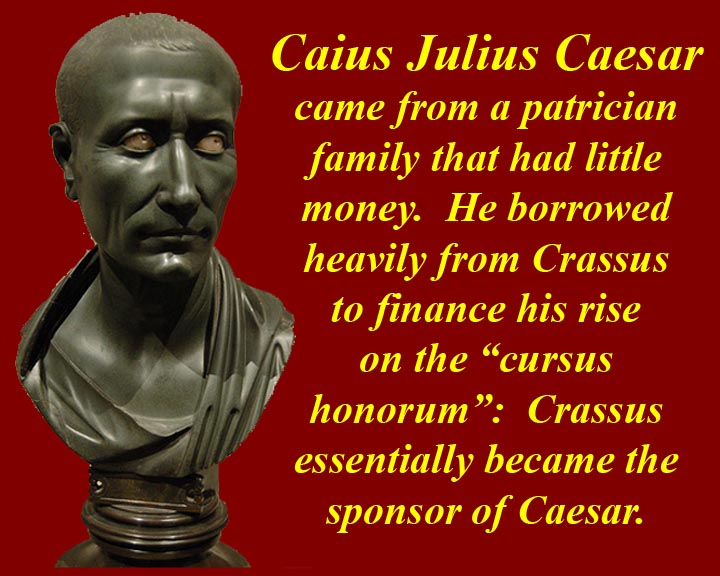
Julius Caesar was a protege and debtor of Crassus, who held a grudge against Pompey for "stealing"
his triumph. Pompey mopped up the Spartacus revolt remnants in the north and then was given a triumph (for his victories in Spain). Crassus was denied a triumph for defeating most of the Spartacus rebels because they were slaves. It's uncertain whether Caesar used Crassus or Crassus used Caesar: Crassus financed Caesar's rise to power and was later repaid both in cash from Caesar's conquest of Gaul and in revenge from Caesar's conquest of Pompey.
http://www.mmdtkw.org/RomeShak202-JCaesarCV.jpg
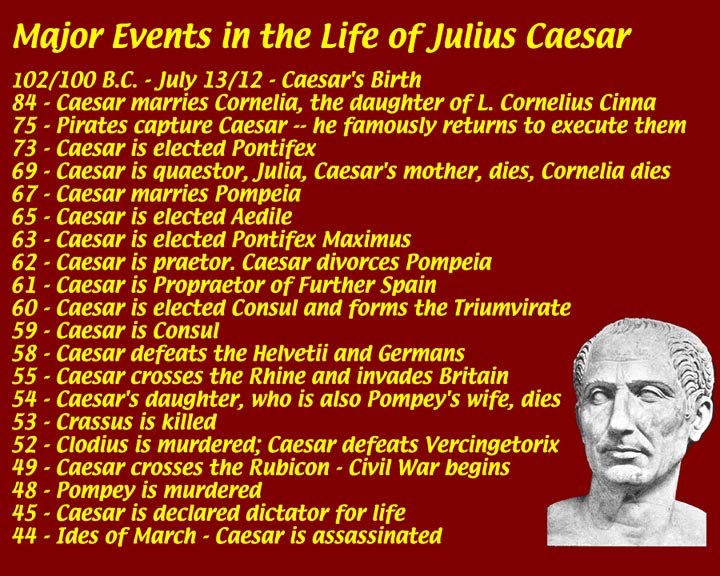
Caesar's CV
http://www.mmdtkw.org/RomeShak203-RomanFamilies.jpg
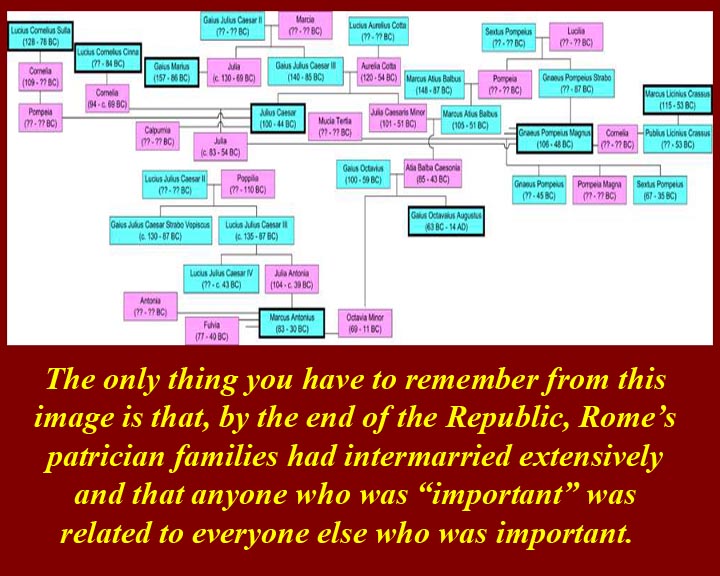
Patrician family intermarriages in the late Roman republican period were extremely complex. The predictable result was a proliferation of genetic problems. Julius Caesar and several other Julio-Claudians (the first dynasty of Roman emperors and their relatives) were epileptics. The assertion that Julius Caesar had the "falling sickness" in mentioned in Julius Caesar, Shakespeare's play. Ancient historical references to Caesar's epilepsy ('defectio epileptica' according to Suetonius) are given at http://www.epilepsiemuseum.de/alt/caesaren.html.
http://www.mmdtkw.org/RomeShak204-Caesar.jpg
http://www.mmdtkw.org/RomeShak205-Flamines.jpg
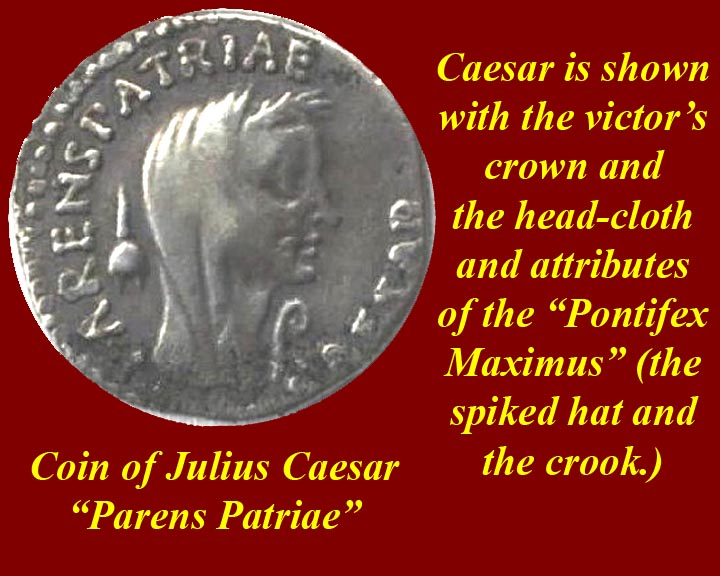
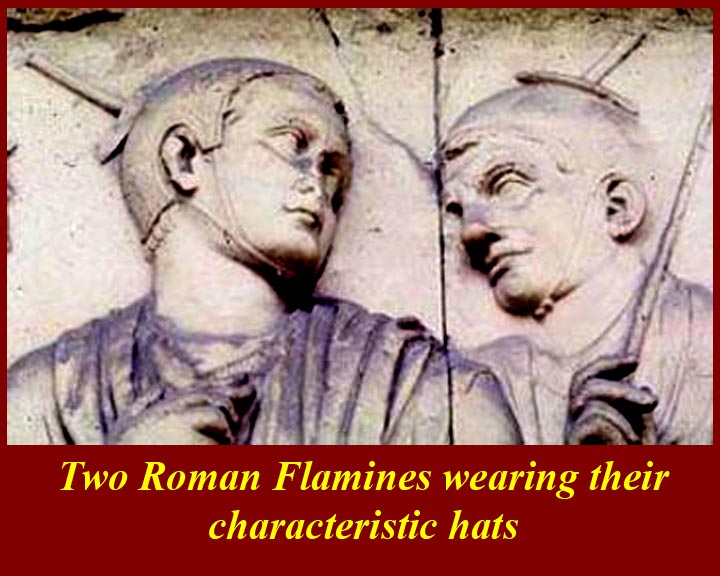
In 63 BC Caesar was elected Pontifex Maximus by his fellow pontifices. The coin shows him both as pontifex maximus and as conqueror (crowned with the conqueror's wreath). The title is, according to the Lewis and Short Latin Dictionary, doubtless from pons-facio; but the original meaning is obscure. Some authorities link it to ceremonies derived from the building and rebuilding of wooden bridges, especially the Pons Sublicius ( = pile bridge), which was the first bridge across the Tiber. Ancient Romans believed that the earliest iteration of this bridge dated from seventh century BC during the early monarchy and that the bridge, which linked the east and west banks of the Tiber, was a symbol of Roman unification and unity. According to tradition, this and other early wooden Tiber River bridges were built without metal fasteners so that they could easily and quickly be disassembled to prevent enemies from crossing the river.
http://www.mmdtkw.org/RomeShak205a-CaesarCalendar.jpg
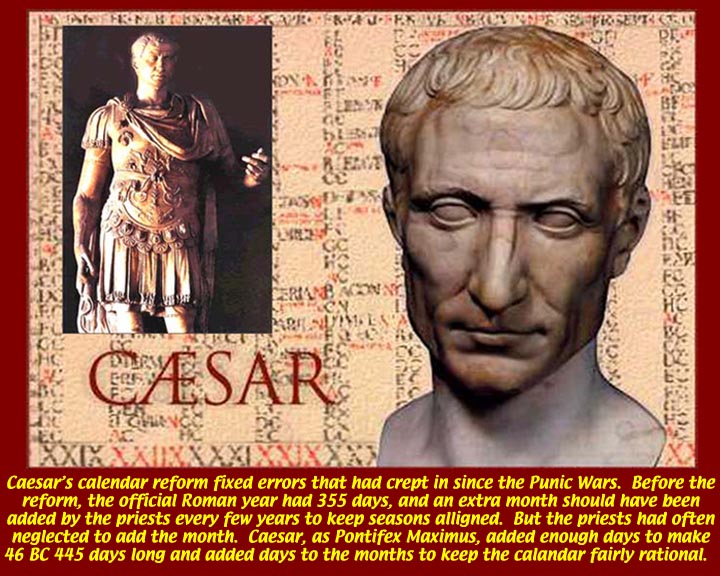
One of the important duties of the Pontifex Maximus was to regularize the Calendar by adding days at the end of the year. The neglect of this duty by Caesar's predecessors had led to a divergence between the religious and the solar calendars. With the help of an Egyptian astronomer/mathematician, Sosigenes of Alexandria, Caesar revised the calendar. The "Julian calendar" was probably designed to approximate the tropical year, known at least since Hipparchus. It has a regular year of 365 days divided into 12 months, and a leap day is added to February every four years. Hence the Julian year is on average 365.25 days long. The Julian calendar was eventually replaced by the Gregorian calendar which is slightly more accurate.
http://www.mmdtkw.org/RomeShak205b-CaesarDenarii.jpg
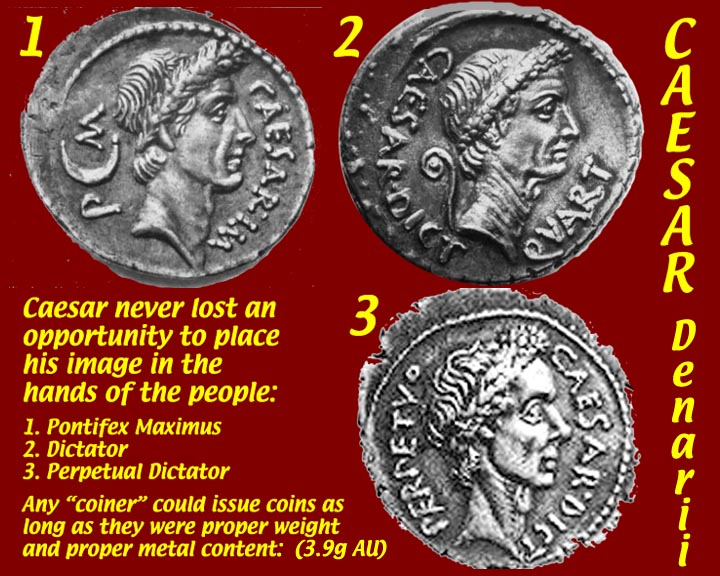
Caesar missed no opportunity to publicize his own accomplishments. In addition to his self-published histories of his Gallic Wars, he issued coins which would widely circulate. Some are still around.
http://www.mmdtkw.org/RomeShak207-PompeyCrassusRivals.jpg
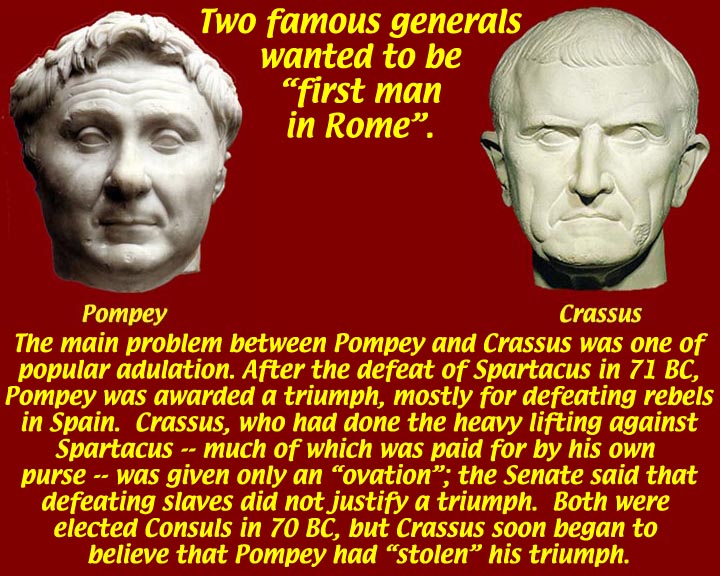
As mentioned above, Crassus, Rome's richest man of his time, and Pompey, Rome's top general of his generation, were political rivals. They were co-consuls in 70 and in 53 BC, but Crassus was always Consul Minor to Pompey's Consul Maior.
http://www.mmdtkw.org/RomeShak207a-VictorJulius.jpg
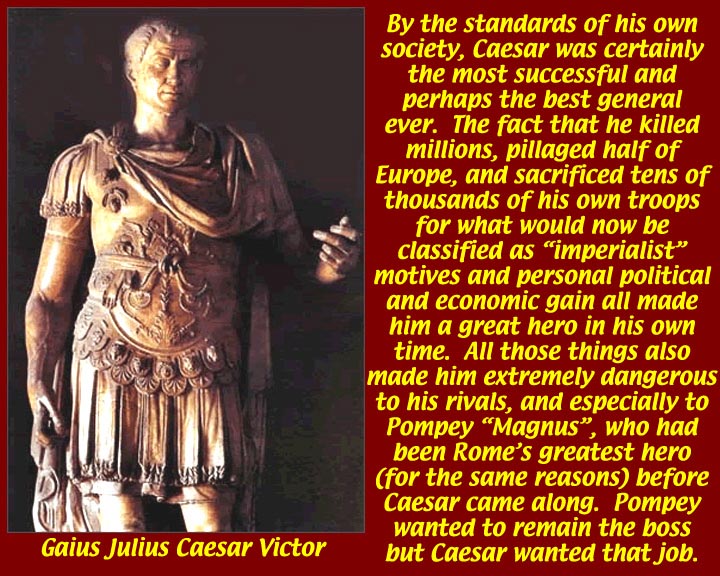
Meanwhile, Caesar was working his way up the Cursus Honorum and accumulating military victories.
http://www.mmdtkw.org/RomeShak208-Triumvirate1.jpg
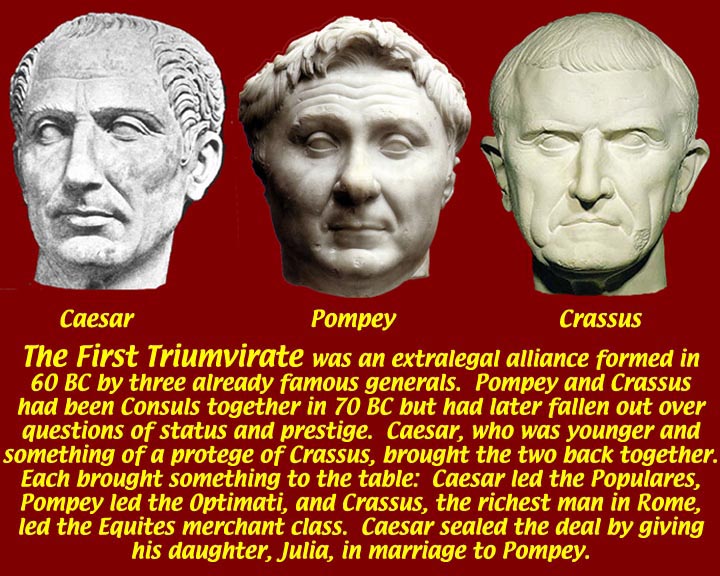
The First Triumvirate was the political alliance of Gaius Julius Caesar, Marcus Licinius Crassus, and Gnaeus Pompeius Magnus. Unlike the Second Triumvirate, the First Triumvirate had no official status whatsoever – its overwhelming power in the Roman Republic was strictly unofficial influence, and was in fact kept secret for some time as part of the political machinations of the Triumvirs themselves. It was formed in 60 BC and lasted until Crassus's death in 53 BC, although it had been seriously weakened by the death of Julia, the daughter of Julius Caesar, who Caesar had given as a wife to Pompey.
http://www.mmdtkw.org/RomeShak208a-Triumvirate2.jpg
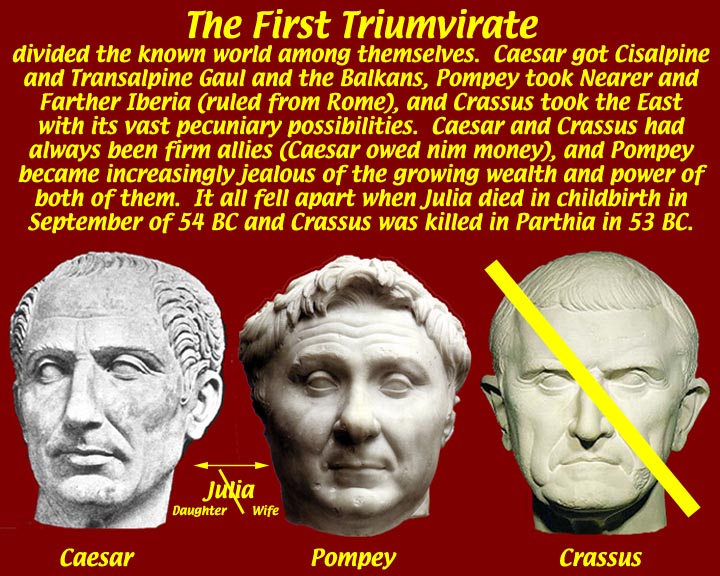
Crassus still desired recognition for military victories in the shape of a triumph. He finally got a real military command after becoming part of the First Triumvirate. His command was in Syria, where he was defeated and killed in the Roman defeat at the Battle of Carrhae, which was fought against the Parthian leader, Spahbod Surena. Crassus had suppressed the Spartacus revolt, but his real significance in world history stems from his financial and political support of the impoverished young Julius Caesar, which allowed Caesar to embark upon his own political career.
http://www.mmdtkw.org/RomeShak209-CaesarPompeyEnemies.jpg
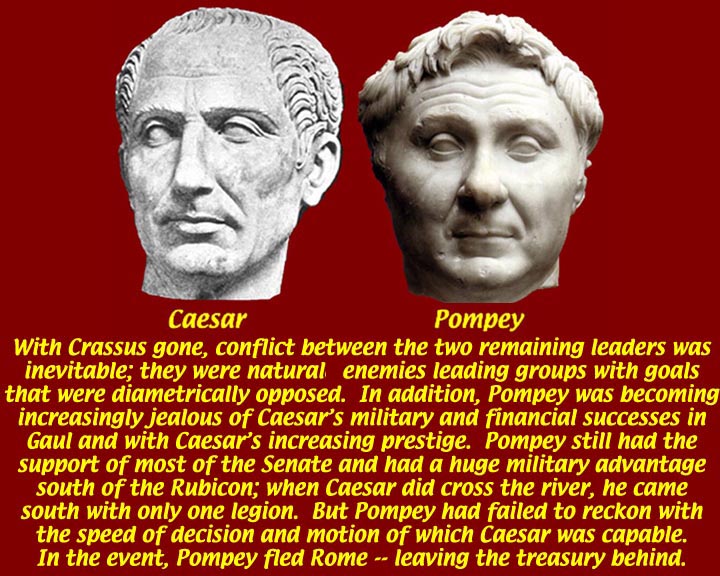
The enmity between Pompey, whose constituency was the Senate and the old establishment, and the now very rich with Gallic loot upstart Caesar, who led the "populares" and whose main support was still the Roman mob, grew quickly after the deaths of Crassus and Julia. Pompey rightly feared that Caesar's legions were personally loyal to Caesar rather than to the state.
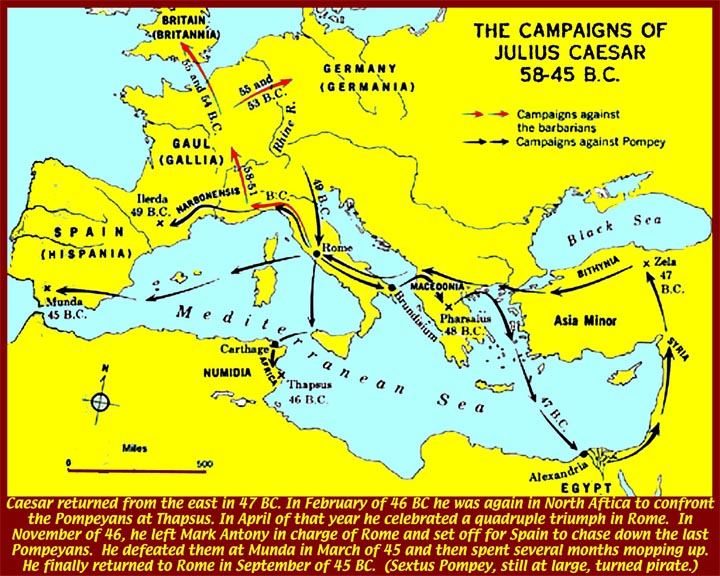
http://www.mmdtkw.org/RomeShak210-CaesarCampaigns.jpg
The map shows the campaigns led by Julius Caesar before crossing the Rubicon (red arrows) and during and after his civil war with Pompey (black arrows).
http://www.mmdtkw.org/RomeShak211-CaesarRubicon.jpg
http://www.mmdtkw.org/RomeShak211a-Rubicon.jpg
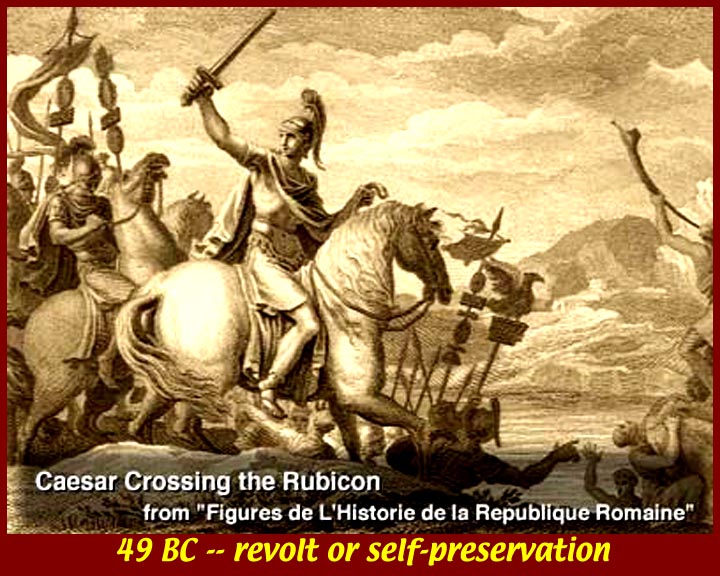
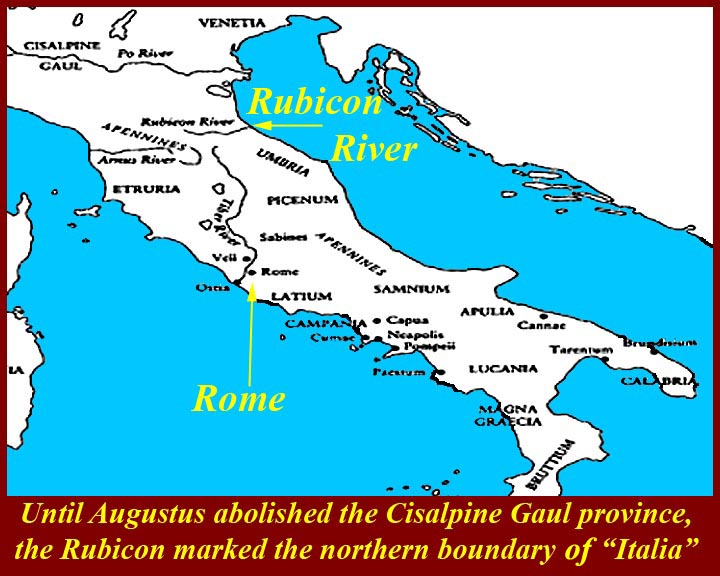
The present course of the Rubicon (and even its map identification) is questionable. Coastal flooding and irrigation schemes have altered its course and location many times in the last two millennia. Regardless of where it actually was, Caesar's crossing of the river with one legion was illegal. The point became moot very quickly, however, when Pompey and most of the Senate fled Rome and eventually tried to rule in absentia from Greece. Their attempt was futile mostly because they had failed to take the treasury with them when they left. Caesar seized the money to pay his troops and buy more troops and to ensure the loyalty of the home Roman population.
http://www.mmdtkw.org/RomeShak212a-Pharsalus.jpg
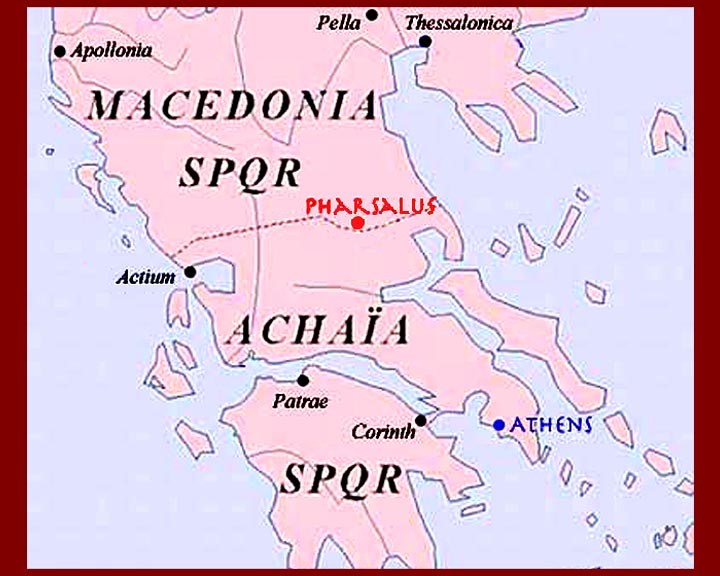
Caesar quickly caught up with Pompey at Pharsalus near the border between Greek Macedonia and Achaia. Both provinces had long been under Roman control. Pompey's forces were overwhelmed, and Pompey himself fled to Alexandria where he thought he could get assistance from Egyptian forces and Roman mercenaries. His assessment was fatally incorrect.
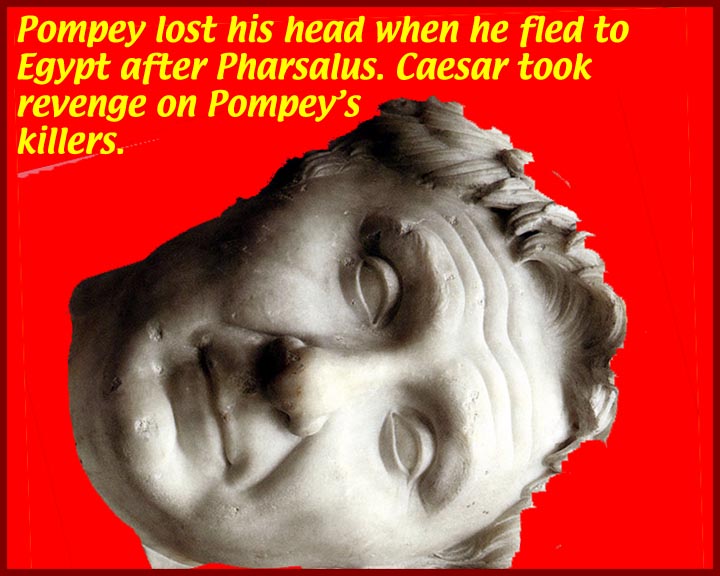
http://www.mmdtkw.org/RomeShak212b-PompeyHead.jpg
When he landed on the Egyptian coast near Alexandria, Pompey was met by Roman mercenaries, who were under orders from the Ptolemaic Pharaoh. While Pompey waited offshore, he young king Ptolemy XIII had argued with his advisers over the cost of offering Pompey refuge when Caesar was already on his way to Egypt. The king's eunuch Potheinos won out. In the final dramatic passages of Pompey's biography, Plutarch had Cornelia watch anxiously from the trireme as Pompey left in a small boat with a few sullen, silent comrades and headed for what appeared to be a welcoming party on the Egyptian shore. As Pompey rose to disembark, he was stabbed to death by his companions Achillas, Septimius and Salvius. Plutarch has him meet his fate with great dignity, one day after his 59th birthday. His body remained on the shoreline, to be cremated by his loyal freeman, Philip, on the rotten planks of a fishing-boat. His head and seal were later presented to Caesar, who not only mourned this insult to the greatness of his former ally and son-in-law but punished his assassins and their Egyptian co-conspirators, putting both Achillas and Pothinus to death. Caesar also may well have been interested in teaching foreigners not to kill Romans -- even enemies of conquering Romans.
(a)
 (b)
(c)
(b)
(c)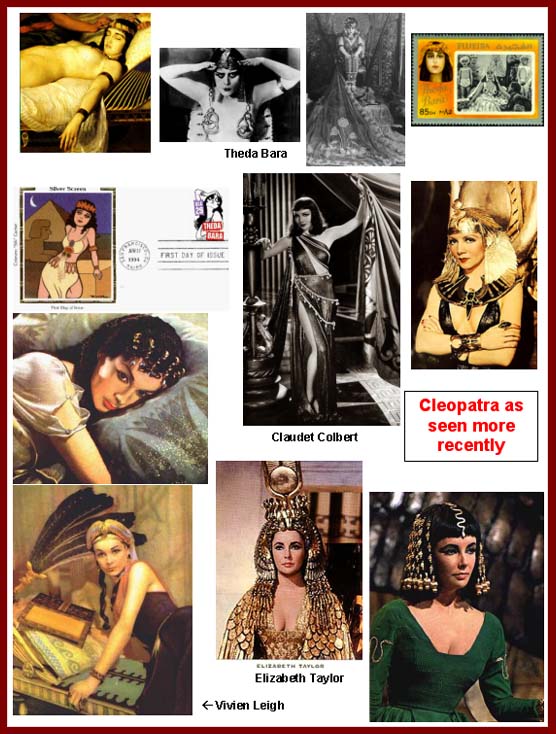
http://www.mmdtkw.org/RomeShak213-Cleopatra.jpg
http://www.mmdtkw.org/RomeShak215-AncCleos.jpg
http://www.mmdtkw.org/RomeShak216-ModCleo.jpg
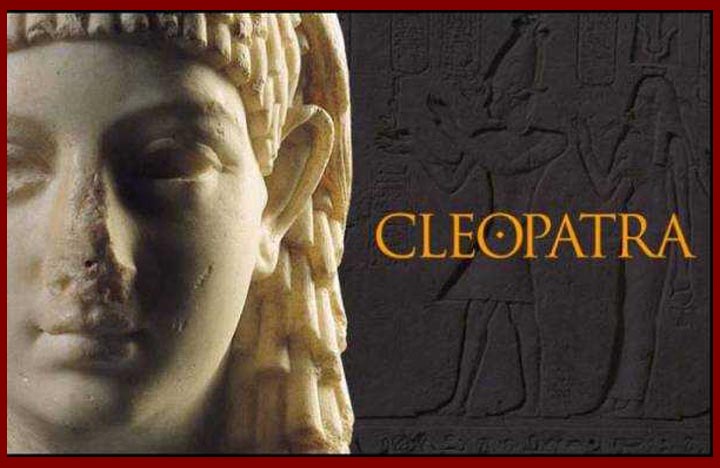
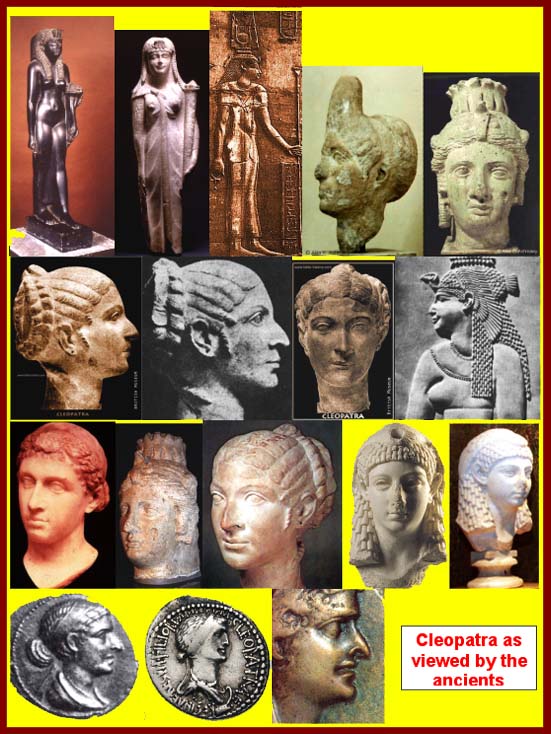
After settling with the assassins of Pompey, Caesar took the side of Cleopatra VII in her palace dispute with her Brother, Ptolemy XIII. After Ptolemy's defeat, Caesar tarried with Cleopatra long enough to father a son, Ptolemy Ceasarion, who well might have been the last Ptolemaic Pharaoh. Verifiable ancient images of Cleopatra are rare because most were broken up after the defeat of Antony and Cleopatra by Octavian. Most of the known ancient images are shown in (b) above. We have many modern images of Cleopatra (c). My Favorite is Claudette Colbert, center and center right, but Theda Bara in her Princes Leia wire bra is a close second. Theda Bara, by the way, said she chose her stage name because the letters could be arranged to make "Arab death" -- she was an ardent Zionist.
http://www.mmdtkw.org/RomeShak216a-JuliusReturns.jpg
http://www.mmdtkw.org/RomeShak216b-TheaterMarcellus1.jpg
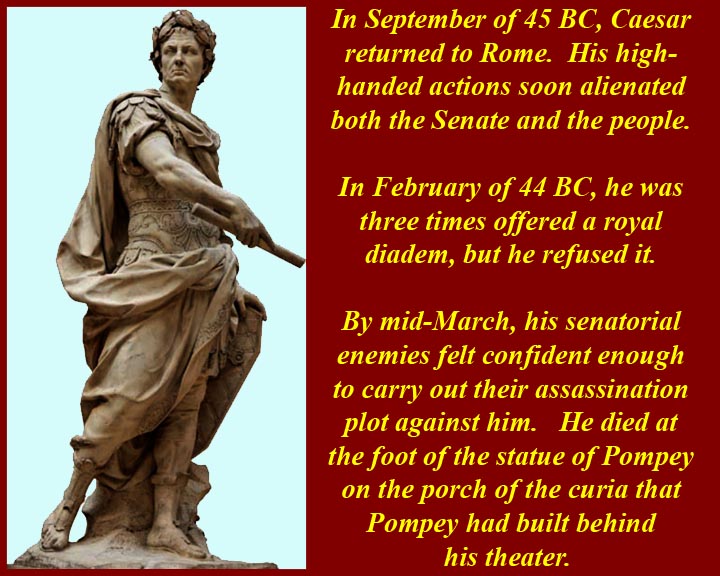
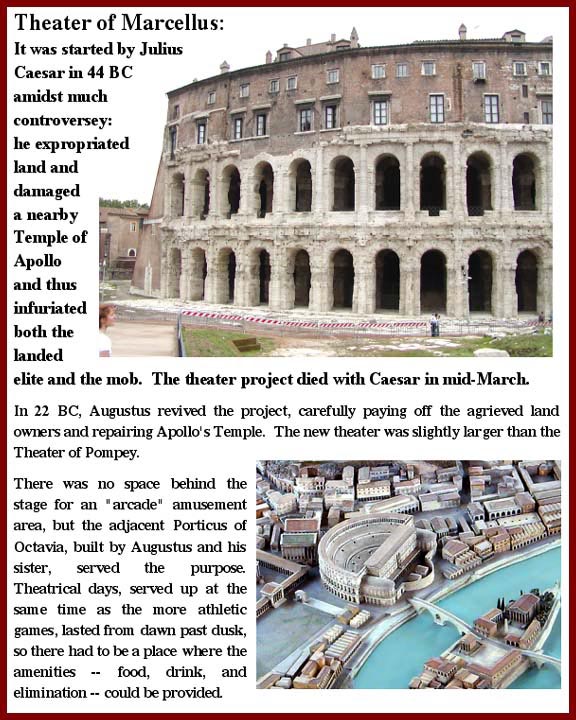
After mopping up the Pompeian partisans in the Middle East, in Greece, in Spain, and in North Africa (they seem to have taken refuge all around the Mediterranean) Caesar finally returned to Rome in September of 45 BC. He had left Mark Antony in Rome to rule in his absence, and during that period, Antony lived up to his bad reputation. He did, however suppress the last of the street gangs, including those who had theretofore been loyal to Caesar and who had then outlived their usefulness. On his return, Caesar had himself elected sole Consul (the law required two, but this was the victorious Caesar), then elected Dictator, and finally elected Perpetual Dictator -- see above, http://www.mmdtkw.org/RomeShak205b-CaesarDenarii.jpg. Among his high handed decisions was one to build a theater near the Temple of Apollo on the riverside below the Palatine hill. To do so he expropriated land, thereby infuriating the rich Senators, and knocked down part of the Temple precinct, thus losing the support of the superstitious masses, who thought of Apollo as the protector of the city. The latter would have been a factor that would embolden his Senatorial enemies when they decided to assassinate him. (Augustus later actually built the theater after carefully reimbursing the landowners and after slightly resiting it to avoid the Apollo Temple precinct. It still stands as a landmark in the city.)
http://www.mmdtkw.org/RomeShak217-DeathCaesar.jpg
http://www.mmdtkw.org/RomeShak217a-CuriaPompey.jpg
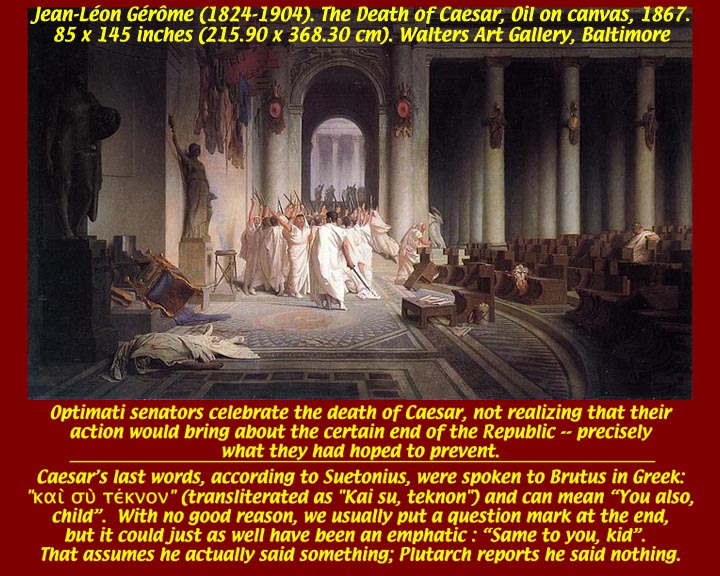
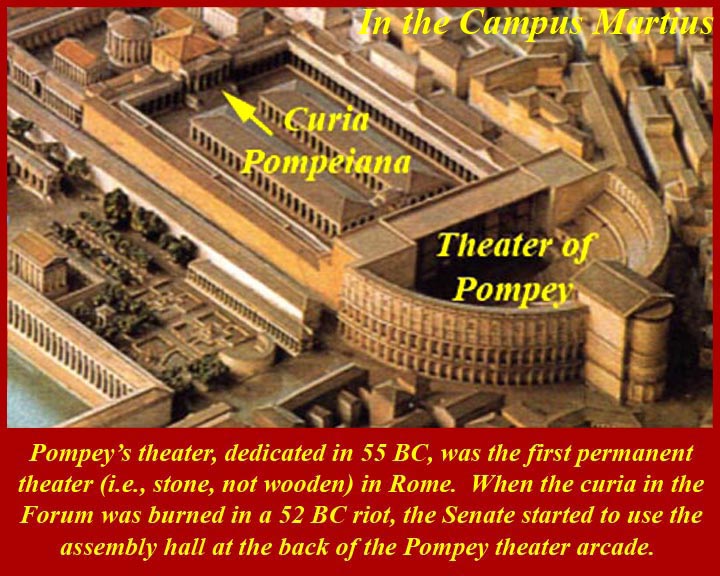
The plot to kill Caesar was carried out on the Ides of March 44 BC. Caesar had, according to contemporary reports, 27 "fatal wounds". It seems that many Senators joined in make sure he was dead. The Assassination took place on the porch of the Curia Pompeiana behind Pompey's theater. (The ruins of the curia are buried beneath the Teatro Argentina on the Largo Argentina in Rome's Campo Marzio. The "Argentina" name of has nothing to do with the country of Juan and Evita and everything to do with an Alsatian bishop named Johannes Burckardt, or, in Latin, Burcardo Argentinensis. The Argentinensis part of his name came from Argentoratum, the old Latin name of his native town, Nieder-Haslach, near Strasbourg. For more on Burcardo, see http://www.mmdtkw.org/VBurcardo.html. The Curia ruins may never be fully excavated because the Teatro Argentina is itself a national monument of modern Italy.)
http://www.mmdtkw.org/RomeShak218-AntonySpeech.jpg
http://www.mmdtkw.org/RomeShak219-MarkAntony.jpg
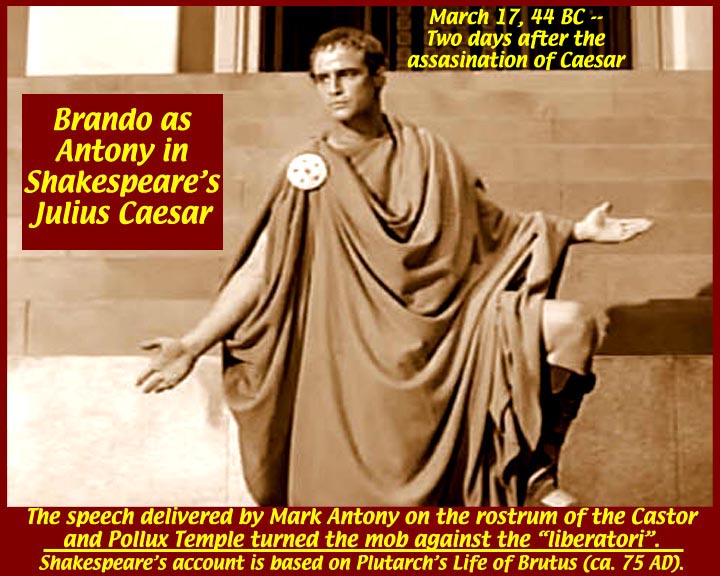
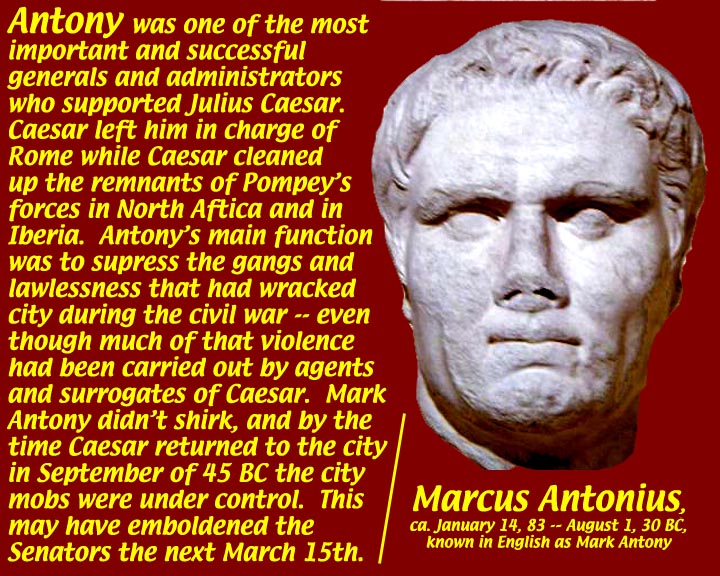
Shakespeare puts Antony's speech immediately after his murder, but it actually came two days later. Antony spoke Latin, of course, and Shakespeare's English version is a fairly good translation of what ancient sources reported that Antony initially said. But Shakespeare departs from the ancient texts when he has Antony then talk about Caesar's will, which the ancient authors said was not read to the public until much later.
http://www.mmdtkw.org/RomeShak220-Octavian.jpg
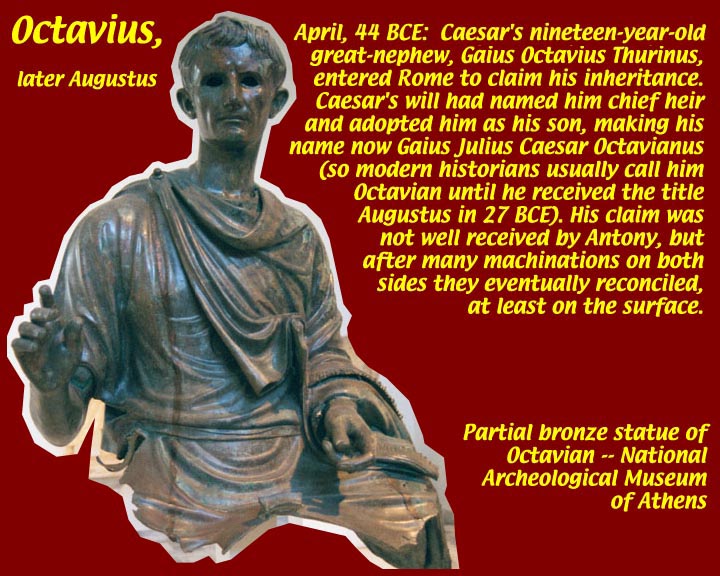
Octavian was out of town when Caesar was killed. He was with his friends Marcus Agrippa and Marcus Salvidienus Rufus in Apollonia in Epirus completing his academic and military studies, when news reached him of Caesar's assassination. At once he returned to Rome, learning on the way that Caesar had adopted him in his will. No doubt this only increased his desire to avenge Caesar's murder.
When he arrived in Rome, Octavian found power in the hands of Mark Antony and Aemilius Lepidus. They were urging compromise and amnesty, but Octavian refused to accept this plan. With his determined stand he soon succeeded in winning over many of Caesar's supporters, including some of the legions. Though he failed to persuade Marc Antony to hand over Caesar's assets and documents. Therefore Octavian was forced to distribute Caesar's legacies to the Roman public from whatever funds he was able to raise himself. His efforts to see Caesar's will carried out helped raise Octavian's standing with the Roman people considerably. For much more on Octavian, see http://www.unrv.com/fall-republic/octavian.php
http://www.mmdtkw.org/RomeShak221-VirRPC.jpg
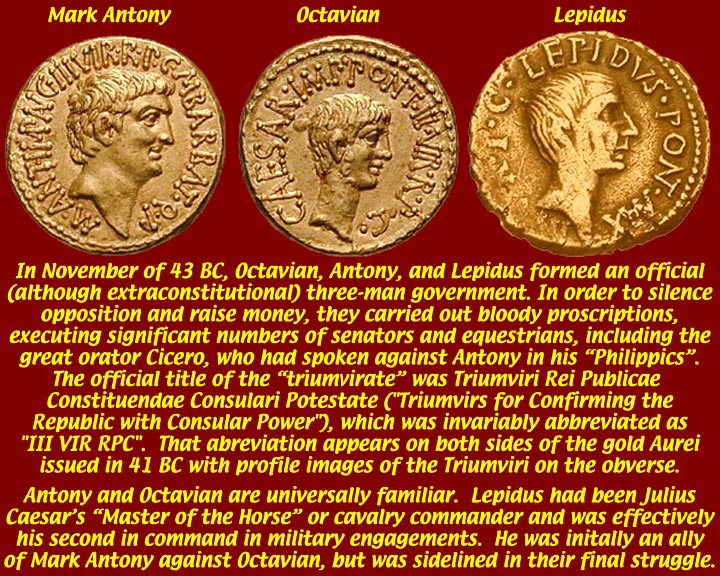
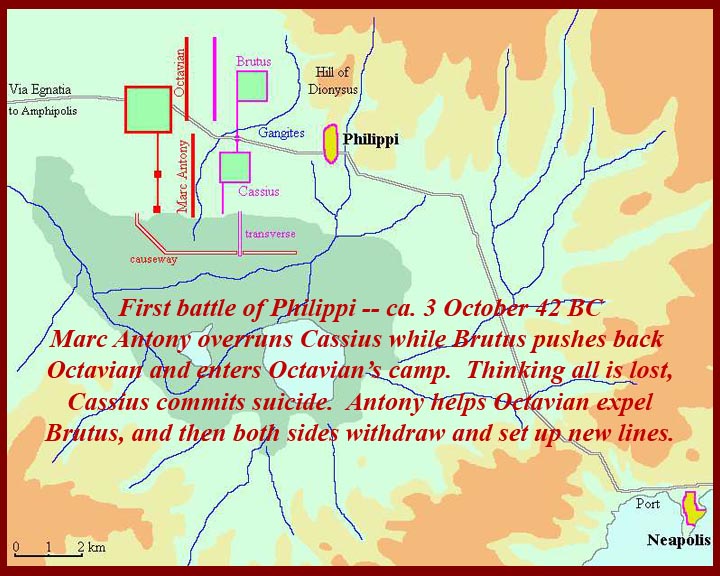
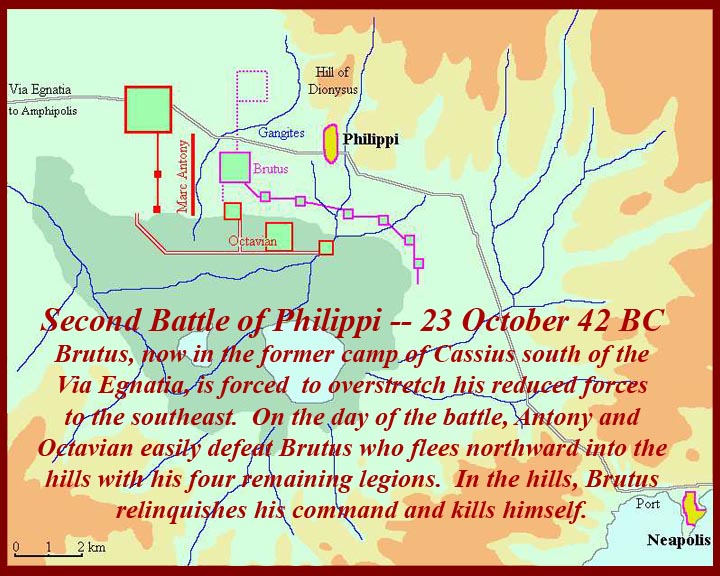
Although initially at odds, Octavian and Antony, with Lepidus, formed the Second Triumvirate and split the rule of the Roman territories. Octavian had Rome and the West, Antony got Greece and the East, and Lepidus was given Sicily and North Africa. But a prime reason for their agreement, however, was their knowledge that the Liberatori -- Brutus, Cassius, and other assassination conspirators -- had mustered forces that were marching toward Rome. The newly formed triumvirate quickly aligned and mobilized their forces and rushed eastward. In October of 42 BC, the Triumvirate forces intercepted the Liberatori armies on the Via Egnatia near the small town of Philippi in eastern Macedonia that had been founded by Macedonian King Philip II (father of Alexander), just to the north of the Aegean Sea.
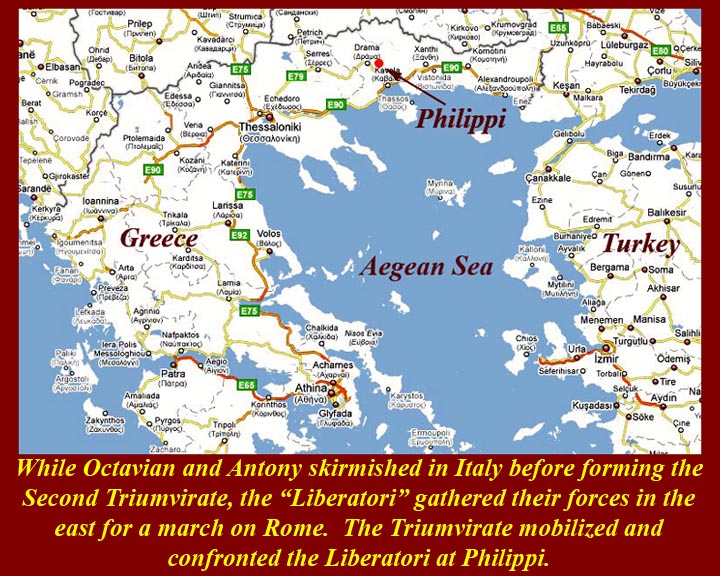
http://www.mmdtkw.org/RomeShak222-PhilippiLocatorMap.jpg
http://www.mmdtkw.org/RomeShak223-Philippi1.jpg
http://www.mmdtkw.org/RomeShak224-Philippi2.jpg
Shakespeare telescopes the action at Philippi into one battle, but there were actually two battles, the first on or about 3 October 42 BC and the second on October 23 42 BC. For details on the historical battles, see http://en.wikipedia.org/wiki/Battle_of_Philippi.
http://www.mmdtkw.org/RomeShak225-AntonyCleopatraTarsus.jpg
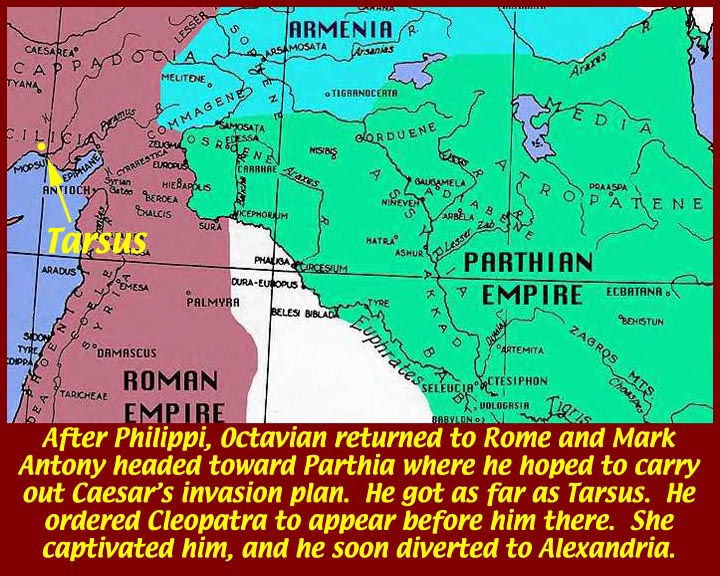
After the Philippi battles, Octavian returned to Rome and Antony headed eastward to carry out Julius Caesar's plan for a war against Parthia. On a stop in Tarsus, he summoned Cleopatra, who arrived from Egypt on her storied royal barge. Shakespeare repeats and only slightly embellishes Plutarch's description of Cleopatra's voyage up the Cyndus River. See http://www.shakespeare-online.com/sources/antonysources.html. The sequel, of course is that Antony went back to Alexandria with Cleopatra and never personally pursued Caesar's Parthian war. For a short bio sketch of Cleopatra, see https://en.wikipedia.org/wiki/Cleopatra.
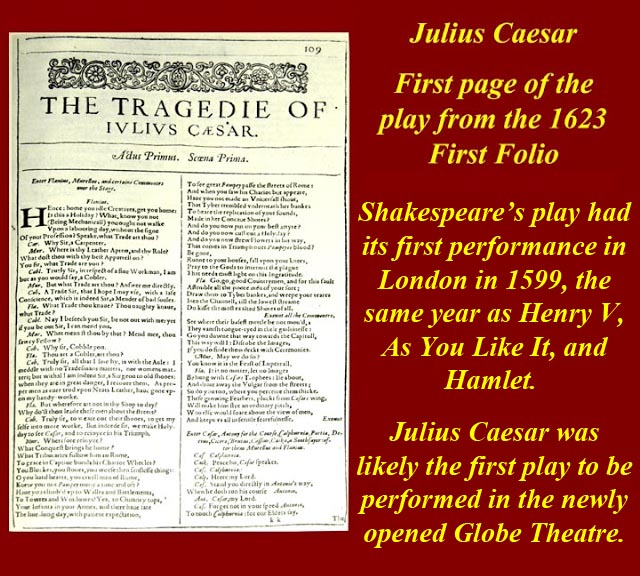
http://www.mmdtkw.org/RomeShak228-FirstFolioJulius.jpg
The first page of the 1623 First Folio version of Julius Caesar.
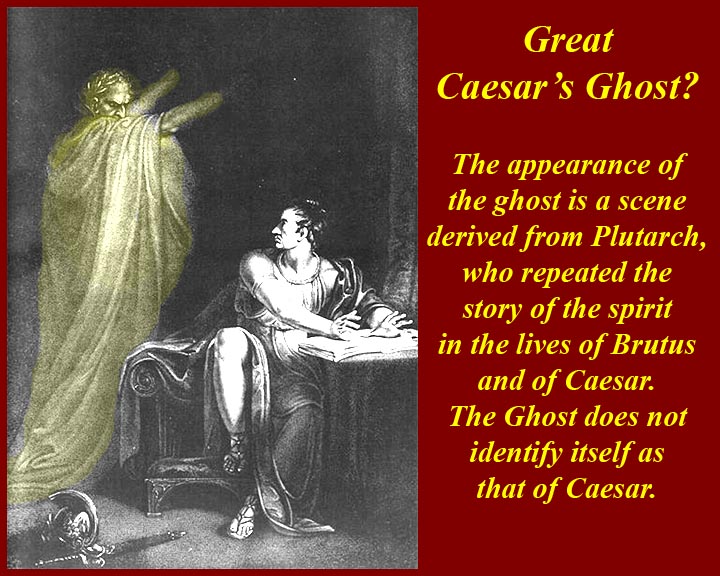
http://www.mmdtkw.org/RomeShak229-CaesarGhost.jpg
Plutarch's story of the ghost that visited Brutus, repeated both in his life of Julius Caesar and his life of Brutus, would certainly have resonated with the superstitious Elizabethans. It was one of several of Shakespeare's notable ghosts and spirits.

http://www.mmdtkw.org/RomeShak115-Plutarch.jpeg
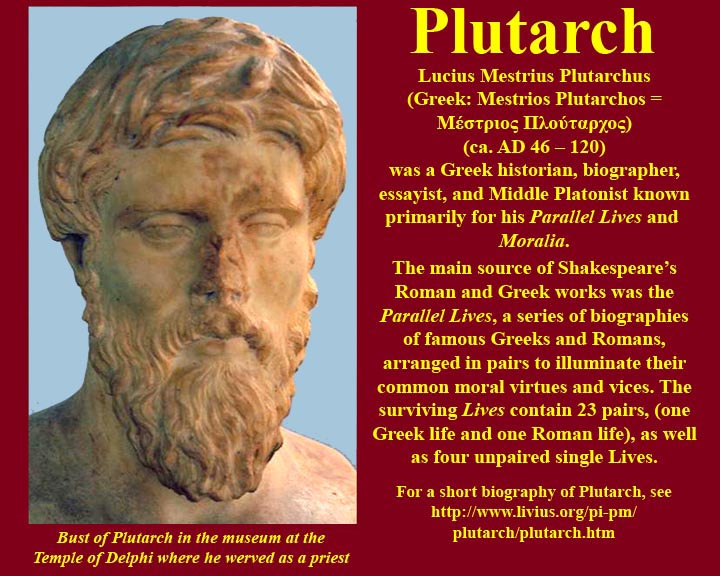
Shakespeare's main source for Julius Caesar was Plutarch's life of Brutus. For a bio of Plutarch, see http://www.livius.org/pi-pm/plutarch/plutarch.htm.

http:/www.mmdtkw.org/RomeShak122-OldGlobeDrawing.jpg
Julius Caesar was likely one of Shakespeare's first plays to be performed at the Globe Theatre. Thomas Patter, a Swiss traveler, saw a tragedy about Julius Caesar at a Southwark theater on September 21, 1599 and this was most likely Shakespeare's play, as there is no obvious alternative candidate. The story of Julius Caesar was dramatized repeatedly in the Elizabethan/Jacobean period, but no other known play is as good a match with Patter's description as is Shakespeare's play.
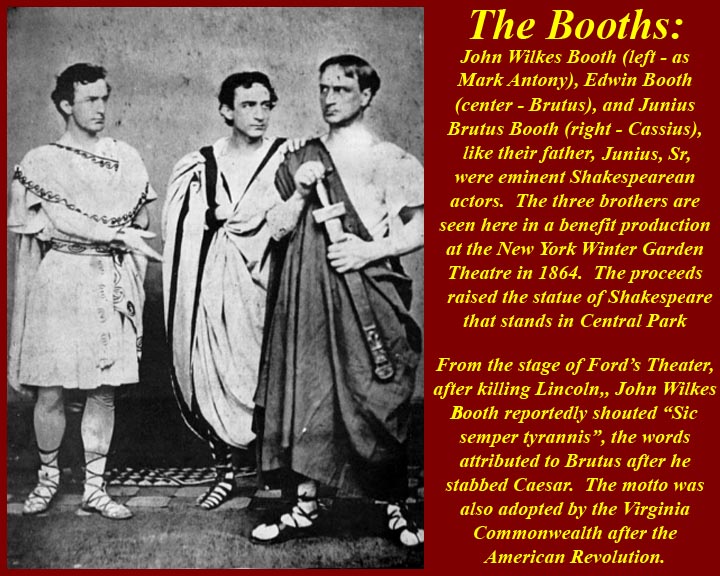
http:/www.mmdtkw.org/RomeShak119-Booths_Caesar.jpg
The performance of the 19th century -- November 25, 1864: the distinguished Shakespearean Booth brothers acted together for the first and only time in a benefit performance of Julius Caesar. John Wilkes Booth, who played Mark Antony, the only non-assassin Booth in the production, finally became one in Ford's Theater on Good Friday, April 14, 1865. The Shakespeare play may have convinced John Wilkes Booth that a single audacious act would change history. Ironically, just as the assassination of Julius Caesar produced the opposite of what the Senatorial plotters had sought (the "Liberatori" wanted but didn't get the restoration of of the Roman Republic), the assassination of Lincoln led to the rise of the post-Civil War American "Radical Republicans", who suppressed rather than restored the south.