Free Internet Italian Grammar
|
|
|
|
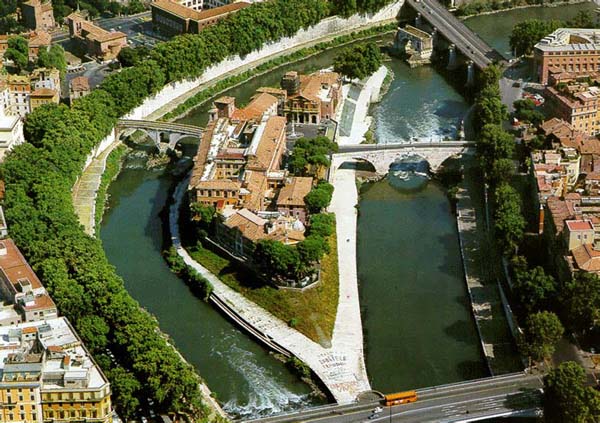
Tiber Island -- site of first known habitation in Rome (click image for larger view)
By TKWukitsch, Rome, 1999 (Revised, Washington, DC, 2008)
Optimized for horizontal resolution of 1024 or higher.Alphabet and Pronunciation
Consonant PairsSentences
Conjunctions
Coordinate Conjunctions (e, ma, and o)
Intensified Coordination (both...and, etc.)
Subordinate Conjunctions
Subordinate Clauses
Noun clauses
Sequence of Tenses in Noun Clauses
Direct and Indirect Address
Adverbial Clauses
Adverb Clauses of Time
Cause and Effect
Conditional Clauses
Possibility
Supposition
Comparative Clauses
Hypothetical Clauses: Subjunctive After Se and Impersonal Expressions
Other ClausesArticles
Definite Article
Preposition-definite Article Contractions
Indefinite Article
Omission of the Article Top of Page
Partitive Construction (Plural Article - "some")Prepositions
Simple Prepositions
Combined Forms/Contractions
"Prepositioni Improprie"Nouns
Gender and Number
Agreement
Quantity in Nouns
Non Count Nouns
Noun/Adjective Suffixes
Making Diminutives
Making Augmentatives
Making Pejoratives
Other Noun/Adjective SuffixesAdjectives and Adverbs
Forming Adjectives
Adjective Agreement
Forming Adverbs
Comparison of Adverbs and Adjectives
Cardinal Adjectives: One, Every, Both, Many, Some, A Pair Or, A Few, Etc.
Ordinal Numbers as Adjectives
Indefinite Adjectives
Negative Adjectives
Possessives
Demonstratives Top of PagePronouns
Subject Pronouns
Object Pronouns
Disjunctive Pronouns
Relative Pronouns
Indefinite Pronouns
Doubled Pronouns
Imperative with Pronoun
Pronominal and Adverbial Particles: "Ne", "ci", and "vi"Verbs
Conjugation: Tense, Person, and Number
First Conjugation (-are)
Third Conjugation (-ire)
Second Conjugation (-ere)
Avere and Essere
Avere
Essere
Indicative Mood
Present Tense
Future Tense
Other Ways of Expressing the Future
Imperfect Tense
Simple Past Tense
Compound or Perfect Tenses
Compound Indicative Top of Page
Compound Subjunctive
Present Perfect Tense
Future Perfect Tense
Pluperfect Tense
Past Anterior or Preterite Perfect Tense
Conditional Mood
Present Conditional
Past Conditional
Subjunctive Mood
Present Subjunctive
Imperfect Subjunctive
Perfect or Past Subjunctive
Pluperfect Subjunctive
Subjunctive Required in Dependent Clauses by Certain Verbs and Expressions
Subjunctive after Se and Impersonal Expressions
Imperatives
Familiar Imperative (tu and voi)
Polite form Imperative
Reflexive Verbs
Passive Voice
Passive Conjugation
Participles
Infinitive
Auxiliary Verbs
Verbs Conjugated with Essere
Irregular Verb List
Polite vs. familiar forms
Verb-Preposition Idioms Top of PageQuestions
Interrogative Pronouns
Interrogative AdverbsPunctuation Differences
Periods in Abbreviations
Comma in Expressions of Time
Quotation Marks (le virgolette)Prefixes and Suffixes
Common Prefixes
Common SuffixesNumbers
Cardinal Numbers
Formation
Ambiguity: Billions, Trillions, etc.
Collective Numbers (about ten, about twenty, etc., dozen)
Forming Collective Numerals
Mathematics
Fractions
Decimals (Frazione decimale)
Multiplicative numbers (double, triple, etc.)
Telephone numbers
Ordinal Numbers
Degree, Quality, or Position
"To the Nth Power" Top of PageTime
"What time is it? "
Minutes
Quarter Hours (and Thirds)
"At what time?","When?"
Time Expressions
One Time, Two Times, many times, at times, sometimes, etc
Days, months, seasons, years, dates
Days of the Week
Months
SEASONS
DATES
CenturiesIdiomatic Verb Constructions
Piacere <to be pleasing to/to like>
Fare
Weather
Professions
to "Have something done"
Other Idiomatic Fare Expressions
Avere in "To be hungry, thirsty, etc."
Essere vs. Stare
C'e and Ci sono
Aver bisogno di and Bisognare
Volere
Dare
Andare
Sapere and Conoscere
The Italian Alphabet and pronunciation:Top of Page
a |
as in mama |
b |
as in boy |
c |
as in cat, before a consonant or the vowels A, O, U |
c |
like CH in chip, before the vowels I or E |
d |
as in dollar |
e |
(open) as in elbow |
e |
(closed) as in egg |
f |
as in forest |
g |
as in girl, before consonants and the vowels A, O, U |
g |
like J in jump, before the vowels I or E |
h |
is silent |
i |
like the e in the English word ego |
j |
is only used in foreign words |
k |
is only used in foreign words |
l |
as in like |
m |
as in motor |
n |
as in nickel |
o |
(open) as in over |
o |
(closed) as in olive |
p |
as in picture |
q |
as in queen (as in English, followed by u) |
r |
with a slight trill |
s |
as the z in zebra |
t |
as in table |
u |
as in fruit |
v |
as in vine (but sometimes like a w in older words) |
w |
is only used in foreign words (the w sound can also be made, as in Latin, by using an oe combination) |
x |
as in box |
y |
is only used in foreign words |
z |
as in TS combination in pits or the DS combination in pads |
Consonant Pairs
Top of Page
CH |
before I or E is pronounced as a ck sound as in click |
GH |
before I or E is pronounced as a hard g sound as in gallop |
RR |
is "trilled" more than a single R |
SS |
is pronounced more like the S in English as in summer |
ZZ |
as in pizza |
SCI or |
is pronounced as an SH sound as in sheet |
SCA, SCU, |
is pronounced as SK in ski |
GN |
almost always has the pronunciation of the NY combination as in vineyard |
GU |
is pronounced like a GW sound as in language |
Top of Page
Articles in Italian
DEFINITE ARTICLE ("articolo determinativo"):
in italian has a number of different forms, depending on whether the noun it accompanies is masculine or feminine, singular or plural. It also changes its form according to the initial letters of the word that follows it.
MASCULINE SINGULAR, before: |
|
|
|
single consonant: |
il |
"il teatro" |
<the theater> |
double consonants: |
lo |
"lo specchio" |
<the mirror> |
vowels: |
l' |
"l'orso" |
<the bear> |
|
|
|
|
|
MASCULINE PLURAL, before: |
|
|
|
single consonants: |
i |
"i denti" |
<the teeth> |
double consonants: |
gli |
"gli stivali" |
<the boots> |
vowels: |
gli |
"gli alberghi" |
<the hotels> |
|
|
|
|
|
FEMININE SINGULAR, before: |
|
|
|
consonants: |
la |
"la casa" |
<the house> |
vowels: |
l' |
"l' anima" |
<the soul> |
|
|
|
|
|
FEMININE PLURAL: |
|
|
|
invariably: |
le |
"le regole" |
<the rules> |
"Z" and "X" count as double consonants ("DS" and "KS").
"Lo" and "la" elide (lose their vowels and take an apostrophe) before words beginning with a vowel.Definite articles are used with nouns which are abstract, general or collective:
"la vita" <life>;
"l'oro" <gold>;
"la gente" <people>.They are used with parts of the body and articles of clothing, where English would use a possessive adjective:
"le mani" <her hands>;
"le scarpe" <his shoes>.Definite articles are also used with titles preceding a last name, except in direct address:
"Il signor Bianchi è di Firenze." <Mr. Bianchi is from Florence.>BUT;
"Buon giorno, signor Bianchi" <Hello, Mr. Bianchi>.Another important use of the definite article is with possessive adjectives:
"Ho perso il mio libro" <I lost my book>.The INDEFINITE ARTICLES ("articoli indeterminativi")are:
Top of Page
MASCULINE, before: |
|
|
|
single consonants: |
un |
"un teatro" |
<a theater> |
double consonants: |
uno |
"uno specchio" |
<a mirror> |
vowels: |
un |
"un orso" |
<a bear> |
|
|
|
|
|
FEMININE, before: |
|
|
|
consonants: |
una |
"una casa" |
<a house> |
vowels: |
un' |
"un' anima" |
<a soul> |
Omission of the Article:
Top of Page
The indefinite article is omitted after the verbs essere and diventare before nouns that indicate religion, profession, marital status, or titles:
Mario è dottore e Alfredo è avvocato. (Mario is a doctor and Alfredo is a lawyer.)
Io sono cattolica e lui è protestante. (I am Catholic and he is a Protestant.)It is also omitted after che in exclamations:
Che bel uomo! (What a handsome man!)
Che peccato! (What a shame!)The definite article is omitted after in with geographical terms if the terms are feminine and singular and not modified.
L'Emilia-Romagna è in Italia. (Emilia-Romagna is in Italy.)It is omitted with names of cities.
Conosci Milano? (Do you know Milan?)
Avete mai visto Sorrento? (Have you ever seen Sorrento?)In some common expressions.
a sinistra (to the left)
a destra (to the right)
in cima (on top)"Some" or "any" is expressed in Italian in affirmative sentences by the partitive construction of di + the definite article.
Compro del formaggio e del pane. (I buy some cheese and some bread.)
Abbiamo dei parenti in Italia. (We have some relatives in Italy.)
Abbiamo comprato della carne. (We bought some meat.)Plural Indefinite Articles: The partitive construction:
Top of Page
can be considered as the plural form of the indefinite article. It is never used in negative sentences and is often omitted in questions.
Non vendono pane qui. (They don't sell bread here.)
Vuole carne o pesce? (Does he want meat or fish?)The partitive is also expressed with un po' di with singular nouns and alcuni,-ewith plural nouns:
Devo comprare un po'di verdura. (I need to buy some vegetables.)
(I want to buy some apples.)
Interjections:
An interjection is a word or expression often given increased emotive value in the stream of speech. Interjections are rarely used in formal or business writing. In print interjection is usually followed by an exclamation mark or a comma:suvvia! = alas!
aiuto! = help!
hey! = hey!
oh! = wow!
ahi! = ouch!
bontà mia! = My goodness!Ahi! Mi sono rotto una gamba! <Ouch! I broke my leg!>
Prepositions:Top of Page
Prepositions are invariable connecting words preceding elements in a sentence (nouns, pronouns, verbs, adverbs) that show the relationship between other elements or other sentences:
La bicicletta di Paolo è rotta. <Paolo's bicycle is broken.>
Mettilo sul tavolo. <Put it on the table.>
Dopo averci detto tutto ciò, lui sparì. <After telling us all that, he disappeared.>
Per quello che lei ci disse, cambiammo idea. <Because of what she told us, we changed our mind.>Simple Prepositions
Top of PageIn Italian the basic or simple prepositions, are:
di (of)
a (at, to)
da (from)
in (in)
con (with)
su (on)
per (for)
tra (among, between)
fra (among, between)
sotto (under)
sopra (over)Scrivo a Piero. <I'm writing to Piero.>
Poco lontano da qui, câè un ristorante. <Not too far from here, there is a restaurant.>
Carlo è tra quella folla. <Carlo is among that crowd.>
Some prepositions (a, da, di, in, su) contract and combine with the definite article to form a single word as shown in the chart below. (These are called preposizioni articolate.)
Top of Page
al ristorante (to the restaurant)
Metti il libro sul tavolo. (Put the book on the table.)
Metti il libro nellâarmadio. (Put the book in the closet.)
Potrò vederti domani dalle 5 alle 7. (I can see you tomorrow, from 5 to 7.)
Saltò giú dal secondo piano. (He jumped from the second floor.)
ARTICLE |
IL |
LO |
L' |
LA |
I |
GLI |
LE |
A |
AL |
ALLO |
ALL' |
ALLA |
AI |
AGLI |
ALLE |
DI |
DEL |
DELLO |
DELL' |
DELLA |
DEI |
DEGLI |
DELLE |
DA |
DAL |
DALLO |
DALL' |
DALLA |
DAI |
DAGLI |
DALLE |
IN |
NEL |
NELLO |
NELL' |
NELLA |
NEI |
NEGLI |
NELLE |
SU |
SUL |
SULLO |
SULL' |
SULLA |
SUI |
SUGLI |
SULLE |
CON |
COL |
COLLO |
COLL' |
COLLA |
COI |
COGLI |
COLLE |
Along with the simple prepositions there is a group words, called preposizioni improprie which are actually adverbs, adjectives or rarely verbs, but often they function as prepositions:
Top of Page
davanti (in front of)
avanti (in front of)
innanzi (in front of)
dietro (behind)
dentro (inside)
oltre (further)
presso (by)
fuori (outside)
sopra (over)
sotto (under)
su (on)
accanto (near by)
attorno (around)
intorno (around)
prima (before)
dopo (after)
lungo (along)
secondo (in accordance with)
vicino (near, close by)Examples:
Vai fuori! (Go out!) (adverb)
Starò fuori città per qualche giorno. (I will be out of town for a few days.) (preposition)Tu stai dietro. (You stay behind.) (adverb)
Lâaltro è dietro la casa. (The other is behind the house.) (preposition)Mia nonna abita vicino. (My grandmother lives near by.) (adverb)
La casa di mia nonna è vicina. (My grandmother's house is close.) (adjective)
Mia nonna abita vicino a noi. (My grandmother lives near us.) (preposition)
Nouns: Gender and agreementTop of Page
Gender and number
NOUNS ("sostantivi") can have two GENDERS ("generi"), masculine and feminine, and two NUMBERS, singular and plural.
Generally speaking, masculine nouns end in "-o" (plural "-i") and feminine nouns end in "-a" (plural "-e"):
"il libro" <the book>, "i libri" <the books>;
"la casa" <the house>, "le case" <the houses>.There are exceptions:
Some feminine nouns end in "-o". they either form the plural in "-i":
"la mano" <the hand>, "le mani" <the hands>;
or (if foreign loanwords ) remain unchanged,
"la foto" <the photograph>, "le foto" <the photographs>.Some masculine nouns end in "-a"; they form their plural in "-i":
"il problema" <the problem>, "i problemi" <the problems>.Some masculine nouns change their gender to feminine in the plural, with a singular-type "-a" ending rather than the usual plural form "-e":
"l'uovo" <the egg> BUT "le uova" <the eggs>;
"il dito" <the finger> BUT "le dita" <the fingers>.There are also a number of nouns which do not end in "-o" or "-a."
Nouns ending in "-e," whether masculine or feminine, invariably form the plural in "-i":
"il fiore" <the flower>, "I fiori" <the flowers>;
"la lezione" <the lesson>; "le lezioni"<the lessons>.Nouns ending in "-i" or an accented vowel do not change in the plural:
"la crisi" <the crisis>, "le crisi" <the crises>;
"la virtù" <the virtue>, "le virtù" <the virtues>;
"la città" <the city>, "le città" <the cities>.The same is true of one-syllable nouns, and of foreign loanwords ending in a consonant:
"il re" <the king>, "i re" <the kings>;
"il film" <the movie>, "i film" <the movies>.Some nouns ending in "-a" or "-e" can be either masculine or feminine, depending on the gender of the person being named by the noun:
"il pianista" <the male pianist>; "la pianista" <the female pianist>;
"il cantante" <the male singer>, "la cantante" <the female singer>.Other nouns change their ending according to gender:
"l'attore" <the actor>, "l'attrice" <the actress>;
"il gallo" <the rooster>, "la gallina" <the hen>;
"il cameriere" <the waiter>, "la cameriera" <the waitress>.There are also nouns that have both genders, but with a different meaning for each:
"il fine" <the purpose>, "la fine" <the conclusion>;
"il tema" <the topic>, "la tema" <fear>.Agreement:
Top of Page
A noun and its modifiers have the same gender and have number AGREEMENT. If a noun is feminine, its modifiers will be feminine:
"una antica chiesa" <an old church>.If a noun is plural, its modifiers will be plural:
"i capelli grigi" <gray hairs>.
Quantity in nouns:Top of Page
Below are examples of countable nouns. Pay special attention to the expressions of quantity in parentheses. Those listed below are used only with countable nouns.Expressions of Quantity Countable Nouns
uno (one) studente (student)
ogni (every) libro (book)
ogni (every) stanza (room)
due (two) piante (plants)
entrambi (both) ragazzi (boys)
un paio di (a pair of) scarpe (shoes)
alcuni (some/few) amici (friends)
molti (many) cani (dogs)
pochi (few) pesci (fish)
parecchi (quite a few/a lot) amici (friends)
meno (fewer) vantagi (advantages)Below are examples of noncountable nouns. The expressions of quantity preceding parentheses are used only with noncountable nouns.
Expressions of Quantity Noncountable Nouns
un po' di (some/a little bit of) caffè (coffee)
molto (a lot of) ghiaccio (ice)
molta (many) gente (people)Cardinal adjectives -- one, two, several etc. -- are used with noncountable mass nouns (nouns of substance) only in a very restricted context and mean portion:
Vogliamo due caffè per favore. (We want two coffees, please.)
Il cameriere ci ha portato un tè e un caffè. (The waiter brought us one tea and one coffee.)Noncount nouns:
Top of Page
refer to things that cannot be counted. In English they do not usually take a definite aritcle, but in Italian they often do.Whole groups of similar items :
il cibo (food)
la posta (mail)
la roba (stuff)
la spazzatura (garbage)Fluids:
il caffè (coffee)
il tè (tea)
il latte (milk)
l'olio (oil)
la benzina (gas)
l'aceto (vinegar)Solids:
il ghiaccio (ice)
il burro (butter)
il formaggio (cheese)
la carne (meat)
il legno (wood)
il sale (salt)
il pane (bread)Gases:
l'aria (air)
lo smog (smog)
l'ossigeno (oxygen)Particles:
il riso (rice)
il grano (grain)
la farina (flour)
lo zucchero (sugar)
la sabbia (sand)Abstract nouns:
la bellezza (beauty)
l'educazione (education)
la salute (health)
l'aiuto (help)
la violenza (violence)Sports, games, and activities:
il calcio (soccer)
il baseball (baseball)
il football (football)
il poker (poker)Nature:
il tempo (weather)
la nebbia (fog)
la pioggia (rain)
la neve (snow)
il fuoco (fire)
la luce (light)
il vento (wind) -- but, figuratively, "i quatri venti" = "the Four Winds"
Noun/Adjective Suffixes:
Suffixes modify the meaning of the base word and can be used to form adjectives from nouns and vice versa.Suffixes can be used to form diminutives, augmentatives, and pejoratives (depreciatives), but they should be coined cautiously: many have preexisting figurative, slang, or sexual meanings.
Many other suffixes form adjectives from nouns and verbs, but most of these adjectives can stand alone as nouns -- the noun they modify can be an unspoken indefinite pronoun: one or some.
Diminutives:
Top of Page
In English, the diminutive endings -let and -ie (-y) are added to nouns to connote small size or endearment: pig, piglet, piggie. Italian uses the diminutive ending in the same way.The final vowel of the noun is dropped before adding the diminutive suffix. In the feminine form the -o changes to -a.
-ino |
uccello --> uccellino (little bird) |
-icino |
cuore --> cuoricino (little heart) |
-etto |
giovane --> giovanetto (little young man) |
-ello |
fontana --> fontanella (little fountain) |
-olo |
figlio --> figliolo (little son) |
-uccio |
bocca --> boccuccia (cute, little mouth) |
-olino |
radio --> radiolina (little radio) |
-uzza |
via --> viuzza (little street) |
|
|
|
|
|
Sometimes diminutives connote a bad quality or contempt. |
-uccio |
casa --> casuccia (small, ugly house) |
-etto |
podere --> poderetto (worthless, little farm) |
|
|
|
|
|
Some nouns change meaning and gender when a suffix is attached. |
-ino |
camera --> camerino (room --> changing room) |
-ino |
coda --> codino (tail--> pigtail) |
|
|
Caution: codina (feminine) in some dialects means prostitute and codino (masculine) can be male prostitute if applied to a person. |
|
|
N.B.: coin diminutives cautiously -- many (including all of the above) have preexisting slang or figurative, including sexual, meanings. |
Augmentatives
Top of Page
Augnentative suffixes are added to a noun to indicate large size or exaggeration of a quality. A common one is -one.
-one |
naso --> nasone (big nose -- or a person who has one) |
-one |
libro --> librone (big book) |
|
|
Some feminine nouns when the -one suffix is attached change gender. |
-one |
la donna --> la donnone (big woman -- or too masculine or dominating, or a male transvestite) |
-one |
la febbre --> la febbrone (high fever -- or excitement, including sexual) |
-one |
la palla --> la pallone (soccer ball, or possibly male sexual arrousal without release) |
-one |
la stanza --> la stanzone (room large room) |
|
|
N.B.: coin augmentatives cautiously -- many have preexisting slang or figurative, including sexual, meanings. |
Pejorative:
Top of Page
The following suffixes convey the idea of ugliness or a bad quality:
-accio |
ragazzo --> ragazzaccio (bad boy) |
-astro |
poeta --> poetastro (a terrible poet) |
-ucolo |
maestro --> maestrucolo (bad teacher) |
-accione |
uomo --> omaccione (ugly man) |
Other Noun/Adjective Suffixes:
-aggine (-ness) |
stupido --> stupidaggine (foolishness or a foolish act) |
-aio (one who uses/makes/ |
forno --> fornaio (baker) |
-anza/enza (makes abstract) |
vedova --> vedovanza (widowhood), magnifico --> magnificenza (magnificence) |
-ata (-ful) |
cucchiai --> cucchiaiata (spoonful) |
-ere/ore (one who does) |
banco --> banchiere (banker), conquista --> conquistatore |
-eria (place where) |
libro --> libreria (bookstore) |
-ero (changes noun to adjective) |
guerra -->guerriero (warlike) |
-eto/-eta (grove/orchard) |
pina --> pineta (pine grove/forest) |
-ia (arts or sciences) |
geologia (geology) |
-iccio (-ish) |
rosso --> rossicio (reddish one or reddish as an adjective) |
-oso (characterized by) |
rocco --> roccoso (rocky) |
-ta' (-ty) |
fraternita' (fraternity) |
-ura |
bravo --> bravura (something worth of a"bravo") |
-uta (adjective-forming) |
barba --> barbuta (bearded) |
CONTRACTIONS:Top of Page
The definite articles form CONTRACTIONS ("contrazioni") with the prepositions
"a" <to, at, in>,
"di" <of, from, by, about>,
"da" <of, by, from, with>,
"in" <in, to>,
"su" <on>, and
"con" <with>:
ARTICLE |
IL |
LO |
L' |
LA |
I |
GLI |
LE |
A |
AL |
ALLO |
ALL' |
ALLA |
AI |
AGLI |
ALLE |
DI |
DEL |
DELLO |
DELL' |
DELLA |
DEI |
DEGLI |
DELLE |
DA |
DAL |
DALLO |
DALL' |
DALLA |
DAI |
DAGLI |
DALLE |
IN |
NEL |
NELLO |
NELL' |
NELLA |
NEI |
NEGLI |
NELLE |
SU |
SUL |
SULLO |
SULL' |
SULLA |
SUI |
SUGLI |
SULLE |
CON |
COL |
COLLO |
COLL' |
COLLA |
COI |
COGLI |
COLLE |
*Modern Italian uses separate words in place of archaic forms: e.g., "con lo" vice "collo."
ADJECTIVESTop of Page
Forming Adjectives:
Some adjectives are formed from verbs by adding the suffix -nte.
Such adjectives are actually archaic forms of the present participle.
ardere (to burn) ---> ardente (hot)
fortificare (to fortify) ---> fortificante (fortifying)Other adjectives are derived from the past participles of verbs.
scrivere (to write) --> scritto (written)
contorcere (to twist) --> contorto (twisted)Adjectives are sometimes formed from nouns by adding the suffixes -so (English -ous) and -ico (English -ic).
miracolo(miracle) --> miracoloso (miraculous)
letargo (lethargy) --> letargico (lethargic)ADJECTIVES agree in gender and number with the nouns they modify.
Regular adjectives with separate masculine and feminine forms end in -o (m.) and -a (f.) in the singular, -i (m.) and -e (f.) in the plural:
"Il battello è bianco" <The boat is white>;
"La colomba ha un'ala bianca" <The dove has a white wing>;
"I miei denti sono bianchi" <My teeth are white>;
"Le mie scarpe sono bianche" <My shoes are white>.
(Note that the letter "h" inserted in bianchi and bianche is there to keep the "hard" sound of the "c".)Regular adjectives with identical masculine and feminine forms have a singular ending "-e" and a plural ending "-i":
"un vestito verde" <a green dress>;
"una mela verde" <a green apple>;
"dei alberi verdi" <some green trees>;
"delle tartaruge verdi" <some green turtles>.N.B. Adjectives describing colors by means of nouns do not change form to show gender or number:
"la rosa" <the rose>, "rosa" <pink>, "dei fiori rosa" <some pink flowers>;
"la viola" <the violet>, "viola" <purple>, "un vestito viola" <a purple dress>.Other adjectives describing colors that are invariable are:
"arancione" <orange>, "marrone" <brown>, "blu" <blue>,If an adjective follows two nouns, it takes a plural form;
if one of the nouns is masculine, the adjective must be masculine plural:
"un vestito e una camicia rossi" <a red dress and a red shirt>.
(also note the difference between rossa = red and rosa = pink.)If the adjective precedes two nouns, however, it agrees with the closest one:
"rosse camicie e vestiti" <red shirts and dresses>.The POSITION of adjectives follows certain rules. Generally speaking, adjectives which describe or differentiate FOLLOW the nouns they modify:
"una fontana magnifica" <a magnificent fountain>;
"la mano destra" <the right hand>.Adjectives PRECEDE the nouns they modify when they express an essential or characteristic quality, and when they limit or quantify:
"un piccolo asino" <a small donkey>;
"le poche case" <the few houses>;
"alcuni romanzi" <some novels>.Some adjectives change meaning when they precede the noun, taking on a figurative sense:
"un uomo povero" <a poverty-stricken man> but "un pover' uomo" <an unfortunate fellow>.Top of Page
ADVERBS:
Forming Adverbs:
ADVERBS of manner are usually formed by adding the suffix "-mente" to adjectives in their feminine singular form:
"esatta" <exact>, "esattamente"<exactly>."Buono" <good> and "cattivo" <bad> have special adverbial forms:
"bene" <well> and "male" <badly>.Some singular masculine adjectives are used adverbially:
"Parlo piano" <I am speaking softly>;
"Abitano vicino" <They live nearby>;
"Sempre risponde giusto" <She always answers correctly>.Top of Page
COMPARISON OF ADVERBS AND ADJECTIVES:The COMPARATIVE form of adjectives and adverbs is expressed by preceding them with "più" <more> or "meno" <less>:
"alto" <tall>, "più alto" <taller>;
"diligentemente" <diligently>, "meno diligentemente" <less diligently>.The complete comparison is usually expressed with "di" <than> before nouns or pronouns and "che" <than> before modifiers:
"Giovanni è più vecchio di te" <John is older than you>;
"La lezione è più istruttiva che divertente" <The lesson is more informative than entertaining>.The RELATIVE SUPERLATIVE of adjectives is expressed by preceding the comparative form with the definite article:
"il più giovane" <the youngest>;
"la meno veloce" <the least rapid>;
"i meno intelligenti" <the least intelligent>;
"le più attive" <the most active>.
(The definite article is not repeated if it already precedes the noun:
"la ragazza più intelligente" <the smartest girl>.)The ABSOLUTE SUPERLATIVE of an adjective (indicating degree rather than comparison) is regularly formed by adding the suffix "-issimo," which is then inflected like a regular adjective:
"un libro utilissimo" <a very useful book>;
"una donna bellissima" <a very beautiful woman>.The ABSOLUTE SUPERLATIVE of adverbs is formed by adding "-issimamente" to the stem of adverbs ending in "-mente" but "-issimo" to the stems of other adverbs:
-issimamente -- "lentamente" <slowly>, "lentissimamente" <very slowly>;
-issimo -- "spesso" <often>, "spessissimo" <very often>.Adjectives and adverbs are sometimes doubled to express an absolute superlative:
"parla piano piano" <speak very softly>Comparisons of Equality:
To form the comparison of equality with adjectives, use:Tanto (as, so) + adjective + quanto (as) + noun
Angela e tanto bella quanto sua sorella. <Angela is as beautiful as her sister.>or:
Cosi (as, so) + Adjective + come (as)
Angela e cosi bella come sua sorella. <Angela is as beautiful as her sister.>(To form the comparison of equality with nouns, only tanto...quanto is used, and these words must agree with the nouns they modify:
Lui vende tanti libri quante reviste. <He sells as many books as magazines.>)Comparisons of superiority or inferiority:
when two charcteristics or qualities of one person are being compared, use:
(Someone is) piu (more) or meno (less) + adjective + che (than) + adjective.When comparing two persons or things, use:
(Someone or something is) piu (more) or meno (less) + adjective + di (someone or something else.)In addition to the
regular (piu, il piu) forms, there are some irregular adjective comparisons:
Alto (high) |
superiore (higher) |
il superiore (highest) |
supremo (very high) |
Basso (low) |
inferiore (lower) |
l' inferiore (lowest) |
infimo (very low) |
Buono (good) |
migliore (better) |
il migliore (best) |
ottimo (very good) |
Cattivo (bad) |
peggiore (worse) |
il peggiore (worst) |
pessimo (very bad) |
Grande (large) |
maggiore (older) |
il maggiore (oldest) |
massimo (very large) |
Piccolo (small) |
minore (younger) |
il minore (youngest) |
minimo (very small) |
The two forms of comparison usually differ in meaning, and the differences are learned through experience and may differ regionally (piu grande <bigger> vs. maggiore <older>.)There are similar irregular adverb comparisons:
Bene (well) |
meglio (better) |
il meglio (best) |
ottimamente (excellently) |
Male (badly) |
peggio (worse) |
il peggio (worst) |
pessimamente (very badly) |
Molto (much) |
piu (more) |
il piu (most) |
moltissimo (very much) |
Poco (little) |
meno (less) |
il meno (least) |
pochissimo (very little) |
The piu, il piu (and meno, il meno) forms of comparison are irregular adverb forms modifying base form adjectives:
il piu (adverb) grande (adjective) = <the most large> = <the biggest>As in English, Combinations and doubling are also used for of emphasis and for special meanings:
il piu maggiore di maggiore <the oldest of the oldest>
meno il superiore <a little less than perfect>
maggiore maggiore <much older>
POSESSIVESTop of Page
POSSESSIVE ADJECTIVES ("aggettivi possessivi") and POSSESSIVE PRONOUNS ("pronomi possessivi") are usually compound forms which include a definite article that is not translated into English.The forms of the possessive adjective are:
MASCULINE |
MASCULINE |
FEMININE |
FEMININE |
MEANINGS |
il mio |
i miei |
la mia |
le mie |
<my> |
il tuo |
i tuoi |
la tua |
le tue |
<your> familiar |
il suo |
i suoi |
la sua |
le sue |
<his,her> or |
il nostro |
i nostri |
la nostra |
le nostre |
<our> |
il vostro |
i vostri |
la vostra |
le vostre |
<your> familiar |
il loro |
i loro |
la loro |
le loro |
<their,theirs> or |
Possessive pronouns are identical in form to possessive adjectives; the difference is in meaning. Where the possessive adjective "il mio" means "my," for example, the possessive pronoun "il mio" means "mine": "le tue scarpe e le mie" <your shoes and mine>.It is important to note that possessives agree in gender and number with the thing possessed, rather than with the possessor:
"i miei amici" <my friends>
"la loro automobile" <their car>.If ambiguity results from the use of possessives, possession may be expressed by means of "di" with a disjunctive pronoun: "la sua valigia" <his or her or your suitcase>; "la valigia di lui" <his suitcase>.
If the possessor is also the subject of the sentence, "proprio" may be used instead of "suo" or "loro":
"Giovanni porta la propria valigia" <John carries his own suitcase>.
"Proprio" MUST be used after impersonal expressions:
"Bisogna portare le proprie valige" <One must carry one's own pieces of luggage>.When referring to articles of clothing and parts of the body, the definite article is regularly used instead of the possessive adjective:
"le scarpe" <her shoes>; "la testa" <his head>.
Demonstratives:Top of Page
The DEMONSTRATIVE ADJECTIVES ("aggettivi dimostrativi") are:
singular |
plural |
singular |
plural |
meanings |
questo |
questi |
questa |
queste |
<this> <these> |
quello |
quelli |
quella |
quelle |
<that> <those> |
codesto |
codesti |
codesta |
codeste |
<that> <those> |
"Codesto" refers to something near the person being spoken to, but itis falling into disuse: "quello" is replacing it."Questa" is sometimes shortened to "sta" and contracted with the noun it modifies:
"questa sera" <this evening>, "stasera" <this evening>.There is elision of "questo," "questa," and "quella" before a noun beginning with a vowel:
"quest'aereo" <this airplane>;
"quest'aula" <this classroom>;
"quell'autostrada" <that highway>.Demonstratives agree in gender and number with the nouns
they modify, and always precede them:
"questo libro" <this book>;
"quella casa" <that house>.The DEMONSTRATIVE PRONOUNS ("pronomi dimostrativi") are identical in form to the demonstrative adjectives, but mean "this one," "that one," etc. They are used alone, but refer back to something mentioned earlier (the antecedent) and agree with it in number and gender:
"Questa casa è bianca e quella è nera" <This house is white and that one is black>.
Pronouns:Top of Page
SUBJECT PRONOUNS ("pronomi") are often omitted, since the verb form indicates the subject:
"Ho freddo" <I'm cold>.When subject pronouns are used, it is for purposes of emphasis, clarification or courtesy:
"Io ho freddo" <I, for my part, am cold>;
"Lui detesta il film" <He hates the movie>;
"Vorrebbe Lei venire con me?" <Would you like to come with me?>.The subject pronouns are:
Top of Page
|
|
Singular |
Plural |
1st person |
io <I> |
noi <we> |
2nd person familiar |
tu <you> |
voi <you all> |
2nd person polite |
Lei <you> |
Loro <you all> |
3rd person |
lui <him> |
loro <them> |
|
|
lei <her> |
loro <them> |
|
|
esso <it (m,)> |
essi <them (m.)> |
|
|
essa <it (f.)> |
esse <them (f.)> |
Note that second person polite form pronouns are capitalized. |
||
In literary usage, "eghli"is sometimes used for "lei" <him>; "ella" is sometimes used for "lei" <her>. Such usage is mainly literary.OBJECT PRONOUNS are either direct or indirect, and cannot stand alone without a verb. The direct object receives the action of the verb directly while the indirect object is indirectly affected by it. With the exception of "loro," they PRECEDE the conjugated verb:
"Ti ho visto ieri" <I saw you yesterday>;
"gli ho dato il mio numero di telefono" <I gave him my phone number>.The forms of the direct and indirect object pronouns are:
Singular |
Direct |
indirect |
1st |
mi <me> |
mi <to me> |
2nd familiar |
ti <you> |
ti <to you> |
2nd polite |
La <you> |
Le <to you> |
3rd masculine |
lo <him/it> |
gli <to him/to it> |
3rd feminine |
la <her/it> |
le <to her/to it> |
|
|
|
|
Plural |
Direct |
Indirect |
1st |
ci <us> |
ci <to us> |
2nd familiar |
vi <you> |
vi <to you> |
2nd polite masculine |
Li <you> |
Loro <to you> |
2nd polite femimine |
Le <you> |
Loro <to you> |
3rd masculine |
li <them> |
loro <to them> |
3rd feminine |
le <them> |
loro <to them> |
With the exception of "loro," pronouns regularly precede the conjugated verb, but they are attached to infinitives (which drop the final "-e"), participles and familiar commands:
"Sono venuto per vederlo" <I have come to see it>;
"Sto chiamandolo" <I am calling him>;
"Ascoltami" <Listen to me!>.In a compound (perfect) infinitive, the pronoun is attached to the auxiliary verb:
"averti chiamato" <having called you>.Some one-syllable familiar commands double the first consonant of the object pronoun:
"Dimmi" <Tell me!>."Lo" is used as a neuter pronoun referring back to a general idea or situation:
"Vale la pena -- Sì, lo so!" <It's worth the trouble-- Yes, I know it!>.When direct and indirect pronouns are used together, the indirect pronoun comes first. "Loro" is the exception to this rule; it always follows the verb:
"Lo disse loro" <He said it to them>.Before "lo," "la," "li," "le," and "ne," the indirect object pronouns change their form as follows:
mi --> me: |
"Giovanni me lo diede" |
<John gave it to me> |
ti --> te: |
"Te lo ho comprato" |
<I bought it for you> |
ci --> ce: |
"Ce lo dà" |
<He gives it to us> |
vi --> ve: |
"Ve l'ho detto ieri" |
<I said it to you yesterday> |
gli--> glie: |
"Glieli manderò" |
<I'll send them to him> |
gli --> glie: |
"Glielo dicono" |
<They say it to her> |
Note that "glie" combines with the direct object pronoun.The 3rd person reflexive pronoun singular and plural "si" changes to "se" before a direct object pronoun:
"Si lava la faccia? Sì, se la lava." <Does he wash his face? Yes, he washes it>After prepositions, the following DISJUNCTIVE PRONOUNS are used:
Top of Page
|
|
Singular |
Plural |
1st person |
me <me/myself> |
noi <us/ourselves> |
2nd person familiar |
te <you/yoursef> |
voi <you all/yourselves> |
2nd person polite |
Lei <you> |
Loro <you> |
3rd person |
lui <him> |
loro <them> |
|
|
lei <her> |
loro <them> |
|
|
esso <it(m.)> |
essi <them (m.)> |
|
|
essa <it (f.)> |
esse <them (f.)> |
|
|
se <yourself/himself> |
se <youselves/themselves> |
|
|
se <heself/itself/oneself> |
se <yourselves/themselves> |
These pronouns, also known as stressed pronouns ("pronomi tonici"),are used most frequently as objects of prepositions. "Parla a me?" <Are you speaking to me?> "Preferisco lavorare per lei" <I prefer to work for her>.
Relative pronouns:Top of Page
RELATIVE PRONOUNS ("pronomi relativi") introduce a subordinate clause and represent persons or things mentioned previously. They can function as either subject or object pronouns without any change in form.The most common relative pronouns are:
1) "che" or "il quale" <who, which, that>, referring to a specific antecedent:
"L'uomo che hai visto è italiano" <The man you saw is Italian>;
"Giulia, la quale è italiana, non parla inglese" <Julia, who is Italian, doesn't speak English>;2) "quel che," "quello che" or "ciò che" <what>, referring to an unspecified antecedent:
"Quel che ha fatto non m'interessa" <What she did doesn't interest me>;
"Non so quello che ha fatto" <I don't know what she's done>;
"Fa ciò che vuole" <She does what she wants>;3) the impersonal pronoun "chi" <the one who/whom>:
"Chi ride vince" <He who laughs wins>.
After a preposition, the invariable pronoun "cui" is used in place of "che":
"Ecco la signora di cui parlai" <Here is the woman of whom I spoke>.
Indefinite Pronouns:Top of Page
Such pronouns refer to indefinite (sometimes unknown) persons or things or to indefinite quantities:Poco fa qualcuno ha bussato alla porta.<Not too long ago somebody knocked at the door..
A nessuno è permesso di parcheggiare lâauto in quella strada.<Nobody is permitted to park the car on that street.>
Chiunque può farlo.<Anybody can do it.>
Tutto è possibile in questa situazione.<Everything is possible in this situation.>
Se ti regalano molti libri ricordati che ne vorrei alcuni anchâio.<If they donate many books to you, remember that I would like some too.>
Tutti applaudirono.<All of them clapped their hands.>
The following indefinite pronouns become indefinite adjectives when they accompany a noun:
Top of Page
poco (little)
alquanto (pretty much)
tanto (much)
altrettanto (as much)
molto (much)
troppo (too much)
tutto (all)
ciascuno (each)
altro (other)
vario (various)
tale (such)Ho bisogno di molti soldi. (adjective) <I need a lot of money.>
Quanto costano questi bicchieri? Me ne servono molti. (pronoun) <How much are these cups? I need many of them.>
Ho pochi soldi. (adjective) <I have little money.>
Devo controllare quanti soldi ho. Ne ho pochi. (pronoun) <I need to check how much money I've got. I don't have much.>
Non mi è piaciuto nessun vestito tra quelli che ho visto. (adjective). (I didn't like any of those dresses that I saw.)
Sì, ho visto I vestiti, ma non mi è piaciuto nessuno. (pronoun) <Yes, I saw the dresses, but I didnât like any of them.>
The following indefinite pronouns can be used only and exclusively as pronouns:
Uno/-a, (a person), indicates a single person, but sometimes can be used in the plural:
Ha telefonato uno, che voleva parlarti. <Somebody called who wanted to talk to you.>Ho ascoltato le opinioni degli uni e degli altri. <I listened to the opinions of different people (the "ones" and the others).>
Qualcuno/qualcuna, <somebody> is used only in the singular.
Qualcuno ha bussato alla porta. <Somebody knocked at the door.>Ho preparato dei panini. Prendine qualcuno.<I fixed some sandwiches. Have some.>
Ognuno/ognuna <each one/every>, is used only in the singular
Ognuno darà il suo contributo. <Each person will give his/her own contribution.>Chiunque <anybody, whoever> is only used in the singular and refers only to people.
Chiunque potrebbe farlo. <Anybody could do it.>Chicchessia <whoever>, used only in the singular, refers only to people.
Non ho paura di chiccessia. <I'm not afraid of anybody.>Qualcosa <something> is invariable and refers to things in general.
Dimmi qualcosa delle tue vacanze. (Tell me something about your vacation.>Niente or nulla (nothing), is also invariable.
Non ho paura di niente. <I'm not afraid of anything.> (Notice the use of the double negative )nessuno (nobody, none)
alcuno (none)
Doubled Pronouns (Pronomi doppi):
Top of Page
When both the direct and indirect object are expressed by pronouns:
The indirect object pronoun always is first,
The -i ending of mi, ti, ci, and vi indirect object pronouns changes to -e,
An -e is added to gli, glie form and the direct objec pronoun are written as one word.
\direct |
lo |
la |
li |
le |
ne |
mi |
me lo |
me la |
me li |
me le |
me ne |
ti |
te lo |
te la |
te li |
te le |
te ne |
gli, le, Le |
glielo |
gliela |
glieli |
gliele |
gliene |
ci |
ce lo |
ce la |
ce li |
ce le |
ce ne |
vi |
ve lo |
ve la |
ve li |
ve le |
ve ne |
...loro o gli |
lo... loro |
la... loro |
li... loro |
le... loro |
ne... loro |
Both pronouns are always before the verb:
Te lo regalo. Ve ne ho parlato. Glieli manderò. Me li hai comprati?unless the verb is an infinitive, in which case they are attaged as suffixes to the infinitive:
E' importante parlargliene
(exceptions to the exception: Voglio/Posso/So/Devo parlargliene or Gliene voglio/posso/so/devo parlare.)or an imperative, where they are also attached to the verb form
Diglielo! Compramelo!Imperative with Pronoun:
Top of Page
Pronouns are always attached to the end of imperatives:
Andiamoci! Non fatelo! Compramelo! Parlagli! (but also Parla loro!) Svegliati! Alziamoci!Negative imperatives (tu) alow two constructions:
Non andarci! or Non ci andare! - Non comprarmelo! or Non me lo comprare!
Negation:Top of Page
A verb is negated by preceding it with "non." When there is an object pronoun in front of the verb, "non" comes before the object pronoun:
"Non mi telefona" <He doesn't call me>.A negative response, as in English, may consist of the single word "No":
"Lei parla italiano?-- No" <Do you speak Italian?-- No>.Double negatives are standard in Italian:
"Non vedo nessuno" <I don't see nobody = anybody>.
Verbs "i verbi":Conjugation: tense, person, and number
Top of Page
There are three verb CONJUGATIONS ("coniugazione") in Italian, identified by the endings of the infinitives:
First Conjugation |
-are |
"parlare" |
<to talk> |
Second Conjugation |
-ere |
"vendere" |
<to sell> |
Third Conjugation |
-ire |
"dormire" |
<to sleep> |
There are four SIMPLE TENSES:
PRESENT: |
"Parlo" |
<I speak> |
FUTURE: |
"Parlerò" |
<I will speak> |
IMPERFECT: |
"Parlavo" |
<I used to speak> |
SIMPLE PAST: |
"Parlai" |
<Ispoke> |
There are four COMPOUND TENSES:
PRESENT PERFECT: |
"Ho parlato" |
<I have spoken, I spoke> |
- |
"Sono arrivato" |
<I have arrived, I arrived> |
FUTURE PERFECT: |
"Avrò parlato" |
<I will have spoken> |
- |
"Sarò arrivato" |
<I will have arrived> |
PLUPERFECT: |
"Avevo parlato" |
<I had spoken> |
- |
"Ero arrivato" |
<I had arrived> |
PAST ANTERIOR: |
"Ebbi parlato" |
<I had spoken> |
- |
"Fui arrivato" |
<I had arrived> |
The pluperfect is sometimes called the past perfect or first past perfect; the past anterior is sometimes called the preterite perfect or second past perfect.There are four verbal MOODS or modes ("modi"):
INDICATIVE (stating a fact): "Parlo italiano" <I speak Italian>
SUBJUNCTIVE (expressing an attitude): "Credo che lei parli italiano" <I think she speaks Italian>
CONDITIONAL (indicating a possibility): "Gli studenti parlerebbero italiano, se potessero"
<The students would speak Italian if they could>IMPERATIVE (giving a command): "Parla italiano!" <Speak Italian!>
The conjugated forms of verbs agree with the person and number of the subject. There are two NUMBERS (singular and plural) and three PERSONS. First person is the speaker; second person is the one spoken to; third person is the one spoken
about.
1ST PERSON: |
io parlo <I speak> |
noi parliamo <we speak> |
2ND PERSON: |
tu parli <you speak> |
voi parlate <you speak> |
3RD PERSON: |
lei parla <she speaks> |
loro parlano <they speak> |
The "Lei/Loro" (polite "you") form of address is second person but uses third person verb forms.
First Conjugation:
Top of Page
Present Infinitive Past Infinitive (Perfect Infinitive)
parlare (to talk) avere parlato
Present Participle Past Participle
parlando parlato, -ata, -ati, -ate
|
|
Present |
|
Present |
io |
parlo |
- |
ho Parlato |
tu |
parli |
- |
hai parlato |
lui/lei |
parla |
- |
ha Parlato |
noi |
parliamo |
- |
abbiamo parlato |
voi |
parlate |
- |
avete parlato |
loro |
parlano |
- |
hanno parlato |
|
|
Imperfect |
|
Pluperfect |
io |
parlavo |
- |
avevo parlato |
tu |
parlavi |
- |
avevi parlato |
lui/lei |
parlava |
- |
aveva parlato |
noi |
parlavamo |
- |
avevamo parlato |
voi |
parlavate |
- |
avevate parlato |
loro |
parlavano |
- |
avevano parlato |
|
|
Future |
|
Future Perfect |
io |
parlerò |
- |
avrò parlato |
tu |
parlerai |
- |
avrai parlato |
lui/lei |
parlerà |
- |
avrà parlato |
noi |
parleremo |
- |
avremo parlato |
voi |
parlerete |
- |
avrete parlato |
loro |
parleranno |
- |
avranno parlato |
|
|
Simple |
|
Preterite Perfect |
io |
parlai |
- |
ebbi parlato |
tu |
parlasti |
- |
avesti parlato |
lui/lei |
parlò |
- |
ebbe parlato |
noi |
parlammo |
- |
avemmo parlato |
voi |
parlaste |
- |
aveste parlato |
loro |
parlarono |
- |
ebbero parlato |
|
|
-Present |
|
Past |
io |
parli |
- |
abbia parlato |
tu |
parli |
- |
abbia parlato |
lui/lei |
parli |
- |
abbia parlato |
noi |
parliamo |
- |
abbiamo parlato |
voi |
parliate |
- |
abbiate parlato |
loro |
parlino |
- |
abbiano parlato |
|
|
Imperfect |
|
Past Perfect |
io |
parlassi |
- |
avessi parlato |
tu |
parlassi |
- |
avessi parlato |
lui/lei |
parlasse |
- |
avesse parlato |
noi |
parlassimo |
- |
avessimo parlato |
voi |
parlaste |
- |
aveste parlato |
loro |
parlassero |
- |
avessero parlato |
|
|
Present |
|
Past |
io |
parlerei |
- |
avrei parlato |
tu |
parleresti |
- |
avresti parlato |
lui/lei |
parlerebbe |
- |
avrebbe parlato |
noi |
parleremmo |
- |
avremmo parlato |
voi |
parlereste |
- |
avreste parlato |
loro |
parlerebbero |
- |
avrebbero parlato |
|
|
Present Imperative |
tu |
parla |
Lei |
parli |
voi |
parlate |
Loro |
parlino |
Top of Page
Second Conjugation
Present Infinitive Past Infinitive (Perfect Infinitive)
vendere (to sell) avere venduto
Present Participle Past Participle
vendendo venduto, -uta, -uti, -ute
|
|
Present |
|
Perfect |
io |
vendo |
- |
ho venduto |
tu |
vendi |
- |
hai venduto |
lui/lei |
vende |
- |
ha venduto |
noi |
vendiamo |
- |
abbiamo venduto |
voi |
vendete |
- |
avete venduto |
loro |
vendono |
- |
hanno venduto |
|
|
Imperfect |
|
Pluperfect |
io |
vendevo |
- |
avevo venduto |
tu |
vendevi |
- |
avevi venduto |
lui/lei |
vendeva |
- |
aveva venduto |
noi |
vendevamo |
- |
avevamo venduto |
voi |
vendevate |
- |
avevate venduto |
loro |
vendevano |
- |
avevano venduto |
|
|
Future |
|
Future Perfect |
io |
venderò |
- |
avrò venduto |
tu |
venderai |
- |
avrai venduto |
lui/lei |
venderà |
- |
avrà venduto |
noi |
venderemo |
- |
avremo venduto |
voi |
venderete |
- |
avrete venduto |
loro |
venderanno |
- |
avranno venduto |
|
|
Simple Past |
|
Past Anterior |
io |
vendei |
- |
ebbi venduto |
tu |
vendesti |
- |
avesti venduto |
lui/lei |
vendè |
- |
ebbe venduto |
noi |
vendemmo |
- |
avemmo venduto |
voi |
vendeste |
- |
aveste venduto |
loro |
venderono |
- |
ebbero venduto |
|
|
Present |
|
Past |
io |
venda |
- |
abbia venduto |
tu |
venda |
- |
abbia venduto |
lui/lei |
venda |
- |
abbia venduto |
noi |
vendiamo |
- |
abbiamo venduto |
voi |
vendiate |
- |
abbiate venduto |
loro |
vendano |
- |
abbiano venduto |
|
|
Imperfect |
|
Past Perfect |
io |
vendessi |
- |
avessi venduto |
tu |
vendessi |
- |
avessi venduto |
lui/lei |
vendesse |
- |
avesse venduto |
noi |
vendessimo |
- |
avessimo venduto |
voi |
vendeste |
- |
aveste venduto |
loro |
vendessero |
- |
avessero venduto |
|
|
Present |
|
Past |
io |
venderei |
- |
avrei venduto |
tu |
venderesti |
- |
avresti venduto |
lui/lei |
venderebbe |
- |
avrebbe venduto |
noi |
venderemmo |
- |
avremmo venduto |
voi |
vendereste |
- |
avreste venduto |
loro |
venderebbero |
- |
avrebbero venduto |
|
|
PresentImperative |
tu |
vendi |
Lei |
venda |
voi |
vendete |
Loro |
vendano |
Top of Page
Third Conjugation
Present Infinitive Past Infinitive (Perfect Infinitive)
dormire (to sleep) avere dormito
Present Participle Past Participle
dormendo dormito, -ita, -iti, -ite
|
|
Present |
|
Perfect |
io |
dormo |
- |
hodormito |
tu |
dormi |
- |
haidormito |
lui/lei |
dorme |
- |
hadormito |
noi |
dormiamo |
- |
abbiamodormito |
voi |
dormite |
- |
avetedormito |
loro |
dormono |
- |
hannodormito |
|
|
Imperfect |
|
Pluperfect |
io |
dormivo |
- |
avevo dormito |
tu |
dormivi |
- |
avevi dormito |
lui/lei |
dormiva |
- |
aveva dormito |
noi |
dormivamo |
- |
avevamo dormito |
voi |
dormivate |
- |
avevate dormito |
loro |
dormivano |
- |
avevano dormito |
|
|
Future |
|
Future Perfect |
io |
dormirò |
- |
avrò dormito |
tu |
dormirai |
- |
avrai dormito |
luilei |
dormirà |
- |
avrà dormito |
noi |
dormiremo |
- |
avremo dormito |
voi |
dormiete |
- |
avrete dormito |
loro |
dormiranno |
- |
avranno dormito |
|
|
Simple Past |
|
Past Anterior |
io |
dormii |
- |
ebbi dormito |
tu |
dormisti |
- |
avesti dormito |
lui/lei |
dormì |
- |
ebbe dormito |
noi |
dormimmo |
- |
avemmo dormito |
voi |
dormiste |
- |
aveste dormito |
loro |
dormirono |
- |
ebbero dormito |
|
|
Present |
|
Past |
io |
dorma |
- |
abbia dormito |
tu |
dorma |
- |
abbia dormito |
lui/lei |
dorma |
- |
abbia dormito |
noi |
dormiamo |
- |
abbiamo dormito |
voi |
dormiate |
- |
abbiate dormito |
loro |
dormano |
- |
abbiano dormito |
|
|
Imperfect |
|
Past Perfect |
io |
dormissi |
- |
avessi dormito |
tu |
dormissi |
- |
avessi dormito |
lui/lei |
dormisse |
- |
avesse dormito |
noi |
dormissimo |
- |
avessimo dormito |
voi |
dormiste |
- |
aveste dormito |
loro |
dormissero |
- |
avessero dormito |
|
|
Present |
|
Past |
io |
dormirei |
- |
avrei dormito |
tu |
dormiresti |
- |
avresti dormito |
lui/lei |
dormirebbe |
- |
avrebbe dormito |
noi |
dormiremmo |
- |
avremmo dormito |
voi |
dormireste |
- |
avreste dormito |
loro |
dormirebbero |
- |
avrebbero dormito |
|
|
Present Imperative |
tu |
dormi |
Lei |
dorma |
voi |
dormite |
Loro |
dormano |
Avere (to have)
Avere and Essere:
Top of Page
|
|
Present |
Imperfect |
Simple |
Future |
Present |
Imperfect |
Conditional |
|
Gerund |
io |
ho |
avevo |
ebbi |
avrò |
abbia |
avessi |
avrei |
|
avendo |
tu |
hai |
avevi |
avesti |
avrai |
abbia |
avessi |
avresti |
|
|
lui/ |
ha |
aveva |
ebbe |
avrà |
abbia |
avesse |
avrebbe |
|
|
noi |
abbiamo |
avevamo |
avemmo |
avremmo |
abbiamo |
avessimo |
avremmo |
|
Past |
voi |
avete |
avevate |
aveste |
avrete |
abbiate |
aveste |
avreste |
|
avuto |
loro |
hanno |
avevano |
ebbero |
avranno |
abbiano |
avessero |
avrebbero |
|
|
essere (to be)
Top of Page
|
|
Present |
Imperfect |
Simple |
Future |
Present |
Imperfect |
Conditional |
|
Gerund |
io |
sono |
ero |
fui |
sarò |
sia |
fossi |
sarei |
|
essendo |
tu |
sei |
eri |
fosti |
sarai |
sia |
fossi |
saresti |
|
|
lui/ |
è |
era |
fu |
sarà |
sia |
fosse |
sarebbe |
|
|
noi |
siamo |
eravamo |
fummo |
saremo |
siamo |
fossimo |
saremmo |
|
Past |
voi |
siete |
eravate |
foste |
sarete |
siate |
foste |
sareste |
|
stato |
loro |
sono |
erano |
furono |
saranno |
siano |
fossero |
sarebbero |
|
|
The PRESENT tense ("presente"):Top of Page
of regular verbs is formed by adding a set of personal endings to the verb stem.
|
|
First conjugation |
|
|
Second conjugation |
|
|
|
"parlare" |
<to speak> |
|
"vendere" |
<to sell> |
io |
parl-o |
<I speak |
|
vend-o |
<I sell> |
tu |
parl-i |
<you speak> |
|
vend-i |
<you sell> |
lei |
parl-a |
<she speaks> |
|
vend-e |
<she sells> |
noi |
parl-iamo |
<we speak> |
|
vend-iamo |
<we sell> |
voi |
parl-ate |
<you speak> |
|
vend-ete |
<you sell> |
loro |
parl-ano |
<they speak> |
|
vend-ono |
<they sell> |
|
|
|
|
|
|
|
|
|
Third conjugation |
|
|
Third (-isco) congugation |
|
|
|
"dormire" |
<to sleep> |
|
"pulire" |
<to clean> |
io |
dorm-o |
<I sleep> |
|
pul-isco |
<I clean> |
tu |
dorm-i |
<you sleep> |
|
pul-isci |
<you clean> |
lei |
dorm-e |
<she sleeps> |
|
pul-isce |
<she cleans> |
noi |
dorm-iamo |
<we sleep> |
|
pul-iamo |
<we clean> |
voi |
dorm-ite |
<you sleep> |
|
pul-ite |
<you clean> |
loro |
dorm-ono |
<theysleep> |
|
pul-iscono |
<theyclean> |
The present tense can have the sense of the English present progressive:
"scrive" <she is writing>.The present tense is also used in conversation to refer to actions which will take place in the immediate future.
It is occasionally used in literature to replace the past tense, lending an immediacy to the narrative (vivid present).
The FUTURE tense ("futuro"):Top of Page
is formed on the basis of a future stem, which is the same as the infinitive (dropping the final "-e"), except that the A of 1st conjugation -AR verbs changes to E. Identical personal endings are used for all three conjugations:
|
|
FIRST CONJUGATION |
|
|
SECOND CONJUGATION |
|
|
|
"parlare" |
<tospeak> |
|
"vendere" |
<to sell> |
|
|
future stem: parler- |
|
|
future stem: vender- |
|
io |
Parler-ò |
<I will speak> |
|
vender-ò |
<I will sell> |
tu |
parler-ai |
<you will speak> |
|
vender-ai |
<you will sell> |
lei |
parler-à |
<she will speak> |
|
vender-à |
<she will sell> |
noi |
parler-emo |
<we will speak> |
|
vender-emo |
<we will sell> |
voi |
parler-ete |
<you will speak> |
|
vender-ete |
<you will sell> |
loro |
parler-anno |
<they will speak> |
|
vender-anno |
<they will sell> |
|
|
|
|
|
|
|
|
|
THIRD CONJUGATION |
|
|
|
|
|
|
"dormire" |
<to sleep> |
|
|
|
|
|
future stem: dormir- |
|
|
|
|
io |
dormir-ò |
<I will sleep> |
|
|
|
tu |
dormir-ai |
<you will sleep> |
|
|
|
lei |
dormir-à |
<she will sleep> |
|
|
|
noi |
dormir-emo |
<we will sleep> |
|
|
|
voi |
dormir-ete |
<you will sleep> |
|
|
|
loro |
dormir-anno |
<they will sleep> |
|
|
|
In addition to expressing future time, the future tense is used to express uncertainty or probability in the present: "Saranno le cinque" <It must be around five o'clock>.
Other ways of expressing the future:
Top of Page
The present tense in Italian can be used to express actions intended or planned for the near future. Words denoting future time such as "domani (tomorrow)," "stasera (this evening)," etc., are usual but not necessary indicators of this construction.
Vieni con noi [domani sera]? (Are you coming with us [tomorrow evening]?)
No, mi dispiace -- [domani sera] lavoro. (No, I'm sorry -- I'm working [tomorrow evening].)The future tense is often used in Italian to make a guess about something in the present. This is called the future of possibility.
Che ore saranno? (What time could it be?) Saranno le due. (It could be around two.)
Di chi è questo libro? (Whose book is this?) Sarà di Sergio. (It might be Sergio's.)
The IMPERFECT tense ("imperfetto"):Top of Page
of regular verbs is formed by replacing the final "_re" of the infinitive form with personal endings. Those endings always begin with the letter "v" and are identical for all three conjugations.
|
|
FIRST CONJUGATION |
|
|
SECOND CONJUGATION |
|
|
|
"parlare" |
<to sell> |
|
"vendere" |
<to sell> |
|
|
imperfect stem: parla |
|
|
imperfect stem: vende |
|
io |
parla--vo |
<I used to speak> |
|
vende--vo |
<I sold> |
tu |
parla--vi |
<you used to speak> |
|
vende--vi |
<you sold> |
lei |
parla--va |
<she used to speak> |
|
vende--va |
<she sold> |
noi |
parla--vamo |
<we used to speak> |
|
vende--vamo |
<we sold> |
voi |
parla--vate |
<you used to speak> |
|
vende--vate |
<you sold> |
loro |
parla--vano |
<they used to speak> |
|
vende--vano |
<they sold> |
|
|
|
|
|
|
|
|
|
THIRD CONJUGATION |
|
|
|
|
|
|
"dormire" |
<to sleep> |
|
|
|
|
|
perfect stem: dormi- |
|
|
|
|
io |
dormi-vo |
<I was sleeping> |
|
|
|
tu |
dormi-vi |
<you were sleeping> |
|
|
|
lei |
dormi-va |
<she was sleeping> |
|
|
|
noi |
dormi-vamo |
<we were sleeping> |
|
|
|
voi |
dormi-vate |
<you were sleeping> |
|
|
|
loro |
dormi-vano |
<they were sleeping> |
|
|
|
The imperfect tense describes a situation in the past, or an action which was ongoing or repeated. For this reason, it is sometimes called the past descriptive.
The SIMPLE PAST tense ("passato remoto"):Top of Page
of regular verbs is formed by adding personal endings directly to the verb stems. Each conjugation has a separate set of endings:
|
|
FIRST CONJUGATION |
|
|
SECOND CONJUGATION |
|
|
|
"parlare" |
<to speak> |
|
"vendere" |
<to sell> |
io |
parl-ai |
<I spoke> |
|
vend-ei |
<I sold> |
tu |
parl-asti |
<you spoke> |
|
vend-esti |
<you sold> |
lei |
parl-ò |
<she spoke> |
|
vend-è |
<she sold> |
noi |
parl-ammo |
<we spoke> |
|
vend-emmo |
<we sold> |
voi |
parl-aste |
<you spoke> |
|
vend-este |
<you sold> |
loro |
parl-arono |
<they spoke> |
|
vend-erono |
<they sold> |
|
|
|
|
|
|
|
|
|
THIRD CONJUGATION |
|
|
|
|
|
|
"dormire" |
<to sleep> |
|
|
|
io |
Dorm-ii |
<I slept> |
|
|
|
tu |
dorm-isti |
<you slept> |
|
|
|
lei |
dorm-ì |
<she slept> |
|
|
|
noi |
dorm-immo |
<we slept> |
|
|
|
voi |
dorm-iste |
<you slept> |
|
|
|
loro |
dorm-irono |
<they slept> |
|
|
|
Second conjugation -ERE verbs have the following alternate endings (unless the verb stem ends in "-t", as with "pot-ere"):
io vend-etti; lei vend-ette; loro vend-ettero.The simple past tense narrates an action with a beginning and an end. For this reason, it is sometimes called the past historic. It is also called the preterite, or the past absolute.
The COMPOUND or PERFECT TENSES:Top of Page
are formed with the auxiliary verb "avere" or "essere" and the past participle of the main verb."Avere" is used with transitive verbs, and with many intransitive verbs which express an action:
"Non l'ho visto" <I haven't seen him>;
"Ho parlato" <I have spoken>.
The past participle does not agree with the subject, although it agrees with a preceding direct object:
"Non l'ho vista" <I haven't seen her>."Essere" is used with reflexive verbs, reciprocal verbs, and verbs which express a change or continuance in a certain state:
"Mi sono lavato" <I washed myself>;
"Ci siamo parlati" <We have spoken to one another>;
"Eravate partite" <You women had left>.
Notice that the past participle agrees in gender and number with the subject of the verb.There are four compound tenses in the INDICATIVE mood:
Top of Page
PRESENT PERFECT: |
"Ho parlato" |
<I have spoken, I spoke> |
|
|
"Sono arrivato" |
<I have arrived, I arrived> |
FUTURE PERFECT: |
"Avrò parlato" |
<I will have spoken> |
|
|
"Sarò arrivato" |
<I will have arrived> |
PLUPERFECT: |
"Avevo parlato" |
<I had spoken> |
|
|
"Ero arrivato" |
<I had arrived> |
PAST ANTERIOR: |
"Ebbi parlato" |
<I had spoken> |
|
|
"Fui arrivato" |
<I had arrived> |
The present perfect uses a present tense auxiliary;
the future perfect uses a future tense auxiliary;
the pluperfect uses an imperfect auxiliary;
the past anterior uses a simple past auxiliary.The pluperfect is sometimes called the past perfect or first past perfect;
the past anterior is sometimes called the preterite perfect or second past perfect.
There are two compound tenses in the SUBJUNCTIVE mood:
Top of Page
PERFECT SUBJUNCTIVE: |
"Abbia parlato" |
<I have spoken> |
|
|
"Sia arrivato" |
<I have arrived> |
PLUPERFECT SUBJUNCTIVE: |
"Avessi parlato" |
<I had spoken> |
|
|
"Fossi arrivato" |
<I had arrived> |
There is one compound tense in the CONDITIONAL mood:
PAST CONDITIONAL: |
"Avrei parlato" |
<I would have spoken> |
|
|
"Sarei arrivato" |
<I would have arrived> |
Top of Page
The PRESENT PERFECT tense ("passato prossimo"):is formed with a present tense auxiliary verb and a past participle of the main verb. It often should be translated by the English simple past rather than the English perfect tense which it resembles:
"L'ho fatto per te" <I did it for you>.
The present perfect tense describes an action which occurred at a definite time in the past.
io |
ho |
parlato |
<I have spoken, I spoke> |
tu |
hai |
parlato |
<you have spoken, you spoke> |
lei |
ha |
parlato |
<she has spoken, she spoke> |
noi |
abbiamo |
parlato |
<we have spoken, we spoke> |
voi |
avete |
parlato |
<you have spoken, you spoke> |
loro |
hanno |
parlato |
<they have spoken, they spoke> |
|
|
|
|
|
io |
sono |
arrivato |
<I have arrived, I arrived> |
tu |
sei |
arrivato |
<you have arrived, you arrived> |
lei |
è |
arrivata |
<she has arrived, she arrived> |
noi |
siamo |
arrivati |
<we have arrived, we arrived> |
voi |
siete |
arrivati |
<you have arrived, you arrived> |
loro |
sono |
arrivate |
<they (f.) have arrived, they arrived> |
The FUTURE PERFECT tense ("futuro anteriore"):
Top of Page
is formed with a future tense auxiliary verb and a past participle of the main verb. It describes an action which will occur in the future prior to another future event or situation, and must often be translated by the English present tense:
"Quando avrai finito, ceneremo" <When you have finished, we will eat supper>.The future perfect may also indicate conjecture or possibility with regard to a past event:
"Sarà andato al teatro" <He probably went to the theater>.
io |
avrò |
parlato |
<I will have spoken> |
tu |
avrai |
parlato |
<you will have spoken> |
lei |
avrà |
parlato |
<she will have spoken> |
noi |
avremo |
parlato |
<we will have spoken> |
voi |
avrete |
parlato |
<you will have spoken> |
loro |
avranno |
parlato |
<they will have spoken> |
|
|
|
|
|
io |
sarò |
arrivato |
<I will have arrived> |
tu |
sarai |
arrivato |
<you will have arrived> |
lei |
sarà |
arrivata |
<she will have arrived> |
noi |
saremo |
arrivati |
<we will have arrived> |
voi |
sarete |
arrivati |
<you will have arrived> |
loro |
saranno |
arrivate |
<they (f.) will have arrived> |
The PLUPERFECT or past perfect tense ("trapassato prossimo"):Top of Page
is formed with an auxiliary in the imperfect tense and a past participle of the main verb. It is sometimes called the first past perfect, to distinguish it from the past anterior (the second past perfect). It describes an action which occurred in the past prior to another past event or situation.
io |
avevo |
parlato |
<I had spoken> |
tu |
avevi |
parlato |
<you had spoken> |
lei |
aveva |
parlato |
<she had spoken> |
noi |
avevamo |
parlato |
<we had spoken> |
voi |
avevate |
parlato |
<you had spoken> |
loro |
avevano |
parlato |
<they had spoken> |
|
|
|
|
|
io |
ero |
arrivato |
<I had arrived> |
tu |
eri |
arrivato |
<you had arrived> |
lei |
era |
arrivata |
<she had arrived> |
noi |
eravamo |
arrivati |
<we had arrived> |
voi |
eravate |
arrivati |
<you had arrived> |
loro |
erano |
arrivate |
<they (f.) had arrived> |
The PAST ANTERIOR or preterite perfect tense ("trapassato remoto"):Top of Page
is formed with an auxiliary in the simple past tense along with a past participle of the main verb. It is sometimes called the second past perfect, to distinguish it from the pluperfect tense (the first past perfect).
The past anterior is a literary tense, not used in conversation. Like the pluperfect, it describes an action which took place in the past prior to another past action (in the simple past tense), and must be introduced by
"quando" <when>,
"dopo che" <after> or
"appena" <as soon as>:
"Quando avesti finito, cenammo" <When you had finished, we ate supper>.
io |
ebbi |
parlato |
<I had spoken> |
tu |
avesti |
parlato |
<you had spoken> |
lei |
ebbe |
parlato |
<she had spoken> |
noi |
avemmo |
parlato |
<we had spoken> |
voi |
aveste |
parlato |
<you had spoken> |
loro |
ebbero |
parlato |
<they had spoken> |
|
|
|
|
|
io |
fui |
arrivato |
<I had arrived> |
tu |
fosti |
arrivato |
<you had arrived> |
lei |
fu |
arrivato |
<she had arrived> |
noi |
fummo |
arrivati |
<we had arrived> |
voi |
foste |
arrivati |
<you had arrived> |
loro |
furono |
arrivate |
<they (f.) had arrived> |
Top of Page
The CONDITIONAL mood ("condizionale"):
is used to express a doubt, a wish, or a possibility.
Che cosa avremmo devuto fare? <What should we have done?>
Vorrei un panino di prosciutto. <I would like a hame sandwich.>
Gli studenti parlerebbero italiano, se potessero. <The students would speak Italian if they could.>The conditional is also used in reported speech. In English, the conditional is used for reported speech with a past tense verb of saying ("She said she would come") and the future tense is used for reported speech with a present tense verb of saying ("She says she will come").
In Italian, though, the present conditional is used with a present tense verb of saying:
"Dice che verrebbe" <She says she would come>.The past conditional is used with a past tense verb of saying:
"Disse che sarebbe venuta" <She said she would have come>.The Present conditional is based on the future stem, and adds identical personal endings to all three conjugations:
Top of Page
FIRST |
"parlare" |
<to speak> |
future stem: |
parler- |
|
io |
parler-ei |
<I would speak> |
tu |
parler-esti |
<you would speak> |
lei |
parler-ebbe |
<she would speak> |
noi |
parler-emmo |
<we would speak> |
voi |
parler-este |
<you would speak> |
loro |
parler-ebbero |
<they would speak> |
|
|
|
|
SECOND |
"vendere" |
<to sell> |
future stem: |
vender- |
|
io |
vender-ei |
<I would sell> |
tu |
vender-esti |
<you would sell> |
lei |
vender-ebbe |
<she would sell> |
noi |
vender-emmo |
<we would sell> |
voi |
vender-este |
<you would sell> |
loro |
vender-ebbero |
<they would sell> |
|
|
|
|
THIRD |
"dormire" |
<to sleep> |
future stem: |
dormir- |
|
io |
dormir-ei |
<I would sleep> |
tu |
dormir-esti |
<you would sleep> |
lei |
dormir-ebbe |
<she would sleep> |
noi |
dormir-emmo |
<we would sleep> |
voi |
dormir-este |
<you would sleep> |
loro |
dormir-ebbero |
<they would sleep> |
The PAST CONDITIONAL ("condizionale passato") is a perfect tense using the conditional of the auxiliary verb and a past participle of the main verb.
Top of Page
io |
avrei |
parlato |
<I would have spoken> |
tu |
avresti |
parlato |
<you would have spoken> |
lei |
avrebbe |
parlato |
<she would have spoken> |
noi |
avremmo |
parlato |
<we would have spoken> |
voi |
avreste |
parlato |
<you would have spoken> |
loro |
avrebbero |
parlato |
<they would have spoken> |
|
|
|
|
|
io |
sarei |
arrivato |
<I would have arrived> |
tu |
saresti |
arrivato |
<you would have arrived> |
lei |
sarebbe |
arrivata |
<she would have arrived> |
noi |
saremmo |
arrivati |
<we would have arrived> |
voi |
sareste |
arrivati |
<you would have arrived> |
loro |
sarebbero |
arrivate |
<they (f.) would have arrived> |
The SUBJUNCTIVE ("congiuntivo"):
Top of Page
indicates a subjective attitude toward the action or situation described by the verb. It is used to express an opinion or an uncertainty:
"Penso che dorma" <I think he's sleeping>;
"Che abbia venduto la macchina?" <I wonder if he sold his car?>It is also used after verbs of emotion, and of willing or hindering an event:
"Ho paura che sia troppo tardi" <I am afraid it may be too late>;
"Desidero che venga con me" <I want her to come with me>.The subjunctive is always used after impersonal constructions ("It is...") and for the polite imperative ("Lei"):
"Bisogna che venda la sua macchina" <It is necessary for him to sell his car>;
"Parli piano" <Speak slowly/more literally: "If you would speak slowly>.The subjunctive has four tenses: present, perfect, imperfect and pluperfect.
The PRESENT SUBJUNCTIVE ("congiuntivo presente") is formed as follows:
Top of Page
|
|
First |
|
|
Second |
|
|
|
"parlare" |
<to speak> |
|
"vendere" |
<to sell> |
io |
parl-i |
<I speak> |
|
vend-a |
<I sell> |
tu |
parl-i |
<you speak> |
|
vend-a |
<you sell> |
lei |
parl-i |
<she speaks> |
|
vend-a |
<she sells> |
noi |
parl-iamo |
<we speak> |
|
vend-iamo |
<we sell> |
voi |
parl-iate |
<you speak> |
|
vend-iate |
<you sell> |
loro |
parl-ino |
<they speak> |
|
vend-ano |
<they sell> |
|
|
|
|
|
|
|
|
|
THIRD |
|
|
THIRD (-isco) |
|
|
|
"dormire" |
<to sleep> |
|
"pulire" |
<to clean> |
io |
dorm-a |
<I sleep> |
|
pul-isca |
<I clean> |
tu |
dorm-a |
<you sleep> |
|
pul-isca |
<you clean> |
lei |
dorm-a |
<she sleeps> |
|
pul-isca |
<she cleans> |
noi |
dorm-iamo |
<we sleep> |
|
pul-iamo |
<we clean> |
voi |
dorm-iate |
<you sleep> |
|
pul-iate |
<you clean> |
loro |
dorm-ano |
<they sleep> |
|
pul-iscano |
<they clean> |
The IMPERFECT SUBJUNCTIVE ("congiuntivo imperfetto") is formed by adding personal endings to the imperfect stem. The endings are identical for all three conjugations:
Top of Page
|
|
FIRST |
|
|
SECOND |
|
|
|
"parlare" |
<to speak> |
|
"vendere" |
<to sell> |
|
|
imperfect stem: parla- |
|
|
imperfect stem: vende- |
|
io |
parla-ssi |
<I used to speak> |
|
vende-ssi |
<I sold> |
tu |
parla-ssi |
<you used to speak> |
|
vende-ssi |
<you sold> |
lei |
parla-sse |
<she used to speak> |
|
vende-sse |
<she sold> |
noi |
parla-ssimo |
<we used to speak> |
|
vende-ssimo |
<we sold> |
voi |
parla-ste |
<you used to speak> |
|
vende-ste |
<you sold> |
loro |
parla-ssero |
<they used to speak> |
|
vende-ssero |
<they sold> |
|
|
|
|
|
|
|
|
|
THIRD |
|
|
|
|
|
|
"dormire" |
<to sleep> |
|
|
|
|
|
imperfect stem: dormi- |
|
|
|
|
io |
dormi-ssi |
<I was sleeping> |
|
|
|
tu |
dormi-ssi |
<you were sleeping> |
|
|
|
lei |
dormi-sse |
<she was sleeping> |
|
|
|
noi |
dormi-ssimo |
<we were sleeping> |
|
|
|
voi |
dormi-ste |
<you were sleeping> |
|
|
|
loro |
dormi-ssero |
<they were sleeping> |
|
|
|
The PERFECT SUBJUNCTIVE or PAST SUBJUNCTIVE ("congiuntivo passato") consists of the present subjunctive of the auxiliary verb and a past participle of the main verb.
Top of Page
io |
abbia |
parlato |
<I have spoken, I spoke> |
tu |
abbia |
parlato |
<you have spoken, you spoke> |
lei |
abbia |
parlato |
<she has spoken, she spoke> |
noi |
abbiamo |
parlato |
<we have spoken, we spoke> |
voi |
abbiate |
parlato |
<you have spoken, you spoke> |
loro |
abbiano |
parlato |
<they have spoken, they spoke> |
|
|
|
|
|
io |
sia |
arrivato |
<I have arrived, I arrived> |
tu |
sia |
arrivato |
<you have arrived, you arrived> |
lei |
sia |
arrivata |
<she has arrived, she arrived> |
noi |
siamo |
arrivati |
<we have arrived, we arrived> |
voi |
siate |
arrivati |
<you have arrived, you arrived> |
loro |
siano |
arrivate |
<they (f.) have arrived, they arrived> |
The PLUPERFECT SUBJUNCTIVE ("congiuntivo trapassato") consists of the imperfect subjunctive of the auxiliary verb and the past participle of the main verb.
Top of Page
io |
avessi |
parlato |
<I had spoken> |
tu |
avessi |
parlato |
<you had spoken> |
lei |
avesse |
parlato |
<she had spoken> |
noi |
avessimo |
parlato |
<we had spoken> |
voi |
aveste |
parlato |
<you had spoken> |
loro |
avessero |
parlato |
<they had spoken> |
|
|
|
|
|
io |
fossi |
arrivato |
<I had arrived> |
tu |
fossi |
arrivato |
<you had arrived> |
lei |
fosse |
arrivata |
<she had arrived> |
noi |
fossimo |
arrivati |
<we had arrived> |
voi |
foste |
arrivati |
<you had arrived> |
loro |
fossero |
arrivate |
<they (f.) had arrived> |
Verbs and expressions that require the subjunctive in a dependent clause express:
Top of Page
Emotion (joy, hope, sorrow, fear):
Sono contenta che lei lavori. (I'm happy she is working.)
Temiamo che piova. (We're afraid it's raining.)A wish or command:
La maestra vuole che gli studenti ascoltino. (The teacher wants the students to listen.)
Voglio che tu lavori. (I want you to work.)An opinion:
Penso che siano ricchi. (I think they are rich.)
Crede che Caterina abbia torto. (He thinks that Caterina is wrong.)Doubt or uncertainty:
Non siamo sicuri che Angelo capisca. (We're not sure Angelo understands.)
Dubita che Cristina arrivi. (He doubts (that) Cristina will arrive.)Expectation:
Aspettiamo che lui venga. (We are waiting for him to come.)Verbs that express advising, permitting, forbidding, ordering, such as suggerire, ordinare, comandare, lasciare, permettere, proibire, raccomandare can be followed by two different constructions having the same meaning.
Permetti che io legga. (Will you let me read?)
Mi permitti di leggere. (Will you let me read?)Subjunctive after Se and Impersonal Expressions:
Top of Page
A hypothetical sentence (periodo ipotetico) consists of two clauses: a dependent clause introduced by se (if) indicating a condition, a possibility, or a hypothesis: and an independent clause indicating the result of the condition. A hypothetical sentence can express real situations, probable situations, and improbable situations.
Real:
Se vanno in Italia, visitano molte città. (If they go to Italy, they (will) visit many cities.)
Probable:
Se andassero in Italia, visiterebbero molte città. (If they went to Italy, they would visit many cities.)
Improbable:
Se fossero andati in Italia, avrebbero visitato molte città. (If they had gone to Italy, they would have visited many cities.)When unlikely situations are described, the se clause is in the imperfect subjunctive and the result clause is in the conditional:
Se lui avesse una macchina, andrebbe in montagna. (If he had a car, he would go to the mountains.)When impossible situations are described, the se clause is in the past perfect subjunctive and the result clause is in the conditional, usually the conditional perfect:
Se avesse studiato, avrebbe superato l'esame. (If she had studied, she would have passed the test.)The subjunctive is used in a dependent clause and is introduced by che after impersonal verbs and expressions that express doubt, uncertainty, emotion.
E' importante che lei finisca il progetto. (It is important that she finishes the project.)
E' probabile che siano partiti. (It's probable that they left.)All impersonal verbs and expressions are followed by a verb in the infinitive if the verb has no expressed subject.
Expressed subject
E' importante che tu parta. (It's important that you leave.)
Unexpressed subject
E' importante partire. (It's important to leave.)
Imperative:Strictly speaking, the imperative mood is only used for second person ("you") familiar commands. For the other persons, the subjunctive mood is used as a "polite imperative."
Familiar ("tu" and "voi") positive commands are expressed by using the present indicative form, except that the imperative singular of first conjugation -ARE verbs ends in "-a" instead of "-i":
Top of Page
|
|
FIRST CONJUGATION |
|
|
SECOND CONJUGATION |
|
tu |
parla |
<speak!> |
|
vendi |
<sell!> |
voi |
parlate |
<speak!> |
|
vendete |
<sell!> |
|
|
|
|
|
|
|
|
|
THIRD CONJUGATION |
|
|
THIRD (-isco) CONJUGATION |
|
tu |
dormi |
<sleep!> |
|
pulisci |
<clean!> |
voi |
dormite |
<sleep!> |
|
pulite |
<clean!> |
The NEGATIVE of familiar singular commands is expressed with the infinitive form
"Non parlare" <Don't talk!>;
"Non vendere la tua macchina" <Don't sell your car>;
"Non dormire" <Don't sleep>.This is also the form used in written instructions (public signs, recipes, etc.), where it has a polite, impersonal sense:
"Non fumare" <No smoking>.
The polite forms of the second person ("Lei/Loro") and the first person plural ("noi") use the present subjunctive for commands:
Top of Page
FIRST |
|
|
Lei |
parli |
<you should speak> |
Loro |
parlino |
<you all should speak> |
noi |
parliamo |
<let's speak> |
|
|
|
|
SECOND |
|
|
Lei |
venda |
<you should sell> |
Loro |
vendano |
<you all should sell> |
noi |
vendiamo |
<let's sell> |
|
|
|
|
THIRD |
|
|
Lei |
dorma |
<you should sleep> |
Loro |
dormano |
<you all should sleep> |
noi |
dormiamo |
<let's sleep> |
The REFLEXIVE VERB ("verbo riflessivo")Top of Page
expresses an action in which the subject is also the object:
"Mi lavo" <I wash myself>.Reflexive verbs are conjugated with reflexive pronouns which normally precede the finite verb form but are attached to infinitives, adverbial participles (usually called gerunds) and affirmative commands:
"Mi lavo" <I wash myself>;
"lavarsi" <to wash oneself>;
"lavandoci" <washing ourselves>;
"Lavati" <Wash yourself!>.Reflexive verbs can also express RECIPROCAL actions:
"Si parlano" <They speak to each other>.REFLEXIVE PRONOUNS have the same form as direct object pronouns except in the third person, where the invariable form is "si".
|
|
SINGULAR |
|
PLURAL |
|
First person |
mi |
<myself> |
ci |
<ourselves> |
2nd familiar |
ti |
<yourself> |
vi |
<yourselves> |
2nd polite |
si |
<yourself> |
si |
<yourselves> |
Third person |
si |
<him/her/itself> |
si |
<themselves> |
The Passive voice:Top of Page
In the PASSIVE VOICE, a verb is turned around so that its object becomes the grammatical subject. When the agent (doer) of the action is specified, the passive voice is expressed by the following construction:
SUBJECT + "essere" + past participle + "da" + AGENT
"Questa lettera è stata scritta da Paolo" <This letter was written by Paul>Since the past participle acts as a predicate adjective (following the verb "is") in this construction, it agrees in gender and number with the subject.
If the passive subject is a thing and the doer is not mentioned, then a construction called the "SI PASSIVANTE" may be used. This passive reflexive construction is formed with the pronoun "si":
"Qui si vendono molti libri" <Many books are sold here>."Si" is also used as an impersonal pronoun (like the English "one" or "they"> to form IMPERSONAL CONSTRUCTIONS with an indefinite subject:
"Qui si mangia bene" <One eats well here>.In compound tenses, impersonal "si" constructions must be conjugated with "essere" as the auxiliary, even when the verb would otherwise be conjugated with "avere":
"Qui si è lavorato molto" <They worked very hard here>.If the verb is normally conjugated with "essere," then the past participle has a plural form:
"Si è abituati al lavoro" <They got used to the work>.
Passive conjugation:Top of Page
lodare (to praise) |
|
|
Present Infinitive |
|
Past Infinitive (Perfect Infinitive) |
essere lodato (to be praised) |
|
essere stato/-a/-i/-e lodato/-a/-i/-e |
Present Participle |
|
Past Participle |
essendo lodato/-a/-i/-e |
|
essendo stato/-a/-i/-e lodato/-a/-i/-e |
|
|
|
Present |
|
|
Perfect |
io |
sono |
lodato |
|
sono |
stato lodato |
tu |
sei |
lodato |
|
sei |
stato lodato |
lui/lei |
è |
lodato |
|
è |
stato lodato |
noi |
siamo |
lodato |
|
siamo |
stato lodato |
voi |
siete |
lodato |
|
siete |
stato lodato |
loro |
sono |
lodato |
|
sono |
stato lodato |
|
|
|
Imperfect |
|
|
Pluperfect |
io |
ero |
lodato |
|
ero |
stato lodato |
tu |
eri |
lodato |
|
eri |
stato lodato |
lui/lei |
era |
lodato |
|
era |
stato lodato |
noi |
eravamo |
lodato |
|
eravamo |
stato lodato |
voi |
eravate |
lodato |
|
eravate |
stato lodato |
loro |
erano |
lodato |
|
erano |
stato lodato |
|
|
|
Future |
|
|
Future Perfect |
io |
sarò |
lodato |
|
sarò |
stato lodato |
tu |
sarei |
lodato |
|
sarei |
stato lodato |
lui/lei |
sarà |
lodato |
|
sarà |
stato lodato |
noi |
saremo |
lodato |
|
saremo |
stato lodato |
voi |
sarete |
lodato |
|
sarete |
stato lodato |
loro |
erano |
lodato |
|
erano |
stato lodato |
|
|
|
Simple Past (Historic) |
|
|
Past Anterior |
io |
fui |
lodato |
|
fui |
stato lodato |
tu |
fosti |
lodato |
|
fosti |
stato lodato |
Lui/Lei |
fu |
lodato |
|
fu |
stato lodato |
noi |
fummo |
lodato |
|
fummo |
stato lodato |
voi |
foste |
lodato |
|
foste |
stato lodato |
loro |
furono |
lodato |
|
furono |
stato lodato |
|
|
|
Present Subjunctive |
|
|
Past Subjunctive |
io |
sarei |
lodato |
|
sarei |
stato lodato |
tu |
saresti |
lodato |
|
saresti |
stato lodato |
lui/lei |
sarebbe |
lodato |
|
sarebbe |
stato lodato |
noi |
saremmo |
lodato |
|
saremmo |
stato lodato |
voi |
sareste |
lodato |
|
sareste |
stato lodato |
loro |
sarebbero |
lodato |
|
sarebbero |
stato lodato |
|
|
|
Imperfect Subjunctive |
|
|
Past Perfect Subjunctive |
io |
fossi |
lodato |
|
fossi |
stato lodato |
tu |
fossi |
lodato |
|
fossi |
stato lodato |
lui/lei |
fosse |
lodato |
|
fosse |
stato lodato |
noi |
fossimo |
lodato |
|
fossimo |
stato lodato |
voi |
foste |
lodato |
|
foste |
stato lodato |
loro |
fossero |
lodato |
|
fossero |
stato lodato |
|
|
|
Present Conditional |
|
|
Past Conditional |
io |
sarei |
lodato |
|
sarei |
stato lodato |
tu |
saresti |
lodato |
|
saresti |
stato lodato |
lui/lei |
sarebbe |
lodato |
|
sarebbe |
stato lodato |
noi |
saremmo |
lodato |
|
saremmo |
stato lodato |
voi |
sareste |
lodato |
|
sareste |
stato lodato |
loro |
sarebbero |
lodato |
|
sarebbero |
stato lodato |
|
|
|
Present Imperative |
|
|
Past Imperative |
tu |
sii |
lodato |
|
essendo |
stato/-a/-i/-e lodato/-a/-i/-e |
noi |
siamo |
lodato |
|
essendo |
stato/-a/-i/-e lodato/-a/-i/-e |
voi |
siate |
lodato |
|
essendo |
stato/-a/-i/-e lodato/-a/-i/-e |
Participles:Top of Page
The ADVERBIAL PRESENT PARTICIPLE or gerund ("gerundio") is formed by adding a suffix to the verb stem:-ARE verbs add "-ando": parl-ando <speaking>
-ERE verbs add "-endo": vend-endo <selling>
-IRE verbs add "-endo": dorm-endo <sleeping>Adverbial participles answer questions about the action expressed by the main verb: "Sbagliando si impara" <One learns by making mistakes> (answering the question, "How does one learn?").
They are used like English present participles to form progressive tenses with the verb "stare":
"Sto parlando" <I am talking> (Present progressive, answering the question, "What am I engaged in doing?");
"Stava dormendo" <He was sleeping> (Past progressive, answering the question, "What was he engaged in doing?").Because they function as adverbs, defining an action, these participles are invariable in form, and do not agree in gender or number with the subject of the verb.
The ADVERBIAL PERFECT PARTICIPLE (Gerundio perfetto) is formed with the adverbial present participle of the auxiliary verb and the past participle of the main verb:
"avendo parlato" <having spoken>;
"essendo arrivato" <having arrived>.NOTE: The Italian name "gerundio" has led to the use of the English word "gerund" to denote adverbial participles. This is misleading, since the English gerund is a verbal noun ("Walking is good exercise"). It is best for English--speaking students to avoid using the term "gerund" when studying the Romance languages like Spanish and Italian.
The ADJECTIVAL PRESENT PARTICIPLE or simple participle ("participio presente") is formed by adding the following suffixes to the verb stem:
-ARE verbs add "-ante": parlante <speaking>
-ERE verbs add "-ente": vendente <selling>
-IRE verbs add "-ente": dormente <sleeping>The ending follows the form of unisex adjectives ending in "_e," changing to "_i" in the plural: "l'uomo dormente" <the sleeping man>; "le lezione seguenti" <the following lessons>.
The PAST PARTICIPLE ("participio passato") is formed by adding the following suffixes to the verb stem:
-ARE verbs add "-ato": parlato <spoken>
-ERE verbs add "-uto": venduto <sold>
-IRE verbs add "-ito": dormito <slept>The ending is inflected like a regular adjective:
MASCULINE SINGULAR: parlato venduto dormito
FEMININE SINGULAR: parlata venduta dormita
MASCULINE PLURAL: parlati venduti dormiti
FEMININE PLURAL: parlate vendute dormiteWhen used with the auxiliary verb "essere" to form compound tenses, the past participle agrees in person and number with the subject of the verb:
"Giulia è arrivata" <Julia has arrived>.When used with the auxiliary verb "avere" to form compound tenses, the past participle has an invariable ending, except that it can agree with a preceding direct object:
"Ho comprato una macchina fotografica" <I bought a camera>;
"Ecco la cartolina postale che ho comprata" <Here's the postcard I bought>.The past participle can also be used in what is called the ABSOLUTE CONSTRUCTION, where it modifies a noun to form a phrase with no strict grammatical connection to the rest of the sentence:
"Finita la lezione, sono partiti" <When the lesson was over, they left>.The noun being modified may form part of the absolute construction, as in the preceding example, or it may be the subject of the main clause:
"Arrivata a Firenze, Giulia gli telefonò" <Having arrived in Florence, Julia telephoned him >.Note that the past participle agrees in both gender and number with the noun it modifies in the absolute construction.
The INFINITIVE ("infinito"):Top of Page
is the basic form of a verb given in a dictionary. There is a different infinitive ending for each of the three conjugations:
1ST CONJUGATION |
parlare |
<to speak> |
reflexive |
lavarsi |
<to wash oneself> |
2ND CONJUGATION |
vendere |
<to sell> |
reflexive |
sedersi |
<to sit down> |
3RD CONJUGATION |
dormire |
<to sleep> |
reflexive |
sentirsi |
<to feel> |
Infinitives have two tenses: present and past. The present infinitive is the simple form given above. The past infinitive is a compound form consisting of the present infinitive of the auxiliary verb and the past participle of the main verb:
FIRST CONJUGATION: |
avere parlato |
<to have spoken> |
- |
essere arrivato |
<to have arrived> |
reflexive: |
essersi lavato |
<to have washed oneself> |
|
|
|
|
2ND CONJUGATION: |
avere venduto |
<to have sold> |
- |
essere caduto |
<to have fallen> |
reflexive: |
essersi seduto |
<to have sat down> |
|
|
|
|
3RD CONJUGATION: |
avere dormito |
<to have slept> |
- |
essere uscito |
<to have gone out> |
reflexive: |
essersi sentito |
<to have felt> |
Infinitives can function as VERBAL NOUNS, with or without an accompanying definite article (invariably masculine singular):
"Il ballare è molto divertente" <Dancing is very entertaining>.The infinitive is always used after the MODAL AUXILIARY VERBS "potere" <to be able to>, "dovere" <to have to> and "volere" <to want to>:
"Non può parlare" <He can't speak>;
"Ho dovuto portare il loro bagaglio" <I had to carry their luggage>;
"Voglio mangiare" <I want to eat>.The infinitive is used for familiar NEGATIVE COMMANDS:
"Non andare" <Don't walk!>.
It can also be used to give impersonal commands (the type found on public signs, etc.):
"Non fumare" <No smoking>.The infinitive is also used after verbs which are followed by the linking prepositions "a" and "di," and with the causative of "fare" (to make something be done):
"Cominciarono a cantare" <They began to sing>;
"Speravano di essere a tempo" <They hoped to be on time>;
"Fa' correggere gli errori" <See to it that the errors are corrected!>.
Auxiliary Verbs ("verbi ausiliari"):Top of Page
"Avere" <to have> and "essere" <to be> are used as AUXILIARY VERBS to form the compound tenses. Generally speaking, "avere" is used with TRANSITIVE verbs (verbs which take an object) while "essere" is used with REFLEXIVE and INTRANSITIVE verbs (verbs of motion, position, physical or mental condition, etc.):
"Abbiamo venduto la casa" <We have sold the house>;
"Si è frenata" <She restrained herself>;
"Voi siete arrivati a tempo" <You arrived on time>."Stare" <to stay, to be> is used as an auxiliary verb with adverbial participles (so-called gerunds) to form PROGRESSIVE TENSES.
The present progressive uses the present tense of "stare": "Sto parlando" <I am speaking>.
The past progressive uses the imperfect tense of "stare": "Stava leggendo" <He was reading>.
"Andare" is used in a similar fashion as an auxiliary verb: "Andava cantando" <He went around singing>.
Polite vs. familiar forms:Top of Page
"Tu" (plural "voi") is the familiar form of address; to use it is to "dare del tu." This form of address is used with family members, close friends, children and pet animals:
"Tu vai al teatro?" <Are you going to the theater?>.The polite form "Lei" (plural "Loro") is more commonly used in conversation (it does not have to be capitalized); to use it is to "dare del Lei":
"Vorrebbe Lei venire con me?" <Would you like to come with me?>.The polite form of address uses third person verb forms, even though the voice is actually second person (direct address). This gives a sense of formality and respectful distance to the conversation:
"Dove abita lei?" <Where does she live?>;
"Dove abita Lei?" <Where do you live?>.
Top of Page
Verb-Preposition Idioms:
The following verbs require the preposition a when followed by an infinitive. The preposition is not necessarily always translated into English.abituarsi (to get used to)
aiutare (to help)
andare (to go)
cominciare (to begin)
divertirsi (to enjoy oneself)
fermarsi (to stop)
imparare (to learn)
invitare (to invite)
mandare (to send)
mettersi (to begin)
obbligare (to oblige)
pensare (to think of)
riuscire (to succeed)
sbrigarsi (to hurry)
stare (to stay, to stand)
tornare (to return)
venire (to come)Vado a giocare a calcio. (I go to play soccer.)
Impariamo a parlare in italiano. (We learn to speak Italian.)
Sono venuti a trovarmi. (They came to see me.)The following verbs require the preposition di when followed by an infinitive.
accettare (to accept)
ammettere (to admit)
aspettare (to wait)
avere bisogno (to need)
avere paura (to be afraid)
avere voglia (to feel like)
cercare (to try)
credere (to believe)
domandare (to ask)
finire (to finish)
offrire (to offer)
pensare (to plan)
sapere (to know)
suggerire (to suggest)
tentare (to try)
vietare (to forbid)Ho bisogno di un caffè. (I need a coffee.)
Ho finito di mangiare alle otto. (I finished eating at 8:00.)
Tentiamo di riparare l'aspirapolvere. (We're trying to fix the vacuum cleaner.)
Pronominal and Adverbial Particles: "Ne", "ci", and "vi":
Top of Page
When used as a PRONOMINAL PARTICLE, "ne" stands for something mentioned earlier, and means "of it," "about them," etc.:
"Non ne ho bisogno" <I have no need of it>.When used as an ADVERBIAL PARTICLE, "ne" means "from there," "from here":
"Ne siamo appena tornati" <We've just come back from there>."Ci" and "vi" are object pronouns, but they are also used as pronominal particles representing a previously mentioned noun or verb with the understood preposition "a." When used that way, "ci" and "vi" mean "to it/them," "in it/them," "about it/them," etc.:
"Ci penso" <I'm thinking about it>.When used as adverbial particles, they mean "there" or "to there":
"Ci vado" <I'm going there>."Ci" and "vi" change to "ce" and "ve" in front of "lo," "la," "li," "le" and "ne."
Many questions begin with either an interrogative pronoun or an interrogative adverb.
Questions:Interrogative pronouns include the following:
Top of Page
Che? Che cosa? Cosa? <What?>
Chi? <who? whom?>
Quale? Quali? <which one? which ones?>
Quanto?(-a,-i,-e,) <how much? how many?>Che cosa vuole? <What does she want?>
Con chi parli? <With whom are you talking?>
Quante vengono? <How many are coming?
Interrogative adverbs include the following:
Top of Page
Come? <how?>
Quando? <when?>
Perchè? <why?>
Dove? <where?>
Come mai? <how come?>
Come stai? <How are you?>
Perche non studi l'italiano? <Why don't you study Italian?>
Sentences:Top of Page
Sentences are made up of one or more CLAUSES.A clause consists of a SUBJECT (a noun or pronoun) and a PREDICATE (what is said about the noun or pronoun).
The predicate always contains a verb.
In the simple sentence:
Il re ama la regina. <The king loves the queen.>
re is the subject and ama is the predicate.When an adjective or noun is used along with the verb essere <to be> in order to tell us what is being asserted about someone or something, the adjective or noun is said to be in the predicative position.
In the sentence:
Il re è un amante <The king is a lover.>
amante is a predicate noun.Predicate adjectives and nouns have the same case as the noun or pronoun they inform us about.
The DIRECT OBJECT of a verb is a noun or pronoun which receives its action.
In the sentence:
Il re ama la regina <The king loves the queen>
regina is the direct object of the verb.Some verbs take an INDIRECT OBJECT.
In the sentence;
Il re dà un regalo alla regina <The king gives a gift to the queen.>
regalo <servant girl> is the direct object and alla regina <to the queen> is the indirect object.
Some verbs conjugated with essere in compound tenses:Top of Page
abbronzare (to tan)
Accadere (to happen)
accorrere (to run)
andare (to go)
avvenire (to occur)
bastare (to be sufficient)
bisognare (to need)
cadere (to fall)
capitare (to happen)
crepare (to crack)
derivare (to derive)
fiorire (to flourish)
immigrare (to immigrate)
nascere (to be born)
occorrere (to have (to))
partire (to leave)
rinascere (to be reborn)
spiacere (to be sorry)
svenire (to faint)
tornare (to return)
uscire (to go out)
venire (to come)
arrivare (to arrive)
entrare (to enter)
restare (to remain)
diventare (to become)
scendere (to descend)stare (to stay)
List of irregular verbs:Top of Page
The following verbs are irregular in different tenses and persons.andare (to go)
bere (to drink)
cadere (to fall)
cogliere (to pick)
comprendere (to understand)
dare (to give
dire (to say)
divenire (to become)
dovere (to have to, must)
fare (to do, to make)
godere (to enjoy)
introdurre (to introduce)
morire (to die)
parere (to appear)
piacere (to please)
porre (to put)
potere (to be able, can)
riempire (to fill)
rimanere (to remain)
salire (to go up)
sapere (to know)
scegliere (to choose)
stare (to stay)
tacere (to be silent)
tenere (to keep)
tradurre (to translate)
udire (to hear)
uscire (to go out)
vedere (to see)
venire (to come)
vivere (to live)
volere (to want)These verbs are irregular only in the passato remoto (past absolute) and/or the participio passato (past participle). Regular forms are given in parentheses.
Imfinitive (translation) Passato Remoto Participio Passato
accendere (to light) accesi acceso
accorgersi (to notice) accorsi accorto
aprire (to open) (aprii) aperto
chiedere (to ask) chiesi chiesto
concludere (to conclude) conclusi concluso
conoscere (to know) conobbi (conosciuto)
coprire (to cover) (coprii) coperto >
Transfer interrupted!
font size=+1>correre (to run) corsi corso
decidere (to decide) decisi deciso
dipingere (to paint) dipinsi dipinto
discutere (to discuss) discussi discusso
dividere (to divide) divisi diviso
esplodere (to explode) esplosi esploso
evadere (to escape) evasi evaso
fingere (to pretend) finsi finto
giungere (to arrive) giunsi giunto
leggere (to read) lessi letto
mettere (to put) misi metto
nascere (to be born) nacqui nato
offrire (to offer) (offrii) offerto
perdere (to lose) persi perso
(perdei) (perduto)
(perdetti)
piangere (to cry) piansi pianto
piovere (to rain) piovve (piovuto)
prendere (to take) presi preso
rendere (to give back) resi reso
ridere (to laugh) risi riso
rispondere (to respond) risposi risposto
rompere (to break) ruppi rotto
scendere (to descend) scesi sceso
scoprire (to discover) (scoprii) scoperto
scrivere (to write) scrissi scritto
spegnere (to turn off) spensi spento
spingere (to push) spinsi spinto
succedere (to happen) successi successo
trascorrere (to spend (time)) trascorsi trascorso
uccidere (to kill) uccisi ucciso
vincere (to win) vinsi vintoCoordinate conjunctions (e, ma, and o) join units that are equal grammatically (fill the same position in the sentence) or join two clauses of the same type:
Conjunctions:
Top of PageScivolò e cadde sul pavimento. (He slipped and fell on the floor.) E joins two verbs.
Si muoveva velocemente ma silenziosamente. (He moved quickly but quietly.) Ma joins two adverbs
Possiamo andare attraverso il fiume o attraverso i boschi. (We can go over the river or through the woods.)O joins two adverbial phrases
Ieri sera andò a casa e trovò le finestre rotte. (She went home last night and found the windows broken.) E joins two clauses.
The conjunctions:
Top of Page
entrambi · e (both· and..)
non solo· ma anche· (not only.. but also·)
sia · che· (either·or·)
nè · nè·. (neither·nor·)
serve to intensify the coordination.Entrambi Maria ed io andremo alla festa. (Both Maria and I will go to the party.)
Non solo diede regali a tutti noi, ma anche ci invitò alla festa. (She not only gave all of us presents, but she also invited us to the party.)
Nè I soldi nè il potere possono farti felice. (Neither money nor power can make you happy.)
Sia mio marito che io possiamo portarti a casa. (Either my husband or I can drive you home.)
If only two elements (two words, two phrases, two clauses) are joined by a coordinate conjunction, no comma is needed before the conjunction:
Il dottore gli disse di non fumare o bere. (The doctor told him not to smoke or drink.)
Disse che era molto stanco e che stava per andare a casa. (He said that he was very tired and he was going home.)If three or more units are joined, commas separate them:
Uomini, donne, e bambini sono benvenuti. (Men, women, and children are welcome.)
subordinate conjunctions:
Top of Page
join elements of unequal rank, establishing a relation of subordination between two phrases or clauses. Following is the list of commonly used subordinate conjunctions:perchè because
quando when
mentre while
appena che as soon as
una volta che once (that)
come as
se if
sebbene although
a condizione che at the condition that
a meno che unless
dopo che after that
before that prima che
fino a che untilNon lo vide dopo che lui ebbe lasciato la città. (She never saw him after he left the town.)
Prese la multa perchè guidava troppo veloce. (He got a ticket because he was speeding.)
Una volta che hai lavato lâauto asciugala bene. (Once you have washed the car, dry it very well.)
Si ammalò gravemente da quando ebbe l'incidente. (She became very ill, since she had her accident.)
Non va mai ai festini, a meno che sua moglie non vada con lui. (He never goes to parties unless his wife comes with him.)
Aspetteremo dentro fino a che la smette di piovere. (We will wait inside until the rain stops.)
Subordinate Clause:Top of Page
serves as part of a sentence but do not express a complete thought and cannot stand by itself. They are subordinate to the main clause.
The adjective clause (also called relative):
has the same function that an adjective or an apposition has in a sentence. That is, it specifies a preceding noun, noun phrase or pronoun. Relative clauses are linked to the main clause by means of relative pronouns.
John, che è fratello di Mario, è venuto a trovarci. (John, who is Mario's brother, came to see us.)The verb is in the indicative mood when in the relative clause a real and certain situation is presented:
La ragazza, che prese in prestito la rivista, entrò nella stanza. (The girl who borrowed the magazine, entered the room.)Il negozio, nel quale ho comprato la rivista, era chiuso. (The shop where I bought the magazine was closed.)
The verb is in the subjunctive mood instead, when a possible, uncertain, wished, feared or hypothetical situation is presented:
Non sembra esserci nessuno di cui mi possa fidare. (There seems to be nobody I can trust.)Qualsiasi persona che conosca le regole, può giocare. (Anybody that knows the rules can play.)
The interrogative pronoun chi is actually a double pronoun, in that it always refers to people. It stands for:
whoever (that)
he/she (who)
those (who)
and therefore it often introduces a relative clause.Chi ha già terminato il compito, può lasciare la stanza. (Those who have already completed the assignment can leave the room.)
Che (that) is by far the most frequently used relative pronoun.
Noun clauses have the same function that a noun, used as a subject or an object, has in a sentence.
Eâ ben saputo che il vino migliore è fatto in Francia.
(It is well known that the best wine is made in France.) (clause acts as a subject)So che il vino migliore è fatto in Francia.
(I know that the best wine is made in France. )(clause acts as an object)La mia convinzione che il vino migliore sia fatto in Francia, è corretta.
(My belief that the best wine is made in France is correct.) (clause is appositive to subject)
Noun clauses:
Top of Page
occur most frequently as the object of the verb in the main sentence. Compare:
Lui si lamentava ai suoi amici di sua moglie. (He complained to his friends about his wife.)Lui si lamentava ai suoi amici che sua moglie era una cattiva cuoca. (He complained to his friends that his wife was a bad cook.)
The verbs in the main clause usually express mental activities or states and speech:
credere (to believe)
sapere (to know)
dichiarare (to declare)
dire (to tell)
ricordare (to remember)
scrivere (to write)
mostrare (to show)
chiedere (to ask)
spiegare (to explain)
consigliare (to suggest)
dispiacersi (to regret)
sognare (to dream)
predire (to predict)
insegnare (to teach)
accorgersi (to realize)
rispondere (to answer)
menzionare (to mention)
notare (to notice)Non ho notato se lui portava gli occhiali. (I didn't notice whether he was wearing the glasses.)
Credo che sia una persona onesta. (I believe that she is an honest person.)
Non so se abbia intenzione di venire alla festa. (I don t know whether or not she plans to come to the party.)
Noun clauses must be linked to the main clause with che (that) or se (if) and take the indicative if they express a real and certain situation, and the subjunctive if they express an unreal, uncertain or possible condition:
Indicative:
So che il vino migliore è fatto in Francia. (I know that the best wine is made in France.)
Subjunctive:
Penso che ilvino migliore sia fatto in Francia. (I think that the best wine is made in France.)However, the noun clause takes the conditional if it expresses an unreal, uncertain or possible condition that is likely to happen in the future:
Penso che dovresti farlo. (I think that you should do that.)
Sequence of tenses in noun clauses:
Top of Page
The main verb in the present does not require sequence of tenses.
Lui dice che: (He says (that):
l'autobus arriva sempre in ritardo. (the bus always arrives late.)l'autobus sta per arrivare. (the bus is arriving.)
l'autobus è arrivato in ritardo. (the bus has arrived late.)
l'autobus arrivò in ritardo. (the bus arrived late.)
l'autobus arriverà presto. (the bus will arrive soon.)
l'autobus potrebbe arrivare presto. (the bus may be arriving soon.)
If you compare these present tense sentences with the past tense sentences below, you notice that the main verb in the past requires the verb in the noun clause to be shifted to the past:
Lui disse che: (He said (that):l'autobus arrivava sempre in ritardo. (the bus always arrived late.)
l'autobus stava per arrivare. (the bus was arriving.)
l'autobus era arrivato in ritardo. (the bus had arrived late.)
l'autobus arrivò in ritardo. (the bus arrived late.)
l'autobus sarebbe arrivato presto. (the bus would arrive soon.)
l'autobus avrebbe potuto arrivare presto. (the bus might be arriving soon.)
Direct and Indirect Address
Top of Page
There are two ways of describing what one or more persons have said.To refer to the exact words said by a person, direct address (discorso diretto) is used:
Gianni disse: "Ho comprato questa macchina." (Gianni said: "I bought this car.")
Disse is the verb of the first sentence, ho comprato is the verb of the second sentence. The two verbs are independent.To refer to something that was said, without using the exact words said by that person, indirect or reported speech (discorso indiretto) is used:
Gianni disse che aveva comprato quella macchina. (Gianni said that he had bought that car.)
Disse is the principal verb on which the tense of the secondary verb depends (aveva comprato)Indirect address is the union of two or more actions, two or more verbs -- one that is principal and the others are secondary or dependent. The principal verb determines the tenses and moods of the dependent verbs.
Some examples: |
|
DISCORSO DIRETTo |
DISCORSO INDIRETTO |
Disse: "Conosco questa donna." |
Disse che conosceva quella donna. |
Gli rispose: "E' strano che tuconosca questa donna." |
Gli ripose che era strano che lui conoscesse quella donna. |
Disse: "Andrò al mare. |
Disse che sarebbe andato al mare. |
Disse: "Sono arrivata alle sette." |
Disse che era arrivata alle sette. |
Disse: "Vorrei mangiare." |
Disse che avrebbe voluto mangiare |
Adverbial Clauses
Top of Page
Like an adverb, the adverbial clause modifies the predicate of the main clause.
The following conjunctions introduce an adverbial clause:quando (when)
mentre (while)
dal momento che (since)
prima che (before)
dopo che (after)
fino a che (until)
appena che (as soon as)Quando piove, non mi piace guidare. (When it rains, I don't like to drive.)
Mentre camminavo nel parco, vidi dei bambini litigare. (While I was walking in the park, I saw children fighting.)
Dal moment che non vuole ascoltarmi, non gli parlerò più. (Since he doesn't want to listen to me, I will not talk to him any more.
Lavatevi le mani, prima che vi mettiate a tavola. (Wash your hands before you sit down for dinner.)
Dopo che ebbe finito i compiti, andò a letto. (After she finished her homework she went to bed.)
Fino a che non avrai finito i compiti, non potrai andare a giocare. (Until you haven't completed your homework, you won't be going to play.)
Adverb clauses of time:
Top of Page
This type of clause, also called a temporal clause, establishes a relation of time with the main clause.CONTEMPORANEITY. If the action expressed in the adverbial clause is occurring at the same time as the one expressed in the main clause, the adverbial clause is introduced by one of the following conjunctions:
quando, allorchè, allorquando (when)
nel momento che, al tempo in cui (at the time that)
mentre (while)
finchè, fintantochè (as long as)The verb in the temporal clause will be in the indicative mood.
Quando non ci sei, mi sento triste. (When you are not here, I feel sad.)Mentre dormivamo, ha piovuto a dirotto. (While we were asleep, it rained heavily.)
Tutto questo succedeva al tempo in cui abitavamo in campagna. (All of this happened at the time that we were living in the country.)
Puoi restare qui fintanto che te ne stai tranquillo. (You can stay here as long as you are quiet.)
Mentre guardavo la televisione, il telefono squillò. (While I was watching TV, the phone rang.)
This type of adverbial clause can also be expressed by the present gerund if its subject coincides with that one of the main clause:
Elena leggeva, ascoltando la radio. (Elena was reading, (while she was) listening to the radio.)The clause of cause and effect indicates the cause or the reason for which a situation expressed in the main clause is verified. The following conjunctions are used with this type of clause:
Top of Pageperchè, perciò, onde per cui, ragion per cui (because)
come (as)
fintanto che (as long as)
in quanto che, per il fatto che, dal momento che, (since)
poichè, giacchè, siccome, ora che (now that)Non esco perchè sono stanco. (I'm not going out because I'm tired.)
Dal momento che il tempo era così brutto, decidemmo di non uscire. (Since the weather was so bad, we decided not to go out.)
Ora che il progetto è completato, posso prendermi due giorni di vacanza. (Now that
the project is completed, I can take a few days off.)Come arriva lâinverno, passiamo meno tempo fuori. (As it is winter now, we spend less time outside.)
Fintanto che sei libero, puoi portare la lettera allâufficio postale per me? (As long as you are free, can you take the letter to the post office for me?)
Eâ così sensibile che ogni piccola cosa lo disturba. (He is so emotional that every little thing upsets him.)
Aveva passato la settimana scorsa allâospedale, ragion per cui era piuttosto debole quando tornò a casa. (He spent the last week in the hospital, so he was quite weak when he came back home.)
If the subject of the main clause coincides with the subject in the adverbial clause, adverbial clauses of causes and effect can also be expressed by a present or past gerund or past participle:
Avendo finito di studiare, il ragazzo potè finalmente uscire. (Since he had completed his homework, the boy could finally go out.)Conditional clauses:
Statements with real conditions express different kinds of conditional meanings.Possibility:
Top of Page
Se piove, cosa faremo? (If it rains, what will we do?)Se hai bisogno di qualcosa, fammelo sapere. (If you need anything, please let me know.)
I lavoratori in sciopero torneranno al lavoro, se raggiungeranno l'accordo con l'amministrazione. (The strikers will go back to work if they reach the agreement with the administration.)
Supposition:
Top of Page
Se sarai nominato, ti opporrai alle sue misure? (If you are elected, will you oppose his measures?)Note that in Italian if the action will take place in the future (the main clause verb is in the future), the verb in adverbial clause is also in the future.
Se farà bel tempo andremo al picnic. (If the weather is nice, we will go on a picnic.)
Se domani avrà abbastanza tempo, mi chiamerà. (If she has enough time tomorrow, she will call me.)
Comparative clauses:
Top of Page
Adverbial clauses of comparison are usually introduced by comparative words, such as:come (as)
piuttosto che (rather than)
che (than)
di quanto (than)
una volta che (once)
fintanto che (as long as)
allorquando (when)L'esame è stato difficile proprio come prevedevo. (The test was as hard as I thought it would be.)
Finì molto più presto di quando avevamo calcolato. (It ended much sooner than we planned.)
La nuova macchina non è tanto più efficiente di quanto lo sia quella vecchia. (The new machine is not more efficient than the old one.)
Comparative clauses can also be expressed in Italian with piuttosto di plus infinitive:
Piuttosto di stirare tutta quella biancheria , laverei i piatti tutto il giorno. (Rather than iron all that linen, I would wash dishes all day long.)
Punctuation differences:
In almost all cases, Italian punctuation is the same as punctuation in English. Following are some exceptions:Periods in abbreviations :
Top of Page
Often the period is in the middle of an abbreviationSig. Signor (Mr.)
Sig.ra Signora (Mrs.)
Sig.na Signorina (Miss)
Egr. Egregio (distinguished)
C.V. curriculum vitae (resume)
Spett.le Spettabile (respectable)
All. allegato (enclosures)
v. vedi (see)Since the dawn of the internet, the English word "dot" has entered Italian with the meanings:
period, decimal point, and "dot" (as in "netscape.com" = netscape dot com).Comma in expressions of time:
Top of Page
In Italian, expressions of time are written with a comma instead of a colon:8,30 di mattina 8:30 a.m.
10, 45 di sera 10:45 p.m.
11,15 di notte 11:15 p.m.
Quotation marks (le virgolette):
enclose the direct quotation, that is the repetition of someone's exact words. Frequently in Italian they appear in this manner: << >>
L'avvocato disse: <<Lei è disoccupato?>> (The lawyer said: "You are unemployed?")Common Prefixes
Prefixes and suffixes:
Top of Page
ante |
(before) |
antefatto |
(antecedents) |
con |
(with) |
condividere |
(to divide between) |
contra |
(against) |
contrattacco |
(counterattack) |
de/di |
(from) |
deviare |
(to deviate) |
in |
(in, as a negative) |
inesperto |
(inexpert) |
in |
(in, used in forming verbs) |
infiammare |
(to inflame) |
pre |
(before) |
preavviso |
(forewarning) |
trans/tras |
(across) |
Transatlantico |
(transatlantic) |
Latin prefixes |
|
|
|
a/ab |
from/out of |
abrogazione |
(abrogation) |
bi/bis |
(twice) |
bisnonno |
(great-grandfather) |
inter |
(between) |
interporre |
(to interpose) |
pos |
(after) |
posdomani |
(the day after tomorrow) |
pro |
(forward) |
proporre |
(to put forward) |
per |
(through/for/because of) |
perlustrare |
(to reconnoiter) |
re/re |
(again) |
reazione |
(reaction) |
semi |
(half) |
semicerchio |
(semicircle) |
e/ex |
(out) |
eccetto |
(except) |
Greek Prefixes |
|
|
|
anti |
(against) |
anticomunista |
(anti communist) |
peri |
(around) |
periscopio |
(periscope) |
sin |
(with) |
sincronico |
(synchronous) |
common suffixes (Many from Latin)
Top of Page
-zione |
-tion |
operazione |
(operation) |
-tore |
-man |
pescatore |
(fisherman) |
-ia |
-y |
gloria |
(glory) |
-ibile |
-ible |
incredibile |
(incredible) |
-ismo |
-ism |
feminismo |
(feminism) |
-ista |
-ist |
socialista |
(socialist) |
-ice |
-ess |
actrice |
(actress) |
-ore |
-or |
venditore |
(vendor) |
-orio |
-ory |
migratorio |
(migratory) |
x-oso |
-ous |
geloso |
(jealous) |
Numbers:Cardinal Numbers:
Top of Page
0 zero |
10 dieci |
20 venti |
|
|
|
1 uno/una |
11 undici |
21 ventuno |
10 dieci |
100 cento |
1.000 mile |
2 due |
12 dodici |
22 ventidue |
20 venti |
200 duocento |
2.000 duemila |
3 tre |
13 tredici |
23 ventitre |
30 trenta |
300 trecento |
3.000 tremila |
4 quatro |
14 quattordici |
24 ventiquatro |
40 quaranta |
400 quatrocento |
4.000 quatromila |
5 cinque |
15 quindici |
25 venticinque |
50 cinquanta |
500 cinquecento |
5.000 cinquemila |
6 sei |
16 sedici |
26 ventisei |
60 sessanta |
600 seicento |
6.000 seimila |
7 sette |
17 dicasette |
27 ventisette |
70 settanta |
700 settecento |
7.000 settemila |
8 otto |
18 dicotto |
28 ventotto |
80 ottanta |
800 ottocento |
8.000 ottomila |
9 nove |
19 diciannove |
29 ventinove |
90 novanta |
900 novacento |
9.000 novemila |
10 dieci |
20 venti |
30 trenta |
100 cento |
1.000 mile |
10.000 diecimila |
|
|
|
|
101 cent(o)uno |
1.100 millecento |
11.000 undici mila |
Cardinal numbers are used in Italian to count, to indicate quantities, and for giving all dates except the first of every month (which is always "il primo".)Milione, miliardo, bilione, trilione, etc.
are nouns in italian and must be preceded by the indefinite article un or any other number and must be fillowed by the preposition di when used before another noun:
$1.000.000 = un milione di dollari
$2.ooo.ooo = Due milione di dollari
IL1.000.000.000 = un miliardo di lire (Equivalent to the U.S. billion)
IL2.ooo.ooo.ooo = due miliardi di lire (note that miliardi is plural)Bilione, trilione, etc. are ambiguous:
Top of Page
Bilione, for example, now most often means 1,000,000,000 (one thousand million, the same as miliardo and the U.S. billion) although it still sometimes means 1,000,000,000,000 (one thousand thousand million).
Trilione now usually means 1,000,000,000,000 (one thousand thousand million, the same as the U.S. trillion) although it still sometimes means 1,000,000,000,000,000,000 (one thousand thousand thousand thousand million. If your talking about large amounts of money, especially your own money, it is best to show the amount you mean in written figures.In Italian, The only way to say 1,ioo through 1,900 is millecento, milleduecento, milletrecento, etc. There is no italian equivalent to "thirteen hundred".
Top of Page
Collective Numbers ("about ten, about sixty, etc.), normally formed by dropping the final vowel of the cardinal numbers and adding -ina, are used to express approximations ("about ten", "about fifty", etc.) Collective numbers are feminine nouns and are almost always indefinite, so they normally require the indefinite article una. They are followed by the preposition di if used with another noun.
una diecina <about ten>
una cinquantina <about fifty>
una trentina di nostri amici <about thirty of our friends>
Exceptions:
un centinaio <about a hundred>, centinaia <hundreds>
un migliaio <about a thousand>, migliaia <thousands>Dozen/dozens (of):
una dozzina, due dozzine, etc. <a dozen, two dozen, etc.>
Una Dozzina di mele <a dozen apples>
a Dozzina <by the dozen>)
(uno sacco di: Ho uno sacco di cose da fare, <I have dozens of (lots of) things to do.> -- sacco really means "sack" so <I have a sack of things to do>Top of Page
Cardinal numbers in simple Mathematical constructions:
piu = plus -- Addizione
meno = minus -- sottrazione
per = times, multplied by -- multiplicazione
diviso per = divided by -- divizione
Fratto = divided by -- divizionefa (fanno) = equals, are
e uguale a = equals, are
tre piu sette fa (fanno) dieci <3 + 7 = 10>
(Tre piu sette e uguale a dieci <3 + 7 = 10>)
trenta meno quindici fa (fann0) quindici <30 - 15 = 15>
cinque per sei fa (fanno) trenta <5 x 6 = 30>
quaranta diviso per diece fa (fanno) quatro <40 : 10 = 4>Fractions -- frazione:
Top of Page
1/2 = la meta <one/a half> (le due mete <both halves>) (1 1/2 = uno e meta <one and a half>)
1/2 = mezzo,-a,-i,-e <one/a half (something)> (I due mezzi (cosi) <both half (somethings)>)La meta is the noun and mezzo is the adjective:
la meta della classe <half of the class>
mezza bottiglia <a half bottle>Other fractions use the same word for nouns and adjectives, but they are also inflected when used as adjectives, e.g., la terza bottiglia
1/3 = un terzo <one/a third> (2/3 = due terzi <two thirds>) (1.2/3 = uno e due terzi <one and two thirds>)
1/4 = un quarto <one/a fourth or one/a/quarter>
1/5 = un quinto
1/6 = un sesto
1/7 = un settimo
1/8 = un ottavo
1/9 = un nono
1/10 = un decimo
1/11 = un undecimo
....
1/17 = un diciasettimo
1/18 = un dicottimo/un dicottavo
1/19 = un dicianovimo/un dicianono
1/20 = un ventesimo
1/21 = un ventunesimo
1/22 = un ventiduesimo
1/23 = un ventitresimo
....
1/28 = un ventottesimo/un ventottavo
....
1/100 = un centesimo
....
1/1000 = un millesimoAs in English, fractions are formed by using a cardina number in the numerator and an ordinal in the denominator, and if the numerator is more than one, the denominator is plural.
Sources differ on how to form obscure fractions -- mathematicians appear to prefer "un ventottesimo" for 1/28 (but are just as likely to say "uno diviso per (or fratto) ventotto.") Linguists like "un ventottoavo" for 1/28 (but they also may just say "uno diviso per ventotto.")As in English, any fraction can be spoken like "dieci diviso per ventitre <ten divided by twenty three>.
Fratto also is translated by the English word fractional.
Decimals (Frazione decimale):
Top of Page
Decimal fractions are formed regularly in Italian using the word "virgola" <comma>. True to the word, a comma is used in Italian rather than the period used in English:
1,25 = uno virgola venticinque <1.25 = one point two five>
Italians with many english speaking contacts may say "uno punto (decimale) venticinque" when speaking to Enlish speakers.Multiplicative numbers (double, triple, etc.):
Top of Page
Multiplo <multiple, manifold>
doppio <double, twice, dual, twofold>
triplo <triple, treble, threefold>
quadruplo <quadruple>
quintuplo <quintuple>
sestuplo <sextuple>
settuplo <septuple>
ottuplo <octuple>
nonuplo <nontuple>
dieci volte maggiore/tanto <tenfold, decuple>
undici volte maggiore/tanto <elevenfold>
centuplo <hundredfold, centuple>
mille volte magiore/tanto <thousandfold>Multi-, dupli-, tripli- quadrupli-, etc. are used as prefixes
multiplicare, duplicare, triplicare, quadruplicare, etc. <to miltiply, to double, to triple, to quadruple, etc.>
Telephone numbers:
Top of Page
Italian phone numbers can have from five through ten (or even more) digits.
Area codes are either two or three digits, almost always start with zero, and may or may not have to be dialed within local areas -- in Rome, for example, the 06 area code has to be dialed before local numbers.To speak a phone number, first say the individual digits of the area code (e.g., "zero, sei" for Rome, or "zero, sette, uno" for Ancona).
then say the numbers in groups of two (55551515 is "cinquantacinque, cinquantacinque, quindici, quindici" -- 55-55-15-15.) if there are three digits left at the end of the number, they are combined into a group (55151 is "cinquantacinque, centocinquantuno" -- 55-151 -- never "cinquantacinque, quindici, uno.")
A number including its area code combines the two usages. (Ancona 555151 is "zero, sette, zero, cinquantacinque, centocinquantuno" -- 1-7-1-55-151.)The country code for Italy is 39 and is said as a two number group ("trentanove") before all the other numbers (Rome, Italy 55551515 is "trentanove, zero, sei, cinquantacinque, cinquantacinque, quindici, quindici" -- 39-0-6-55-55-15-15.)
If you ask for a repeat, and the person on the line recognizes that you are a foreigner, you may get all the digits individually (39 06 55551515 would be "tre, nove, zero, sei, cinque, cinque, etc." -- 3-9-0-6-5-5-etc.)
Collective numerals are numbers that indicate an approximate quantity. Most of these numbers are formed by adding the suffiix -ina to the cardinal number (minus the final letter). Collective numerals are nouns and take the preposition di before another noun.
Ho parlato con un quarantina di studenti. (I spoke with about 40 students.)
12 roses (12, an exact number) |
una dozzina di rose (an approximation, around 12) |
venti (twenty) |
una ventina (around twenty) |
cinquanta (fifty) |
una cinquantina (around fifty) |
Exceptions:
un centinaio (pl. centinaia) around a hundred (hundreds);
un migliaio (pl. migliaia) around one thousand (thousands)
Ordinal Numbers
Top of Page
ORDINAL NUMBERS EXPRESS DEGREE, QUALITY, OR POSITION IN A SERIES OR SUCCESSION.
1st primo |
11th undicesimo/ |
100th centesimo |
2nd secondo |
12th dodicesimo/ |
200th du(e)centesimo |
3rd terzo |
13th tredicesimo/ |
300th trecentesimo |
4th quarto |
etc. |
etc. |
5th quinto |
|
|
6th sesto |
20th ventesimo |
101st centunesimo/ |
7th settimo |
30th trentesimo |
etc. |
8th ottavo |
etc. |
|
9th nono |
|
1,000th millesimo |
10th decimo |
21st ventunesimo/ |
|
|
|
22nd ventiduesimo/ |
1,000,000th milionesimo |
|
|
etc. |
|
|
|
|
nth ennesimo |
|
|
|
last ultimo |
As in English, ennesimo <nth> can mean "any number" or can mean "utmost"Ordinals agree with the nouns the modify in gender and number
Ordinals normally precede the noun the modify ("il primo capitolo" <the first chapter>) but can follow the noun for empasis and always follow the noun to indicate lines of succession of kings, Popes, ect.: Enrico Ottavo <Henry the Eighth>, Papa Pio decimo < Pope Pius the Tenth.
As in English, ordinals can be used without the noun they modify, but if the noun is known the ordinal should be inflected.
Only the ordinal primo is used in dates: Oggi e il primo (di) febbraio <Today is the first of February.>
All other dates us cardinal numbers: Oggi e il cinque (di) Febbraio <Today is February the fifth.>)"To the nth power"
Top of Page
x al quadrato = x squared
x al cubo = x cubed
x alla quarta (potenza) = x to the fourth (power)
x all'ennesima (potenza) = x to the nth (power)radice quadrata di x = the square root of x
radice cubica di x = the cube root of x
quarta radice di x = the fourth root of x
ennesima radice di x = the nth root of x
Time
What hour is it?
Che ora e? / Che ore sono?
e l'una ----> |
di notte ----> |
it's one a.m. |
e mezzogiorno ----> |
----> |
it's noon |
e mezzanotte ----> |
----> |
it's midnight |
sono le due |
----> |
it's two p.m. |
sono le quattro ----> |
di notte ----> |
it's four a.m. |
sone le cinque ----> |
di mattina ----> |
it's five a.m. |
sono le undici ----> |
di mattina ----> |
it's 11 a.m. |
Because the word ora,-a is implied, the feminine definite article is used.Italian uses e (singular) for 1 o'clock and sono (plural) for hours more than one o'clock.
e l'una <It's one o'clock>
sono le sei <it's ("they are") six o'clock>Morning, Noon and Night:
A.M. (antimeridiano) and P.M. (postmeridiano) exist in Italian, and the abreviations are the same as in English, but they are rarely used. Some Italians use a.m./p.m only when talking to foreigners.di mattina (5 a.m. to noon),
del pomeriggio (noon to 5/6 p.m.),
di sera (5/6 p.m. to 10 p.m.), and
di notte (10 p.m. to 5 a.m.) are more commonly used.Borders between pomeriggio / sera / notte / mattina vary considerably, but the mattina / pomeriggio line is more consistently at noon.
"Mezzogiorno," however, can stretch out several hours into a long lunch. "il mezzogiorno" is the south of Italy, which is famous for long lazy afternoons. "a mezzogiorno" means <in the south>, while "al sud" means <to the south.> "sono a mezzogiorno" can mean <they are lazy> as well as <they are taking a long lunch.>
Minutes are added to the hour using e <and>:
sono le due e venti. = <it's 2:20>
E l'una e trentotto = <it's 1:38>
Sono le otto e cinquantanove = <it's 8:59.>Minutes past the half hour can also be expressed as:
the next hour minus (meno) the minutes until the next hour --
Sono le dieci meno venti = <it's 20 minutes before 10> or <it's 9:40>,
or as:
Minutes "left to go" (mancare = to be lacking) before the next hour --
Mancano dieci minuti alle sette = <it is (They are lacking) ten minutes before seven>
Manca un/uno minuto alla sei = <it is (it is lacking) a/one minute before six.Rarely, minutes can be added to any time for emphasis, meaning "you are this many minutes late" --
Sono le nove e venticinque e dieci <(roughly) It's 9:35 and you were supposed to be here ten minutes ago at 9:25.>Quarters and thirds of Hours:
(ora,-e) e un quarto <a quarter past>
... e mezzo/mezza <half past>
... e tre quarti <three quarters past> (rarely used)
... meno un quarto <a quarter to>
... e un terzo/terza <20 past> (rarely)
... meno un terzo/terza <20 til> <Rarely>At what time? When?
A Che ore ...?
A mezzogiorno <at noon>
All'una precisa <at one o'clock sharp>
alle otto precise <at eight sharp>
alle otto e trentotto <at 8:38>Time expressions:
in anticipo <early, ahead of time>
in orario <on time>
in ritardo <late>
in punto <sharp, on the dot, punctual(ly)
precisa,-e <sharp>
le ore di punta <rush hour(s)>
la mattina <in the morning>
il pomeriggio <in the afternoon>
la sera <in the evening>
la notte <at night>
E' presto <It's early/it's on time>
E' tardi <it's late>
ieri <yesterday>
ieri l'altro/l'alto ieri <the day before yesterday/the other day>
oggi <today>
domani <tommorow><figuratively -- "whenever">
dopodomani <the day after tomorrow>
...fa <...ago> --
venti minuti fa <20 minutes ago>
molto tempo fa <a long time ago>
secoli fa <centuries ago>
Fra...e... <between...and...> --
fra otto e nove <between 8 and 9>
circa <about/approximately> --
e circa l'una <it's about one>
Sono circa le tre <it's about three>One Time, Two Times, Many times, at times, Sometimes, etc.
Volta,-e
La volta expresses repetative time:
Dillo ancora una volta <SAy it once more (one more time)>
Quante volte ...? <How many times ...?>
A volte .... <At times ....>
Qualche volta... <sometimes> --
volta is singular because qualche is always followed by singular nouns
La secunda volta <the second time>
Mille volta <a thousant times> <countless times>
c'era una volta <there once was/once upon a time>
una volta per sempre <once and for all>
per l'ultima volta <for the last time>
tre volte stupido <utterly stupid>
ogni volta <every/each time>
due per volta/tre per volta/etc. <two at a time/three at a time/etc.>
la volta tua <your turn>
la prossima volta <the next time>
la altra volta <the other time>
un'altra volta <another time>
etc.
Days, months, seasons, years, dates
Days of the week:
Top of Page
Lunedi <(on) Monday>
Martedi <(on) Tuesday>
Mercolodi <(on) Wednesday>
Giovedi <(on) Thursday>
Venerdi <(on) Friday>
Sabato <(on) Saturday>
Domenica(F) <(on) Sunday>
THE DEFINITE ARTICLE IS USED WITH DAYS TO MEAN "EVERY":
LA DOMEMICA = <EVERY SUNDAY>
IL VENERDI = <EVERY FRIDAY>MONTHS:
Top of Page
GENNAIO <JANUARY>
FEBBRAIO <FEBRUARY>
MARZO <MARCH>
APRILE <APRIL>
MAGGIO <MAY>
GIUGNO <JUNE>
LUGLIO <JULY>
AGOSTO <AUGUST>
SETTEMBRE <SEPTEMBER>
OTTOBRE <OCTOBER>
NOVEMBRE <NOVEMBER>
DICEMBRE <DECEMBER>
"IN/A GENNAIO"SEASONS:
Top of Page
LA PRIMAVERA <SPRING> (IN PRIMAVERA)
L' ESTATE <SUMMER> (IN ESTATE)
L' AUTUNNO <AUTUMN> (IN AUTUNNO)
L' INVERNO <WINTER> (IN INVERNO)DATES:
Top of Page
"QUAL E' LA DATA?"
RESPONSES:
"OGGIE E' IL PRIMO (DI) FEBBRAIO." (FIRST DAY OF EACH MONTH)
"OGGIE E' IL SETTE (DI) MAGGIO." (ALL OTHER DAYS USE CARDINALS)
MUST USE THE DEFINITE ARTICLE.
"DI" IS OPTIONAL.OR, "QUANTI NE ABBIAMO OGGI?"
RESPONSES:
"NE ABBIAMO UNO."
"NE ABBIAMO CINQUE."
ALWAYS USE ORDINALS.
DEFINITE ARTICLE IS NOT USED.
MONTH NAME IS NOT USED.Centuries (secoli):
Top of Page
il Undicento (secolo) = 1101 through 1200
il Duecento (secolo) = 1201 through 1300
il Trecento (secolo) = 1301 throuh 1400
il Quatrocento (secolo) = 1401 through 1500
il Cinquecento (secolo) = 1500 through 1600
il Seicento (secolo) = 1601 through 1700
il Settecento (secolo) = 1701 through 1800
l'Ottocento (secolo) = 1801 through 1900
il Novecento (secolo) = 1901 through 2000Note that Italian uses "the 1200 (century)" where English uses "the 13th century." The word secolo is used only if needed to avoid confusion.
Centuries are capitalized.
Idiomatic Verb Constructions:
Piacere <to be pleasing to/(roughly) to like>:
Usually used in the third person singular or plural, depending on whether what is pleasing is singular or plural:
Singular --
present |
piace |
imperfect |
piaceva |
future |
piacera |
conditional |
piacerebbe |
present perfect |
e' piaciuto,-a |
past perfect |
era piaciuto,-a |
future perfect |
sara piaciuto,-a |
conditional perfect |
sarebbe piaciuto,-a |
Plural --
present |
piacciono |
imperfect |
piacevano |
future |
piaceranno |
conditional |
piacerebbero |
present perfect |
sono piaciuti,-e |
past perfect |
erano piaciuti,-e |
future perfect |
saranno piaciuti,-e |
conditional perfect |
sarebbero piaciuti,-e |
Note that piacere is conjugated with essere so the past participle agrees with its subject.The recipient of the action (the person(s)) to whom something is pleasing is either the indirect object (or the dative object -- indirect object -- pronoun) or the object (or the disjunctive object pronoun) of the preposition "A."
If the indirect object (dative) pronoun is used, it precedes the verb: Mi piace.... and the subject (that which is pleasing) follows the verb: mi piace il film. The verb, naturally, agrees with its subject.
If a + disjunctive is used it Precedes the verb or follows the subject which follows the verb: A me (disjunctive object pronoun) piace il film (subject). -- 0r-- Piace il film (subject) a me(disjunctive pronoun.)
An infinitive can be the subject of piacere:
Mi piace viaggiare. <To travel is pleasing to me./I like to travel.>
Piace viaggiare a me. <To dance is pleasing to me./I like to dance.>
(The English usage of the participle as a noun is not used with piacere.
Fare:
Weather --
Che tempo fa? <How is the weather?/lit.: What weather makes (it)?>
Fa bel (cattivo) tempo. <the weather is good (bad).:/Lit.: It makes good (bad) weather.>
Fa freddo. <It's cold.>
Fa molto caldo. <it's very hot.>
(But: Poive. <It's raining.>, Neve. <It's snowing.>, Tira vento. <The wind is blowing.>Professions --
Che cosa fa Suo padre? <What does your father do?>
Mio padre fa il medico. <My father is a doctor.>
Faccio il musicista. <I am a musician.>in place of English "have" -- to "Have something done" --
Faccia aprire la porta. <Have the door opened.>
Mi sono Fatto un vestito. <I had a dress made for myself.>
Le ho fatto scrivere una lettura. <I had her write a letter./I made her write a letter.>
Note the use of the infinitive vice the English usage of the past participle.Other Idiomatic Expressions --
Fare una domanda <to ask a question>
fare un viaggio <to take a trip>
fare un bagno <to take a bath>
Fare una passeggiata <to take a walk>
Fare colazione <to have breakfast/brunch/light lunch>
fare da mangiare <to make lunch or dinner>
fare attenzione <to pay attention>
fare un piachere <to do a favor>
Fare una conferenza <to give a lecture>
Farsi male <to hurt oneself>
farsi la barba <to shave>
Si fa tardi. <It's getting late.>
Non fa niente. <It's all right.>
Avere:
To be hungry = to have hunger; to be thirtsy = to have thirst
Ho fame <I'm hungry>
Ho sete <I'm thirsty>
Ho caldo <I'm warm> (not the same as Fa caldo <it's hot/warm>)
ho freddo <i'm cold> (not the same as Fa freddo <it's cold>)
Ho fretta <I'm in a hurry>
Ho paura <I'm afraid>
Ha ragione <You're right>
Ho sonno <I'm sleepy>Also:
Ho venticinque anni <he's fifteen years old>
Ha i capelli biondi <He has blond hair/his hair is blond>
Che cosa hai? <what's the matter with you (familiar singular?>
Non ho niente. <Nothing is the matter with me.>
Essere vs. Stare:
Essere and stare both are often translated into English as "to be" but are not interchangeable.Although efforts have been made to determine rules about their usage, there appear to be almost as many exceptions as there are uses. The easiest way to deal with them is therefore to memorize which kind of expression uses each verb.
Examples:
Milano e Napoli sono in Italia. -- simple location indicated by sono <they are>
Come staI? Sto bene. -- health condition indicated by staI <are you?> and sto <I am>
Sono Ammalati. <I'm not well./(more litterally) I am fallen ill.> -- health indicated by sono <i am> as a helping verb to form the participle of ammalare <essere ammalato,-a,-i,-e = to be(come) ill>
Siamo arrivati. <We arrived.>
Stiamo andando a casa. <We are going home.> -- progressive
Stiamo per andare a casa. <We are about to go home.>
Stiamo a Milano. <We live in milan.>
Stai zitto! <Be Quiet!>
Stai a sentire! <Listen to this!>C'e and Ci sono:
C'e = <there is>
Ci sono = <there are>
C' ere = <there was>
C'erano = <there were>C'e ancora molto da fare. <There is still much to do.>
Ci sono quattro posti liberi. <There are still four empty positions.>
C'era molto da fare. <There was much to do.>
C'erano molte cose da fare. <There were many things to do.>
Aver bisogno di and Bisognare:
Aver bisogno (noun, masculine, singular) di expresses lack of something and is translated literally as "to have need of." --
Ho bisogno di un paio di scarpe. <I need (have need of) a pair of shoes.>The verb bisognare is impersonal and means "to be necessary." It is always followed by the subjuntive. --
Bisogna ch'egli parta. <It is necessary that he go.>
Volere:
Volere <to wish/want> is conjugated irregularly:
voglio, vuoi, vuole, vogliamo, volete, voglionoAlthough volere is used regularly in Italian, its translations are idiomatic in English:
Voglio partire. |
<I want to leave.> |
Vuol farmi questo? |
<Will you do this for me? (more literally: Do you want to do this for me?> |
Vorrei andarci anch'io. |
<I, also, would like to go there.> |
Cosa vuol dire questa parola? |
<What does this word mean? (more literally: This word wants to say what?> |
Ci vogliono due ore per andare. |
|
Come vuole. |
<As you wish.> |
Voglio bene a mia madre. |
<I love my mother. (more literally: I wish my mother well.> |
Dare:
dar ragione <to agree ("give agreement")>
dar torto <to disagree ("give disagreement")>
dare la mano a <to shake hands with ("to give the hand to")>
dare del tu, del voi, del Lei, del Loro <to use tu, voi, Lei, Loro(in direct address)>
Andare:
Andare in treno, in automobile <to go by (lit: in) train, by car>
Andare a cavallo <to ride hrseback>
Come va? <How goes it?>
Va bene. <Very well.>
Sapere and Conoscere:
Both sapere and conoscere are translated as "to know" in English, but sapere really means "to have knowledge about" while conoscere merely means "to be acquainted with."Conoscere also can mean to meet or make the aqcuantaince of.
Sa che ore e? <Do you know what time it is?>
Conosco quel signore. <I know that man.>
Vorrie conoscerla. <I'd like to meet her.>
Non sa suonare il pianoforte. <He doesn't know how to play the piano.>
Piacere di conoscerLa. <I'm pleased to meet you.>
So dove la stazione. <I know where the station is.>
Conosco quell'albergo. <I know that hotel.>