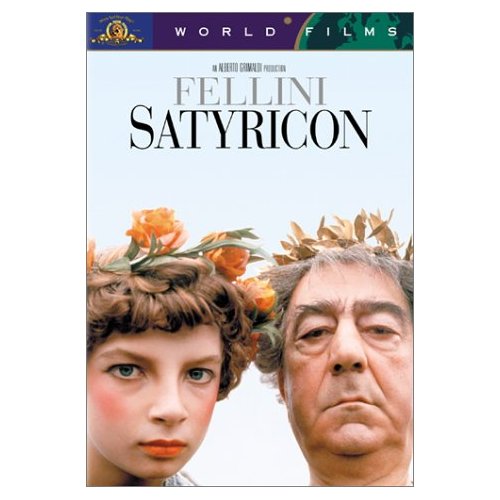
<---The movie title is Fellini Satyricon including Fellini's name: another producer/director, Gian Luigi Polidoro, had beaten Fellini to the screen with another Satyricon based on the same fragmentary ancient Roman novel and had registered his Film -- and he had won his law suit against Fellini. Fellini added his own name to the title and went ahead. In the end Fellini's name (and the fact that his was the much better movie) won the lion's share of the audience, and Polidoro, not being able to compete, gave up and re-titled his movie (The Degenerates) in a vain hope of winning viewers.
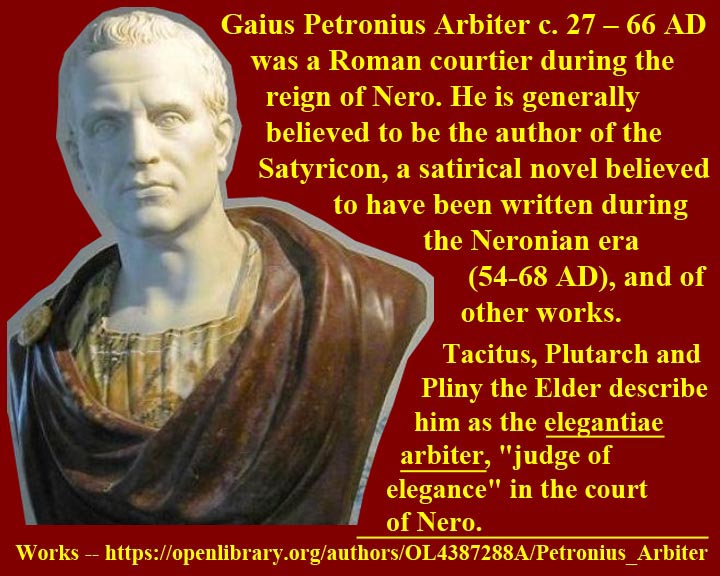
<---Arbiter was on of Nero's courtiers, on whom the court relied on what was "elegant".
See:
https://en.wikipedia.org/wiki/Petronius
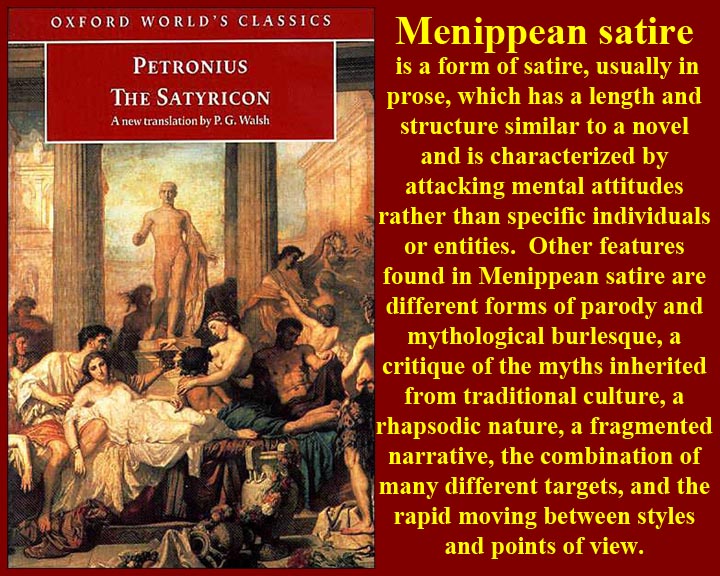
<---Menippean satire is essentially exageration and overstating in order to deride types of behavior and/or personal characteristics. The Satyricon, considered to be the earliest ancient "novel", certainly is Menippean, but ubfortunately it was and sometimes still is read by the unintiated as an accurate description of Roman life. The movie is episodic, because that is part of the Menippean style, and because what remains of the Petronius book has missing sections.
See:
https://en.wikipedia.org/wiki/Menippean_satire
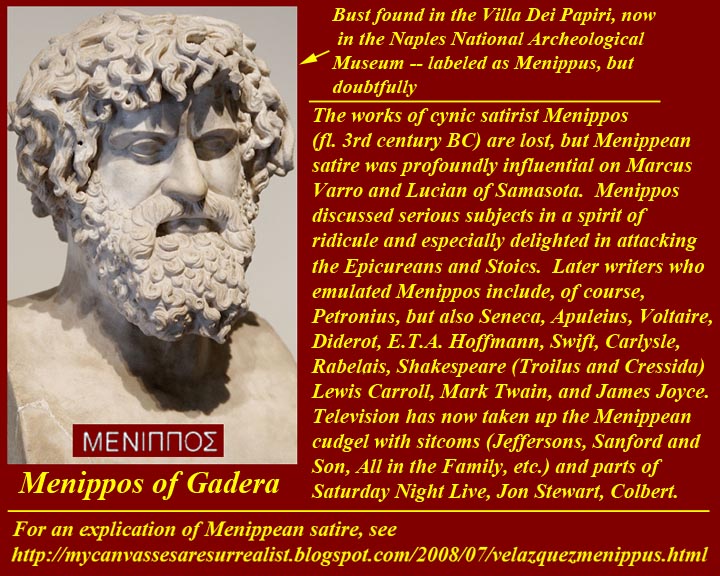
<---A doubted (but only available) image of Menippos.
See
https://en.wikipedia.org/wiki/Menippus
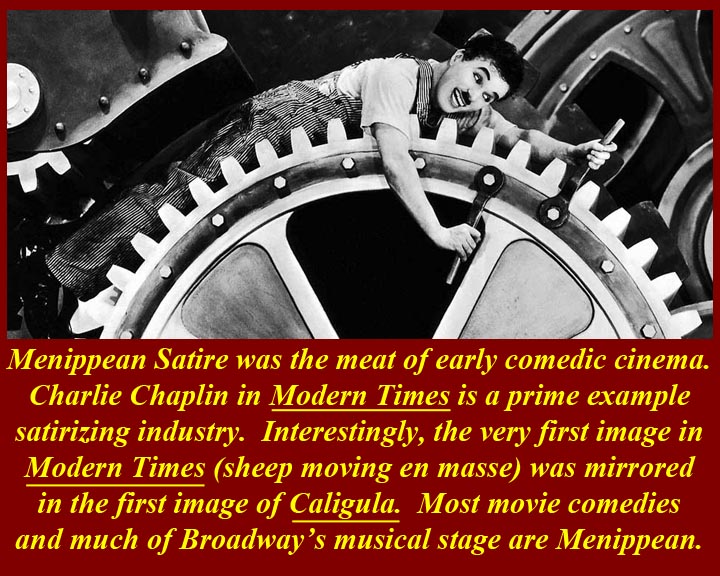
<---Charlie Chaplin was a 20th century proponent of Menippea satire.
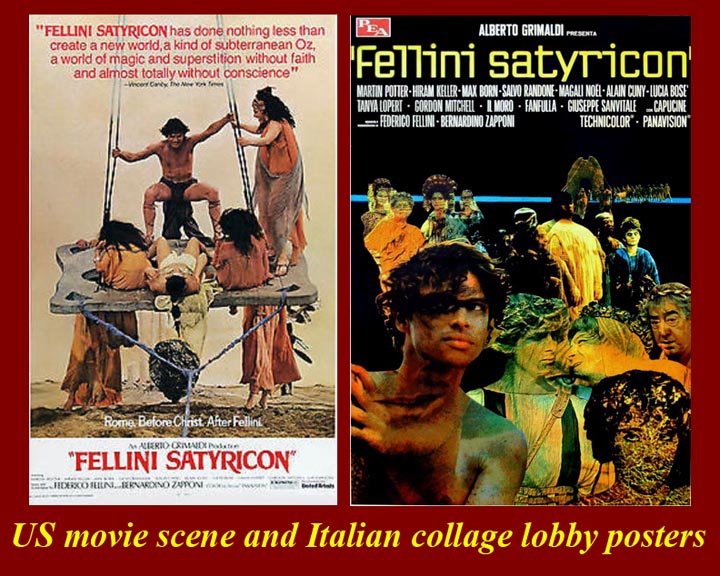
<---Fellini Satyricon US and Italian movie posters.
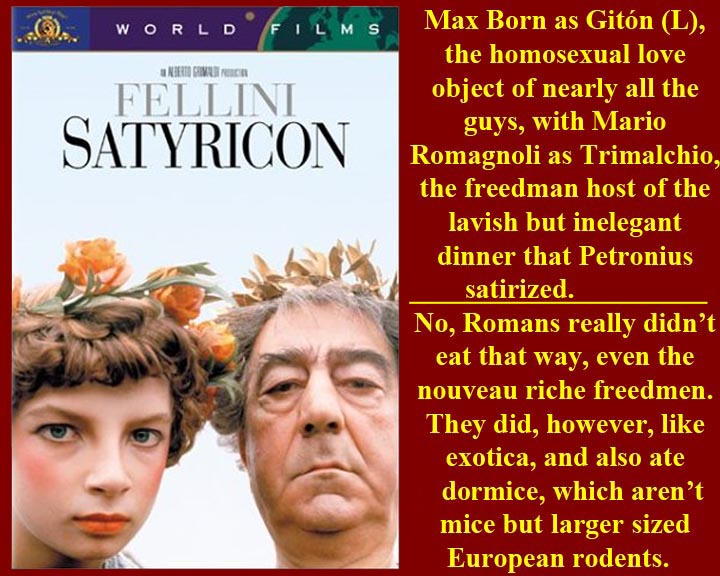
<---Giton and Trimalchio on a Satyricon DVD box.
One of the scenes in the original ancient Roman book that led people astray about ancient Rome and particularly Roman eating habits was "Trimalchio's wedding". 20th century movie-goers also might have thought that ancient Romans actually feasted as the movie depicted.
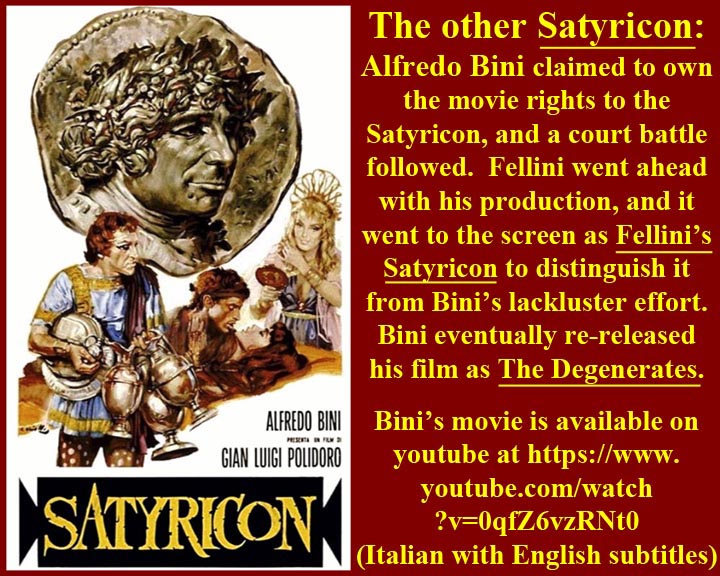
<---Bini had the rights to the Polidoro Satyricon, which, since it flopped, now seems to be only available on the Internet -- but don't bother.
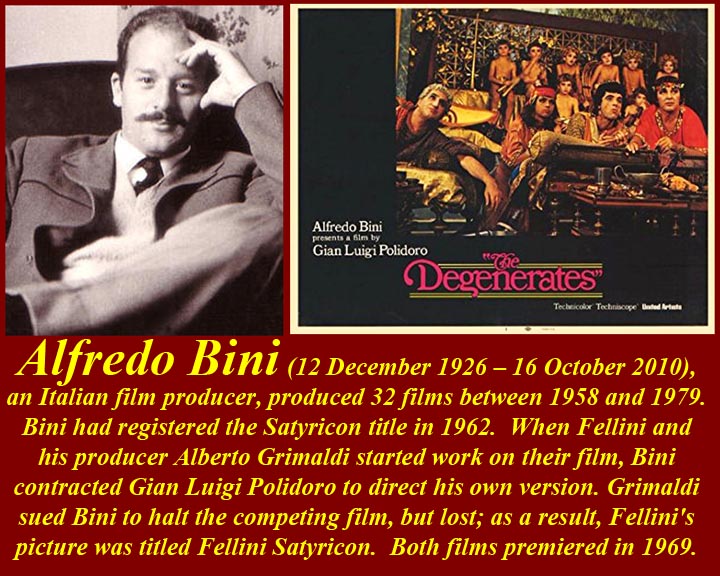
<---Bini of the Bini/Polidoro Satyricon/Degenerates -- maybe scratching his head wondering why they even bothered.
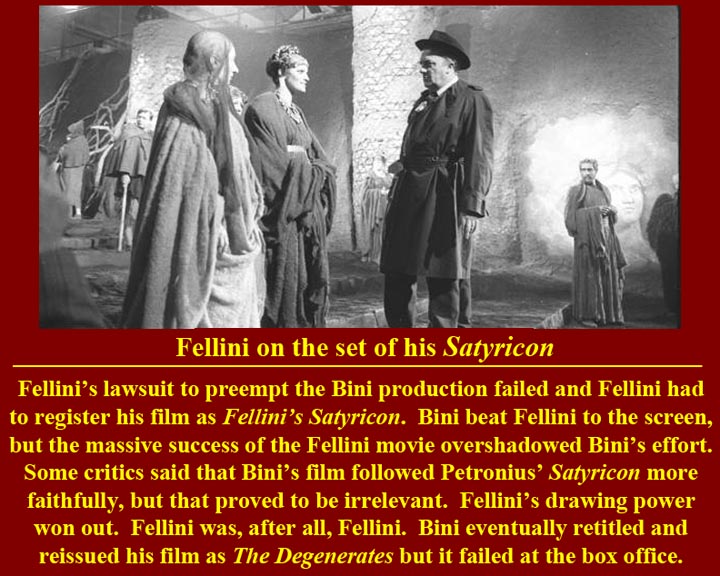
<---Fellini on the set, directing his Satyricon.
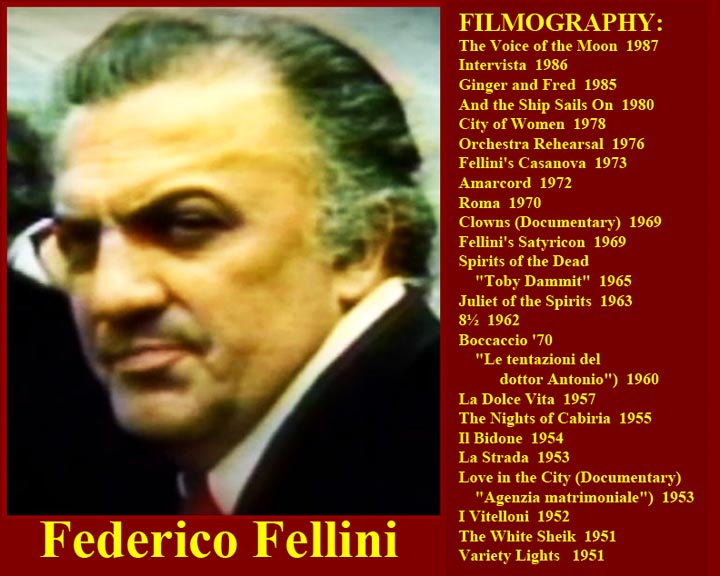
<---Fellini, his Filmography
Classic dad joke: What the Cannibal King thought when his Queen disappeared?
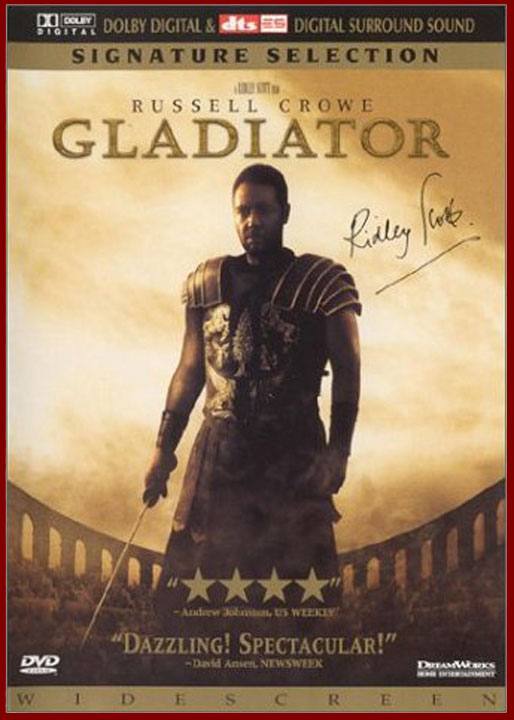
<---DVD box for the Gladiator movie.
Some knowledgeable audience members, after thinking about the first and last "in his dying mind" scenes of the Gladiator movie, saw a similarity to the Ambrose Bierce short story An Occurrence at Owl Creek Bridge.
For info on the Bierce story, see:
https://en.wikipedia.org/wiki/An_Occurrence_at_Owl_Creek_Bridge
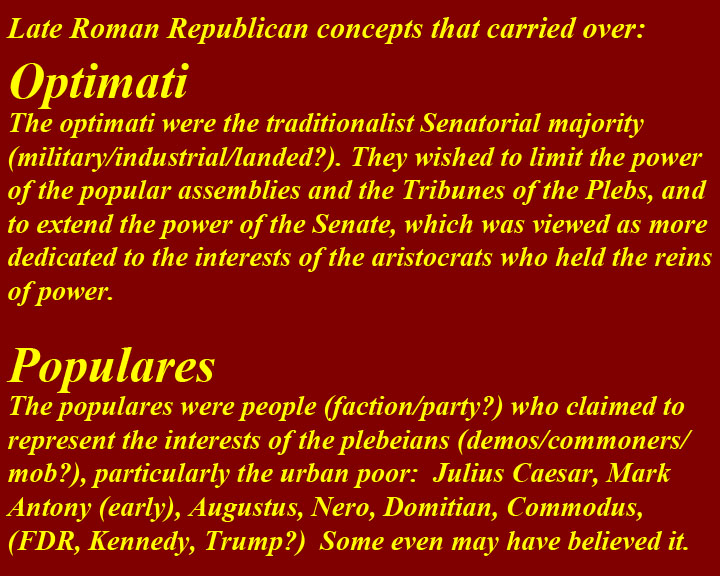
<---One of the lessons the movie highlights is that ancient
Roman politicians whether they fell into the Optimati or Populares category were all from the upper classes. They may have appealed to different audiences, but their real goals were to get themselves and keep themselves into power. Does that sount familiar?
See also:
https://en.wikipedia.org/wiki/Optimates_and_populares
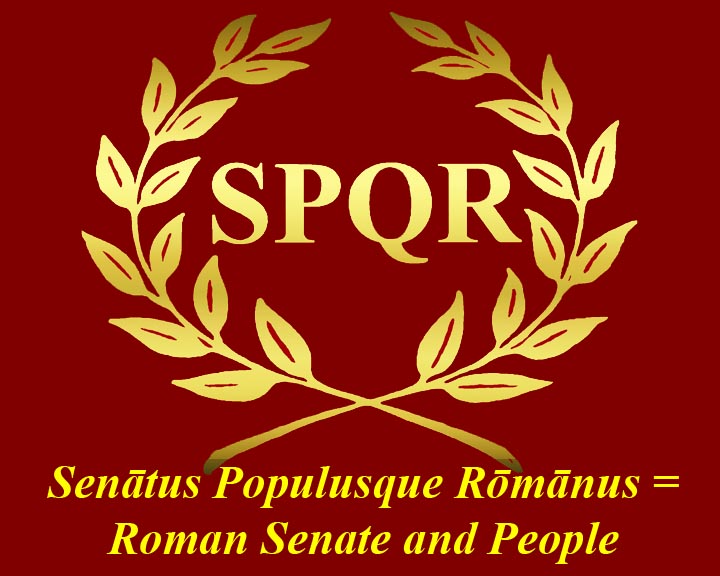
<---depending on who was in power, the "official" logo of ancient Rome might shift, as it reportedly did during the reign of Commodus, the "Populares" emperor portrayed in the Gladiator movie, instead of SPQR, it would read PSQR, listing the People before the Senate of Rome.

<---if you becam a top level gladiator, as "Maximus" did in our movie, your promoter/manager/agent/owner you were headed to the biggest arena, the Flavian amphitheater in Rome.a
ARENA was the Latin word for "sand" and referred to the fighting surfcae of blood-absorbing sand.
AMPHI-theater meant two cojoined and facing theaters using the Latin prefix amphi/ambi that meant two or doubled (think of the Engkish word ambidextrous).
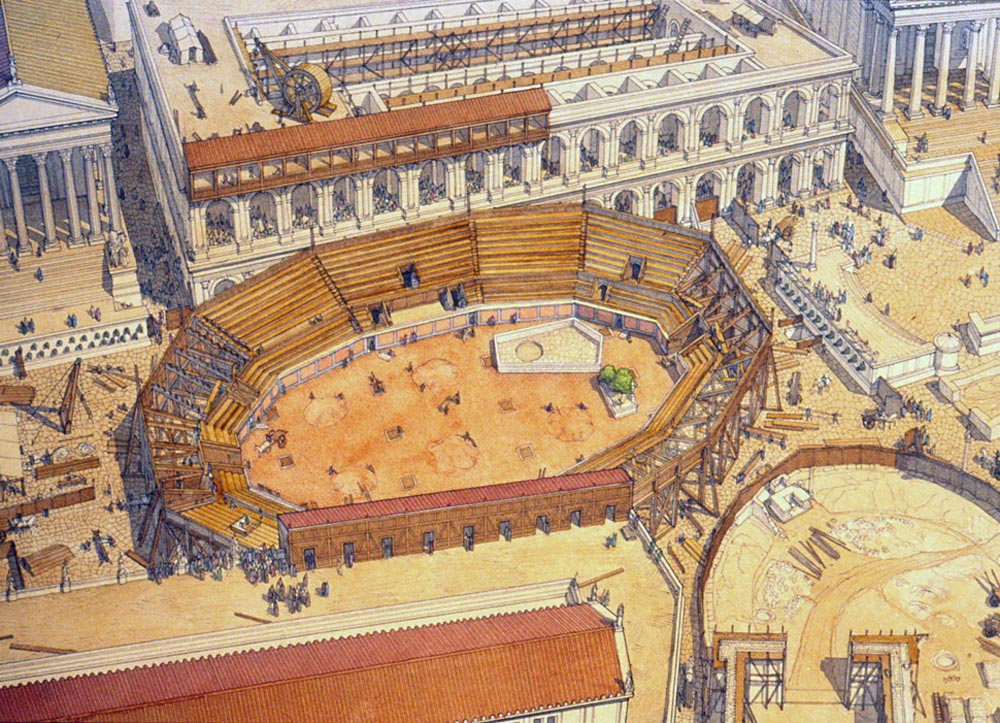
<---Other cities with Roman or allied populations (e.g., Pompeii and Capua) had masonry amphitheaters before Rome did, mainly because permanent theater and gladiatorial game venues would be sacrilegious if built inside tthe "sacred boundary (the "ager") that was established and actually ploughed by Romulus. Rome's first amphitheaters were therefore wood-built and temporary, taken down and stored when a games season ended. The image show how a temporary wooden amphitheater would fit nicely down the center of Romes Republican Forum.
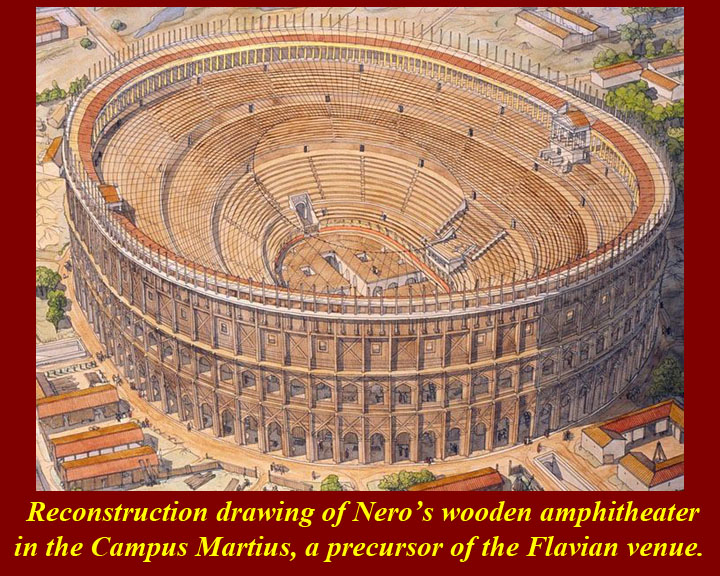
<---Nero commissioned a much bigger amphitheater in the Campus Martius, technically outside the ager, but still wood. Amphitheater games were incredibly popular, so emperors and wannabes would sponsor them and build venues.
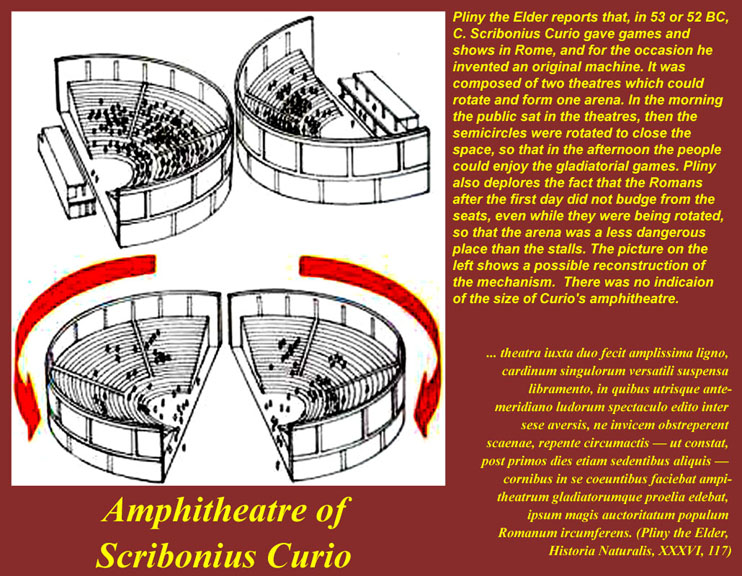
<---The elder Pliny complained that some jaded Roman spectators would refuse to leave their seats when the two rotating (on pivots) halves of this amphitheater were moved between theater and gladiator events. Nevertheless he still admires Roman engineering repute.
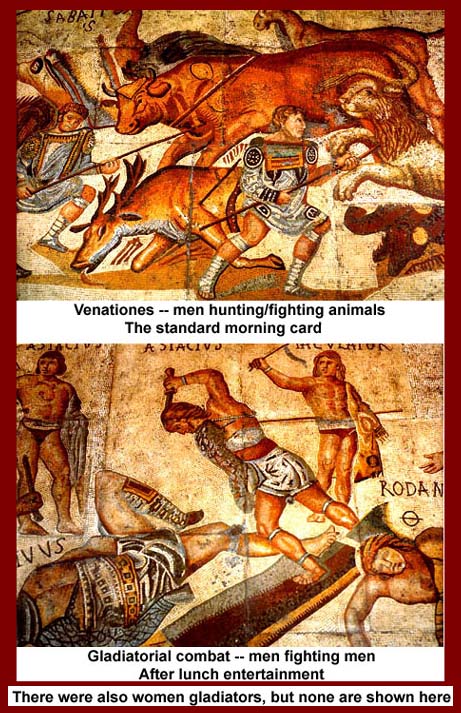
<---In addition to fighting each other, gladiators could fight or hunt wild animals in morning events called venationes.
Criminals, sometimes Christians who refused to participate in adoration of emperors, would be killed by animals during the lunch break, while much of the audience left to the outside food stalls. (The church urged Christians to do the sacrifice to the emperors as required Its position was that those who refused to sacrifice were suicides. Zealots thought otherwise and eagerly sought martyrdom.) The Catholic Church believes that as only about 10,000 Christians suffered damnatio ad besteas in all the years and throughout the Roman Empire, but some Protestant sources use much higher numbers, as do some "charismatic" Roman Catholics. The Vatican also now disavows 2nd and 3rd century martyr "witness statements" supposedly made by
"martyrs" between aprehension and damnatio.
After the lunch break. the audience returned to watch gladiator match-ups.
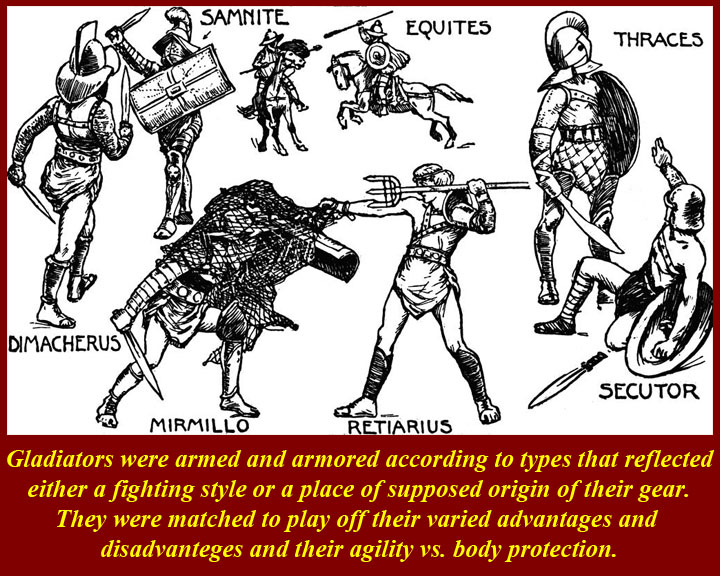
<---Gladiators were matched and denominated according to their weaponry and armor. Spartacus meager ancient sources say he was a Thracian, but experts argue about whether that define his place of orrigin or it refers to his fighting gear.
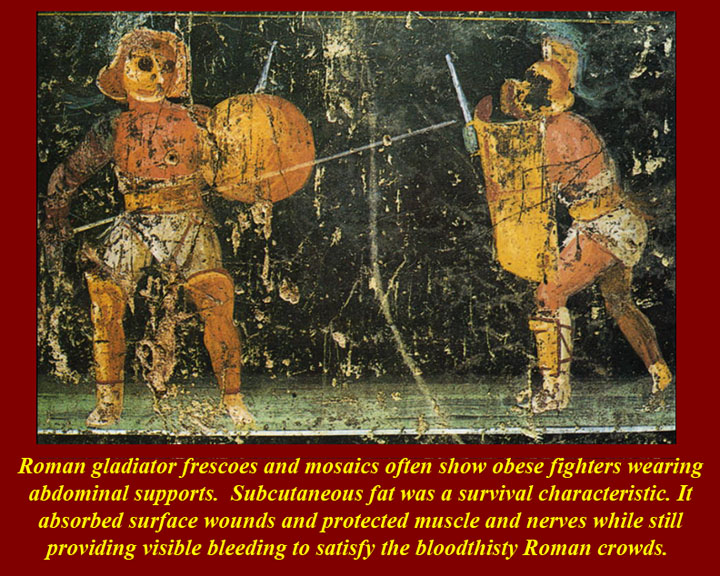
<---Trainers and owners were looking for muscular bodies with as much subcutaneous body bt a possible.
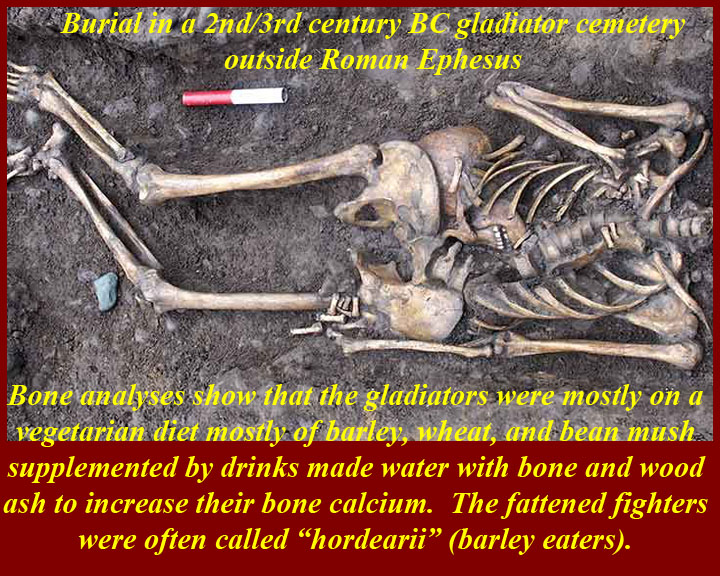
<---One of several skeletons skeletons in an Ephesus gladiator burial ground. Bone alalyses indicate a mostly calcium drink for bone density suuplementing a mostly barley/wheat/bean vegetarean gruel to fatten the gladiators, who were sometime called "barley eaters". Gladiators ate mostly carbs an donly rarely ate animal protean.
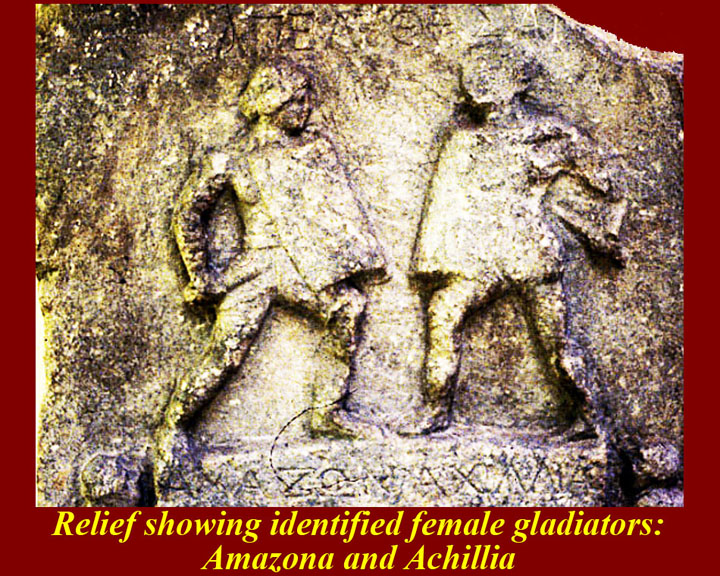
<---A gladiatrix relief captioned with two female names, Amazona and Achillia.
Today all the gender barriers are down. There are female proponents of all the martial arts, the most famous of whom is Cynthia Rothrock.
Known
as the "Queen of Martial Arts," Rothrock is a
legendary competitive martial artist who holds black
belts in seven different styles, including an
8th-degree black belt.
See:
https://en.wikipedia.org/wiki/Cynthia_Rothrock
See:
https://en.wikipedia.org/wiki/Cynthia_Rothrock
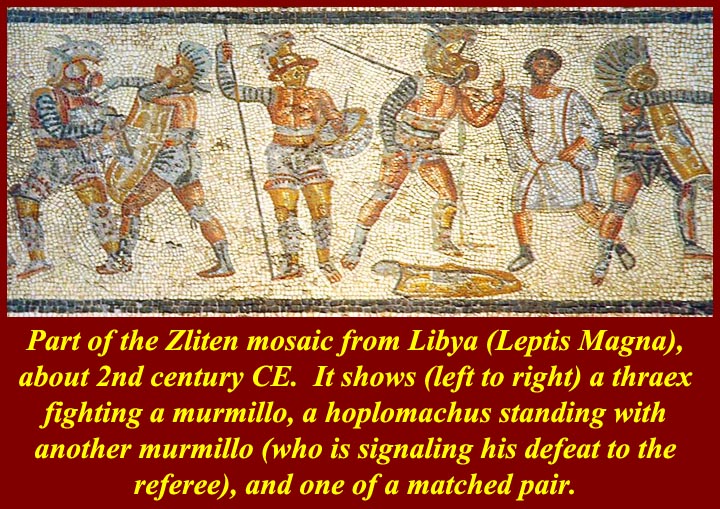
<---Mosaics in a Roman villa in Zliten (Leptis Magna. Libya) indicate the house belonge to either a big fan or even perhaps a very prominent retired gladiator. North Africa was a place to which ancient Roman retirees aspired and resorted, and was a place to which the ultra-rich brought the best mosaicists. Museums in Leptis Magna, Libya, and Tunis hold the worl's best collections of Roman era mosaics (although many of them were designed and installed by Greek artisans).
The Zliten gladiator mosaics fall into the world best and most famous category. See:
https://en.wikipedia.org/wiki/Zliten_mosaic

<---Another segment of the same Zliten floor mosaic shows the musical accompaniment to the slaughter.
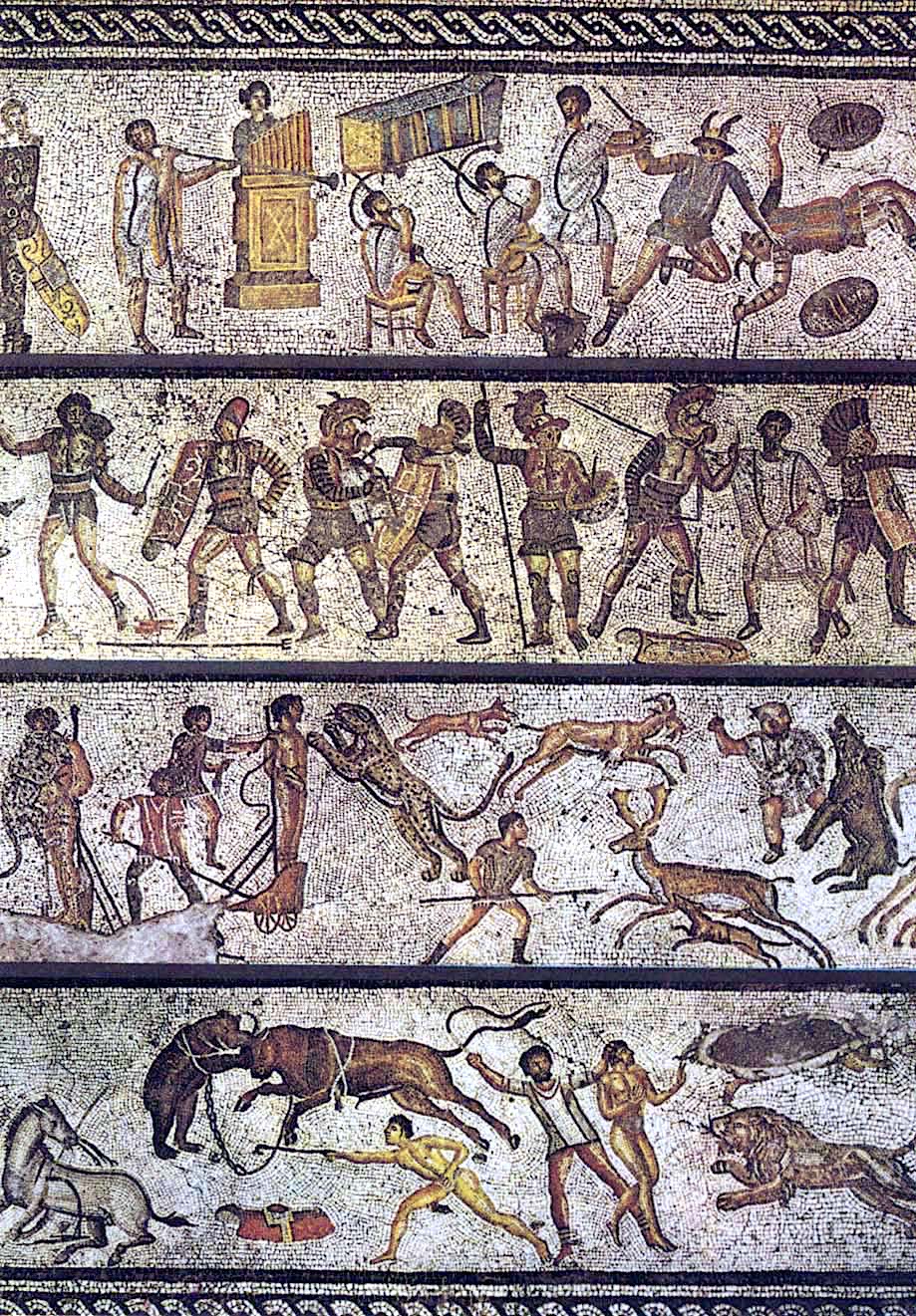
| <---More of the Zliten mosaic |
Only four images
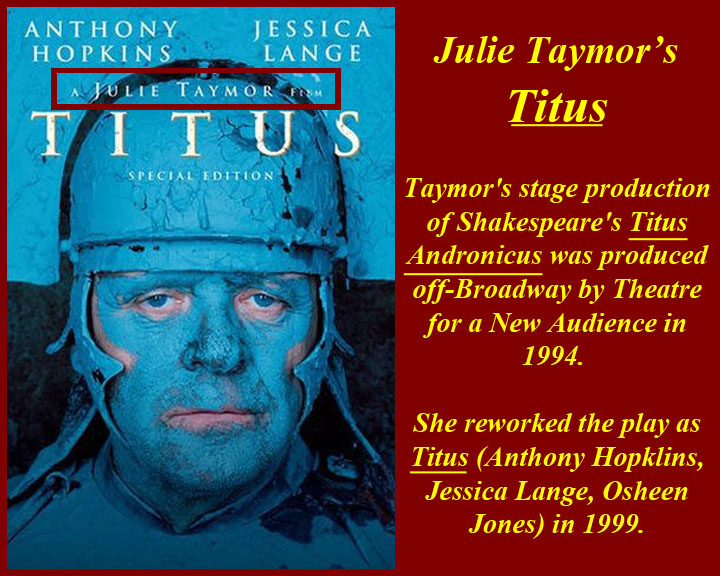
Shakeespeare wrote a bloody "Revenge Play" (in the prevailing style of plays in his early days, all of which were trying to emulate Seneca's sung/chanted odes.) Shakespeare's 1594 londonaudience, already inured to bloody spectacle by earlier revenge dramas and by public executions, beheadings, drawings and quartering, were not partiicularly shocked. Taymor's 1994 New York audience was very shocked.
The film, produced shortly thereafter
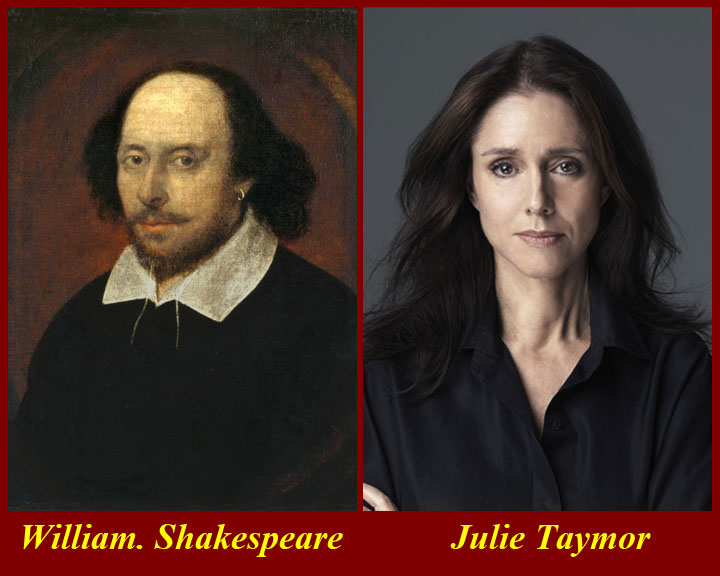
<----Two producer/directors, Shakespeare and Taymor.
Taymor is actually much more famous for her other Shakespeare movies, gender-bending Tempest (Helen Miren. 2001) and Lion King (Hamlet Africanized, 1994).
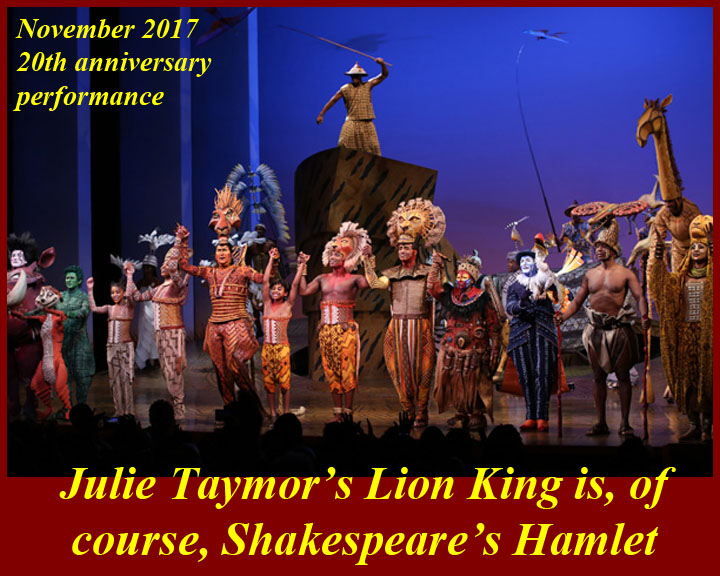
<---Taymor's Disney movie,The Lion King hit screens in 1994 and the Boadway live action costume and puppetry aances,aptation opend in1997 and is still runnng today. With more than 11,200 peforrmances, it is the third longest running Broadway producion after Phantom of the Opera and Chicago.
World wide ticket revenue for staged LION KING is now over 8 Billion Dollars.
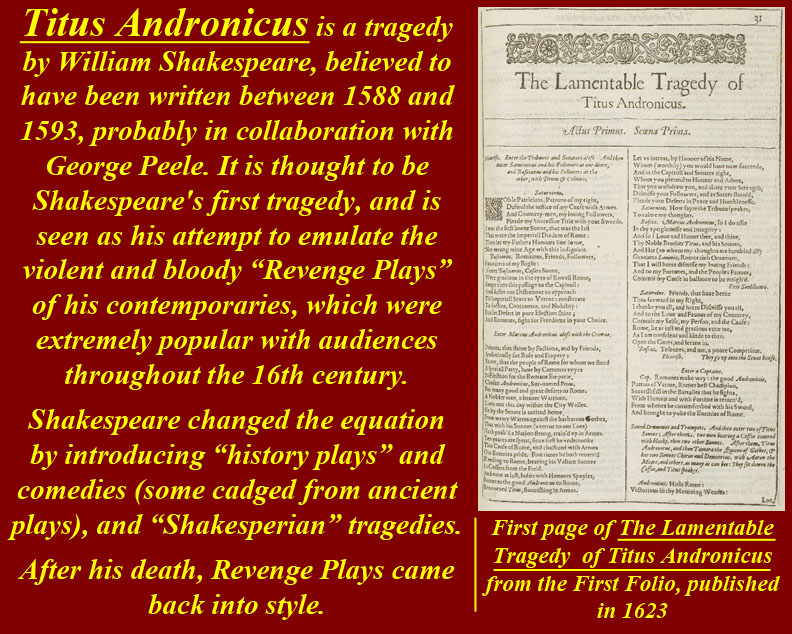
<---Seneca's Revenge "Plays" .were writen as odes that would be sung by a single Rhapsode in a dimly lit odeon. Any ACTION, as if by ACTORS, was left to the imaginations of the audience. By Tudor, Jacobean, and Restoration times, dramatists were writing new very popular "revenge plsys" for multiple live actors to "speak the speeches" while obeying detailed stage directions.
Dramaitsts wrote what audiences liked, to keep the pounds and pence flowing in. Shakespeare and his men (always all men) did very well. They owned their theater, and attained noble and then royal patronage, and mounted popular plays.