Theater Evolution and
A Funny Thing Happened on the Way to the Forum
Scroll down for 2
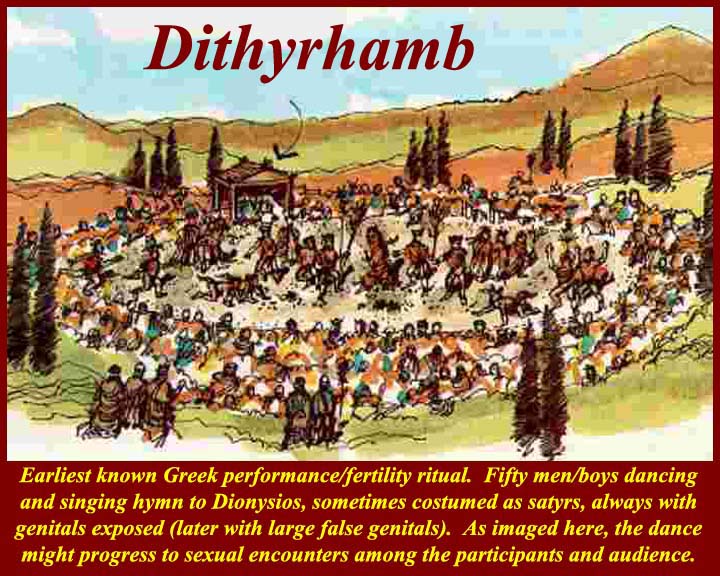
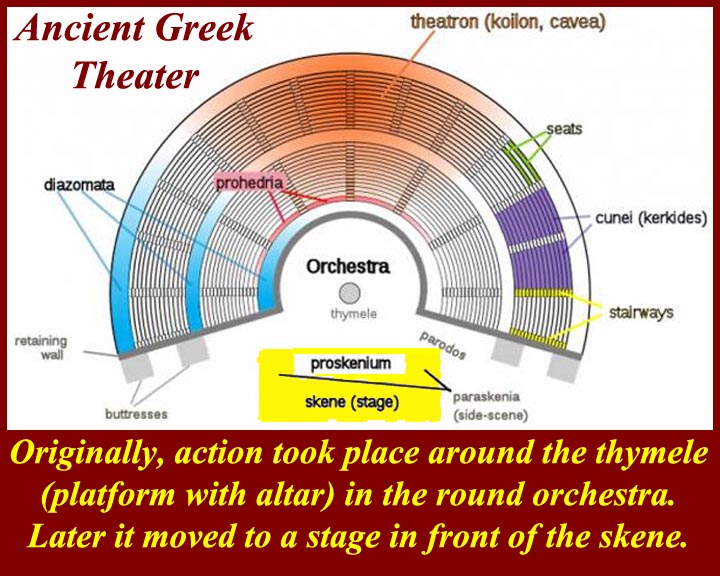
<---The orchestra of a Greek theater (as fully developed) replaced the depression in which the ritual performance had tken place. All Greek theater performances had a ritual aspect even in much later eras. Greek drama started with a single performer/reciter wirh a chorus to react, support, comment on the performance. Gradually, the tradition of dramatic competition developed with award awards for the performed (at first usually the author) and for the choriographer. Over time, the number of performers increased and choruses shrunk. Note that Greek theaters were built into hilsides and had circulas orchestras with seats surrounding them to the extent that the sites allowed.Action took place in the orchestra: the skena was for background and eventully was fronted by a stage, to which the action was moved.
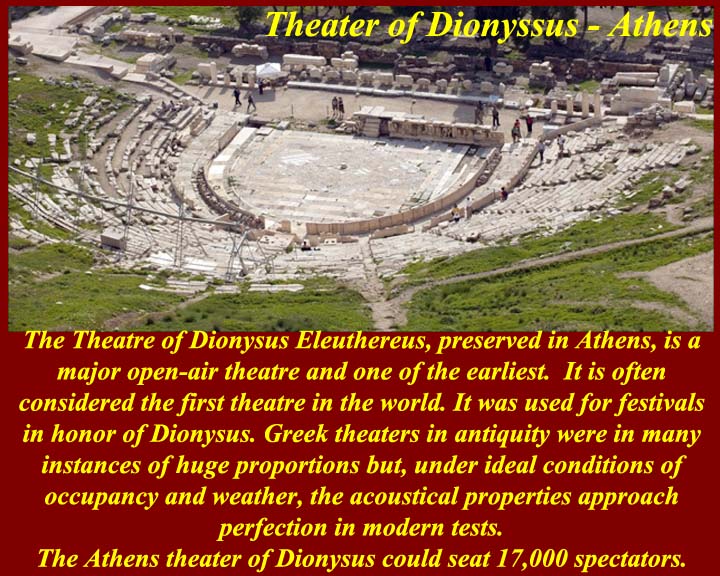
<---The Theater of Dionysus in Athens was much modified by the Romans, increased in size of the seating areaand changed in shape and with retaining walls to support the upper ranges of seating. A smaller Odeon (covered, for darkened recitation of odes) stood behind the seats at the left of the image. Part of the Roman stage is visible, but almost all of the skene is missing. Structurs behind where the skena stood are remains of temples with the Temple of Dionysus to the right.
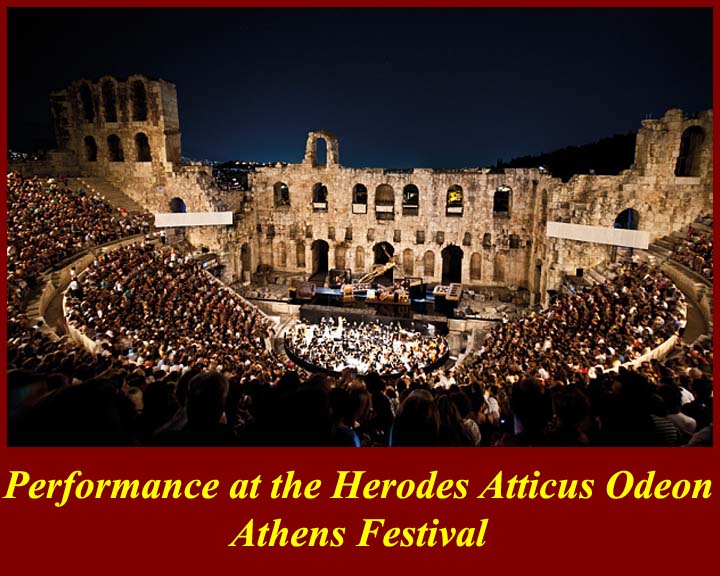
<---Image shows a modern performance in the originally covered Odeon of Herodus Atticus. Built in the 160s AD on the southwest slope of the Athens acropolis, it can accommodate 5000 persons (largest odeon anywhere). It has seen several reconstructions/renovations, the latest of which was in 1950. It now hosts the Athens festival and other performances.
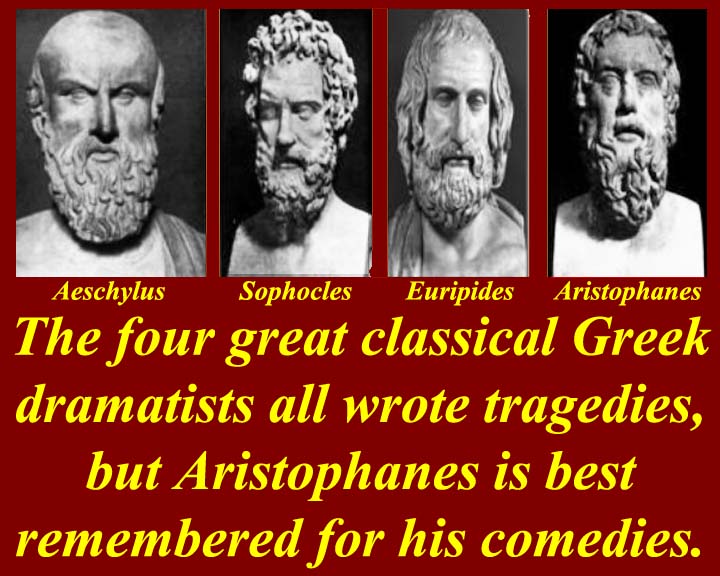
<---There were many Greek dramatistts, but the most famous, those whose works are preserved, the works of whom often took the prizes, whose works are stil performed (although often pretty badly and with strange direction and costumery by university clubs) are the four shown.
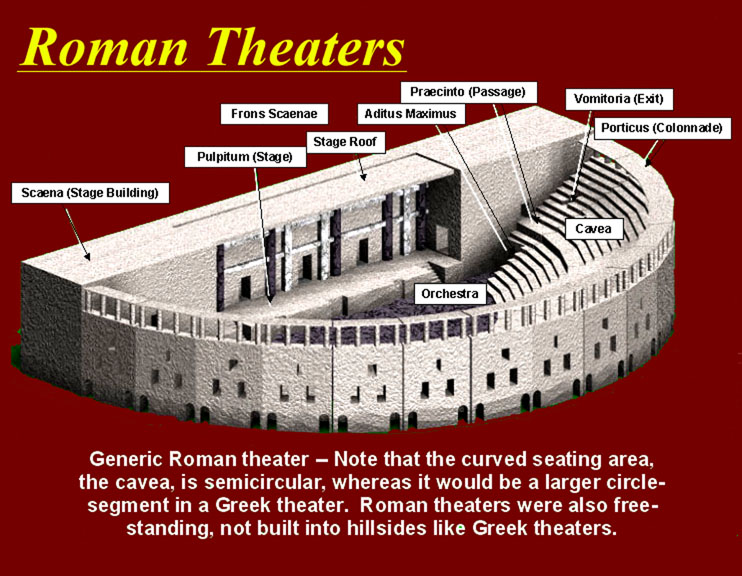
<---Greek theaters were most often built into pre-existing curved slopes with the performance space, the orchestra, at the bottom of the hill. Roman theaters tended to be free standing structures built initially of wood and temporary, for a theater season and then taken apart and stored until the next season of "theater games", which were held in conjunction with the bloodier games at the amphitheater and the immensely popular ludi circenses, the chariot races. The first stone theater in Rome was the Theater of Pompey which he had built under the pretense that it was a temple of Venus.
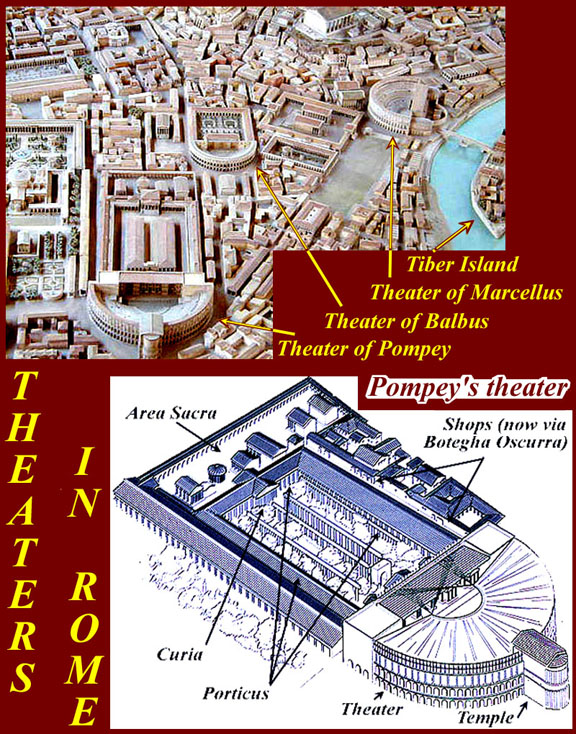
<---Free standing stone theaters inside Rome. The first and largest was built by Pompey Magnus in 55 BC as a putative temple of Venus. The curia at the far end of the rest area behind the skena was the location of Julius Caesar's assassination. The curia has beeen excavated, but it is buried under the Teatro Argentina, which has its own historical significance (Verdi, Rossini).
The temple of Venus is easily seen at the top center of the seating area in both parts of the image. Most of the temple structure remains today and has been enclosed in a modestly priced hotel used by the Vatican for lower ranked clerics and nuns and their guests. Guest rooms are built right into various temple areas and parts of the supporting structures. Much of the substructure of the
cavea (seating area) is built into surrounding buildings and can be seen in and, in fact, are the locations of shops and restaurants.
Way to the
Forum

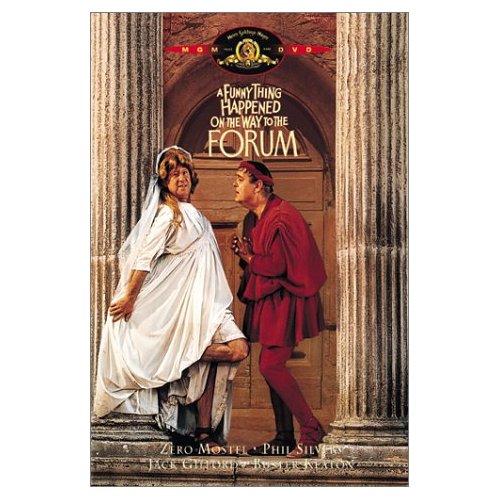
<---Theater poster for the movie.
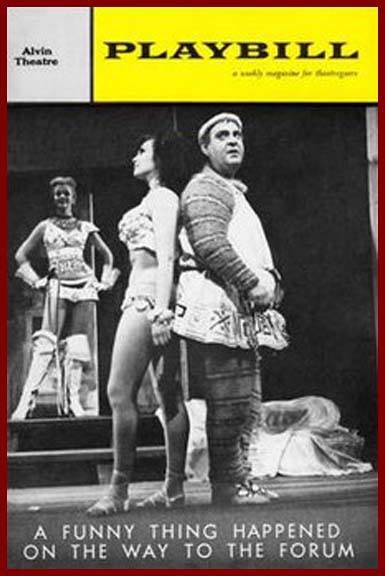
<---A theater playbill cover
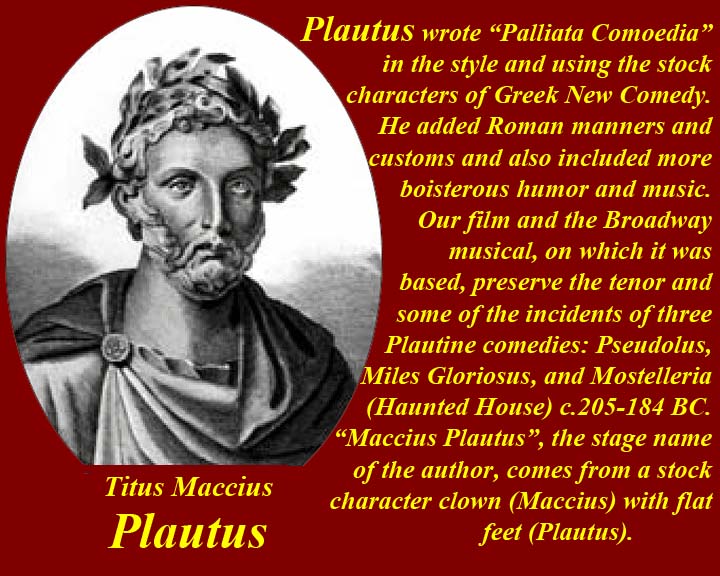
<---There are no known contemporary images of Plautus who wrote the 3rd century "Palliata" omedies, on which Funny Thing are based. He usedstock characters from earlier Greek "new comedy" but put them in Roman situations -- and, with others of his day, continued the "new comedy" tradition of what we later called "situation comedy.

<---Two great Greek comedy dramatists in a Janus-like dual bust. Aristtophanes personifies Greek "old comedy", which ridiculed institutions including religion (gods and goddesses). Menander represents "new comedy", which uses archtypal characters, common people in laughable "situations". Plautus used stock characters from Menander and other Greek "new comedy" writers.
c.f., https://en.wikipedia.org/wiki/Menippean_satire
(Janus was the god who loooked to the past and to the
future -- often shown as a dual image, sometimes old-young.)
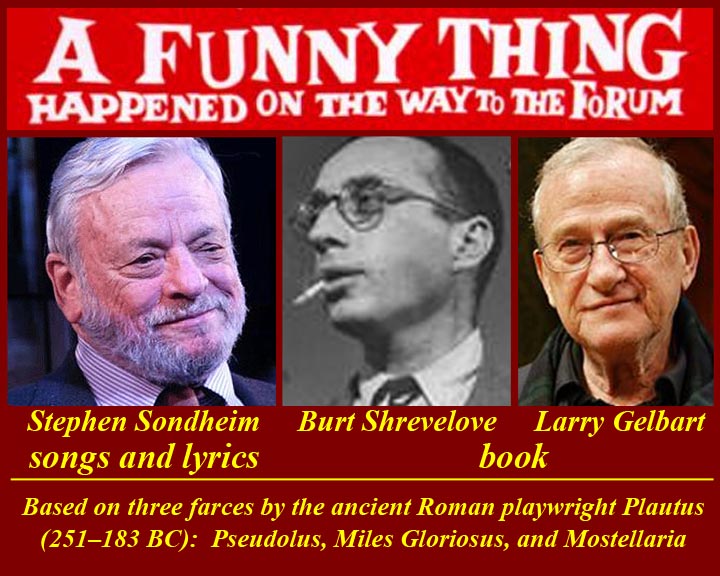
<---The three who conflated plays by Plautus and brought Funny Thing to Broadway (May 1962 through August 1964). The movie adaptation (1966) kept most of the Broadway dialogue but removed several songs and added others. Both the Broadway and hollywood versions were massive and award winning successes. Zero Mostel starred as pseudolus in both and was a major contributor to their successes. Several successful Broadway and East End (London) revivals have been mounted. Very successful "road" productions have also toured the US.
Original poor reception on Broadway was saved by the insertion of the introductory song/monologue "Comedy Tonight" sung by Zero Mostel, after first performances.
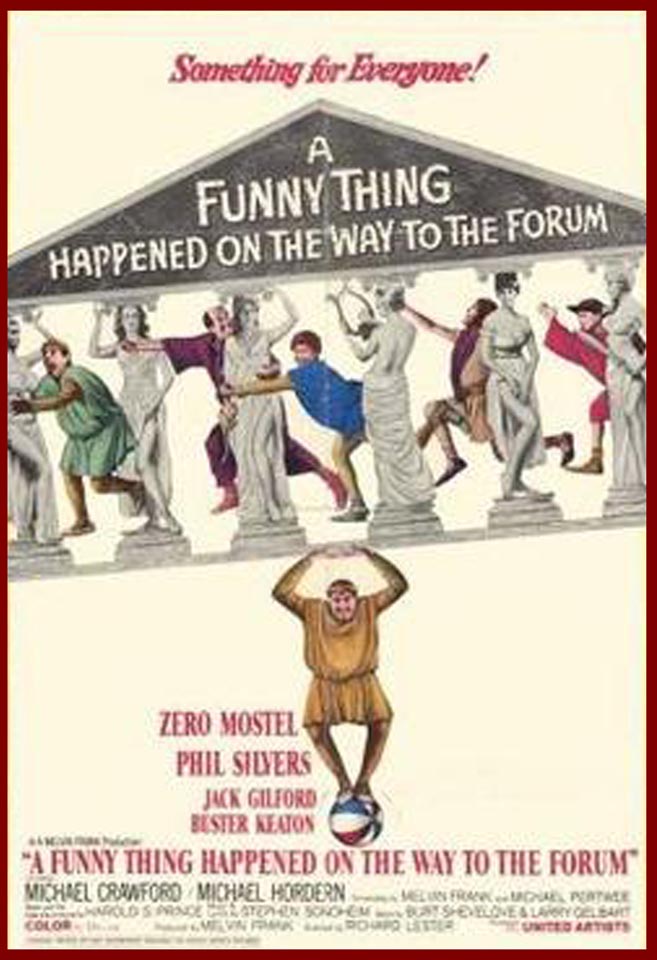
<---Movie lobby Poster shows Zero Mostel supporting the show -- which he did.
Scipio Africanus - The Defeat of Hannibal
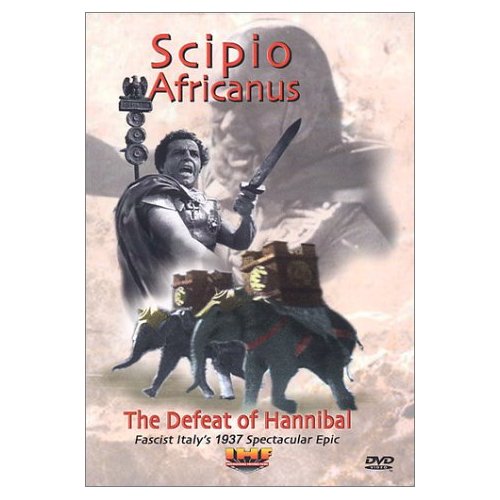
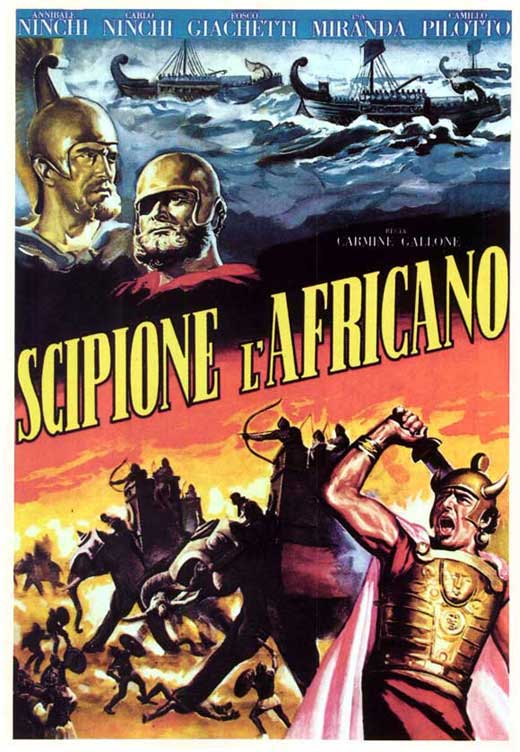
<---Cover of the American English dubbed version of the Italian Fascist propaganda movie about Scipio Africanus. Masssive cast (mostly Italian Military) and redolent with 1930s Fascist salutes and songs. Produced by Mussolini's son with the obvious purpos of rousing the Italian public for war. (Shortly afte the movie was made, the same miitary personel were sent to rea war against
Ethiopia.
The movie is infamous for its close-up segment in which elephants were really slaughtered on screen.
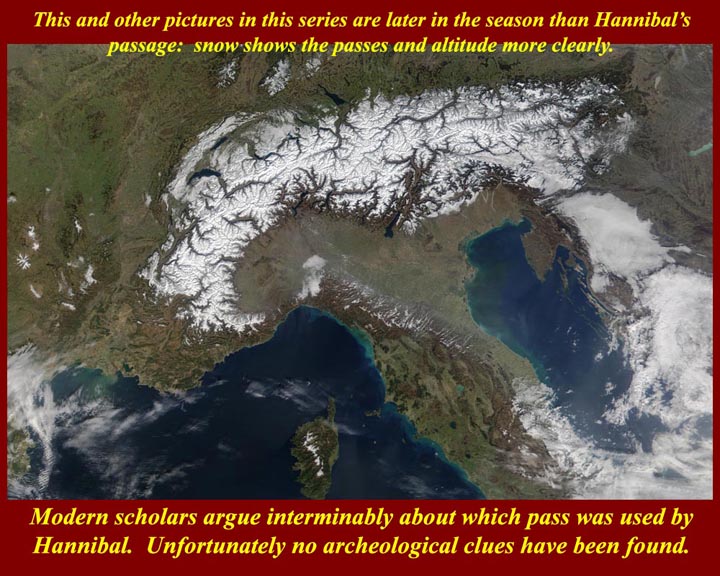
<---As noted on the bottom of the image, Hannibal's route through the Alps is still not settled. Lots of recent theorists rely on finds of chemicals and DNA characteristic of passage of many horses and men (fecal and urine remnants), but their ocritics point out that all the passes have had horse and human transits for centuries. As far as I know, nobody has claimed to have found elephant remains or droppings in the
Aps.
The Greek general/historian/hostage, Polybios, who interviewed Hannibal (and other participants of the Alps passage) and who lived in Rome with the Scipios gave a fairly detailed description of the passage, but not detailed enough to actually identify the actual route.
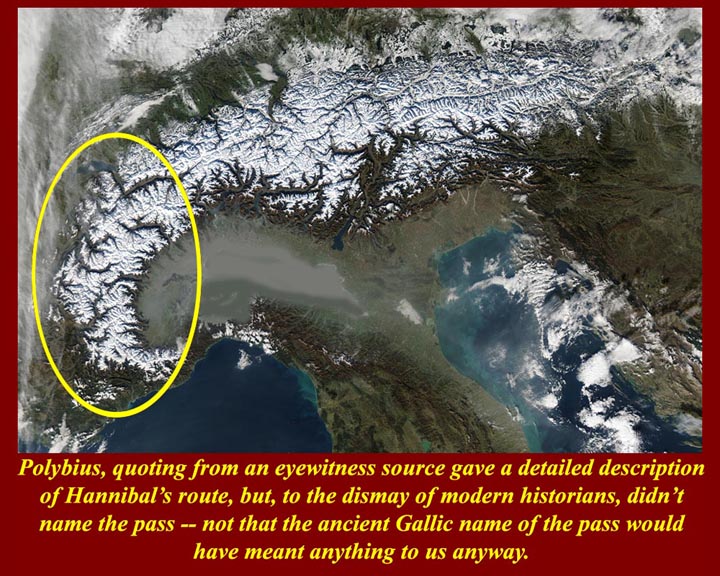
<---Most modern academics and historians assume Hannibal used a pass nearer to the western end of the
alps.
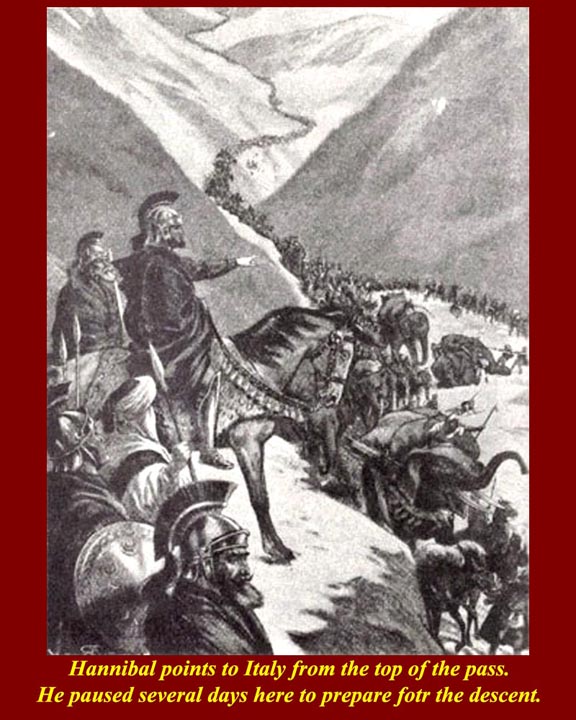
<---A modern image supposedly of Hannibal standing at the high point ot the pass through the mountains pointing to the fertile plains of Italy (surrounding Torino(?) where possible allies lived (Celtic Taurini tribesmen?).
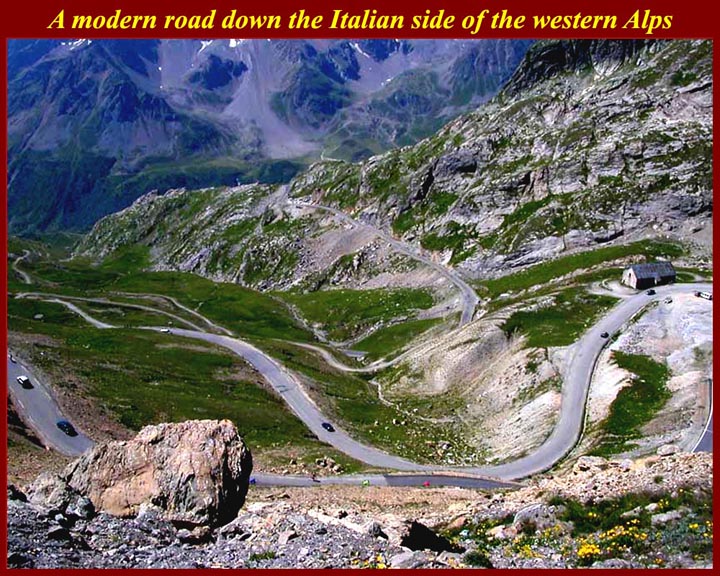
<---The modern road down the Italian side of the Alps toward Torino from one of the possible passes used boy Hannibal follows the route of a later Roman road. According to Polybios because it was late in the year when Hannibal started the descent, new snow was falling on top of snow from the previous year, making the narrow path very hazardous and slick. More men and horses were lost going down than had been lost going up. Only one go of Hannibals 37 elephants survived the Alps (but he got more by sea after entering Italy.
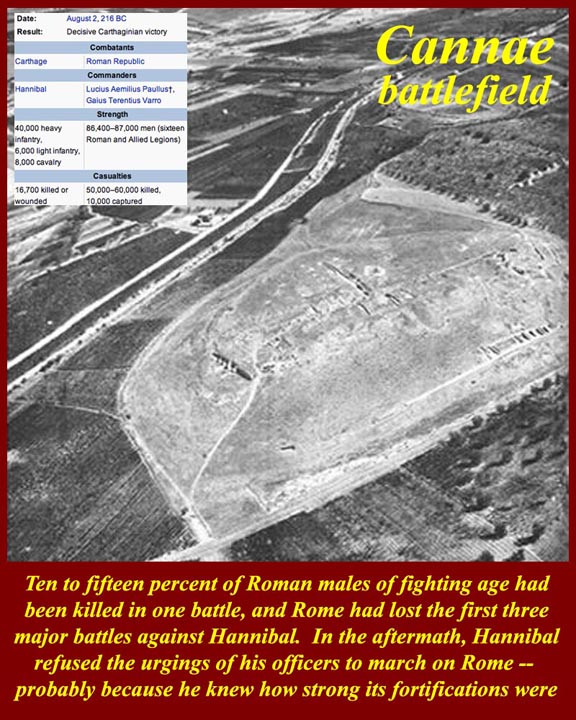
<---The Romans lost the battle of Cannae with massive casualties. They lost due to the impulsive actions of one of the commanding Consuls, who ignored the previously successful "Fabian strategy" of Quintus Fabius Maximus Verucosus, who had harassed the Carthaginians but had completely avoided set-piece battles.
In his time, Fabius Maximus acquired an additional nickname: "Cunctator" , which means "delayer", because of his strategy of putting off set-piece battles.
Initially, his stratgy was not popular with the people or the army, but after Cannae, its wisdom was recognised.
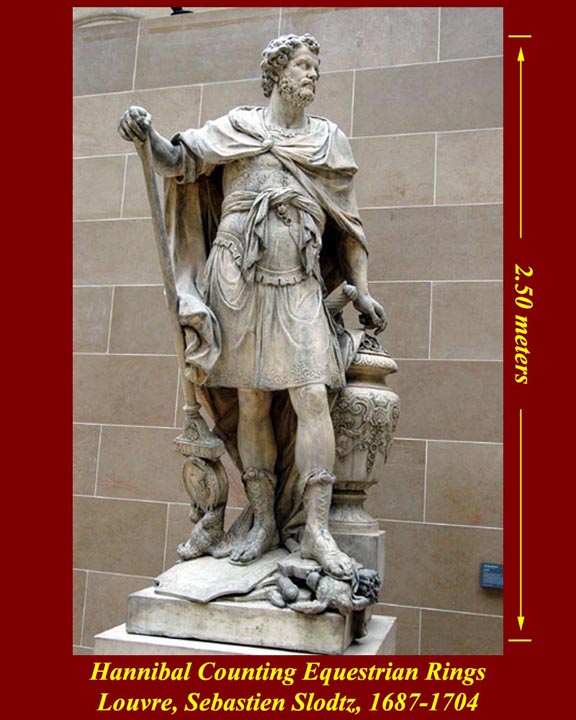
<---During the period of the 2nd Punic War (Hannibal's War) Roman cavalrymen were "equestrians", men who could afford their own horses. By the time of the Renaissance the story had grown that Hannibal had tallied the number of Roman cavalrymen killat at Cannae by counting the rings that equestrians wore, which had been recovered from the Cannae battlefield.
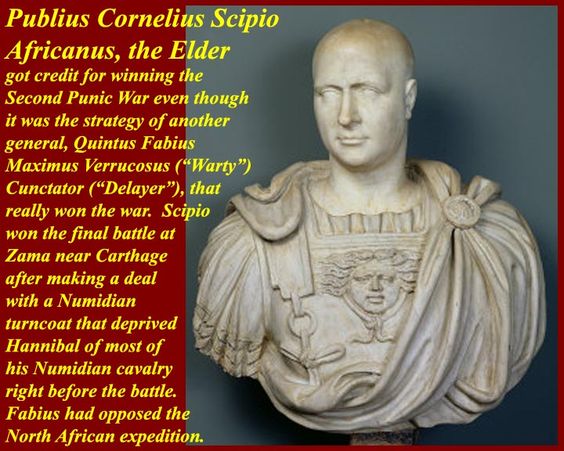
<---Hannibal ran around Itatly for years pursued by Roman armied following the Fabian strategy. Hannibal had local temporary successes, but eventually his forces had to move to other areas just to be able to supply and feed themselves. Meanwhile the politicians back in Carthage gave Hannibal only minimal support. Scipio the Elder eventually took the war back to North Africa and Hannibal followed him right out to an inland battlefield called Zama, where Scipio defeated him using tactics very similar to Hannibal's at Cannae
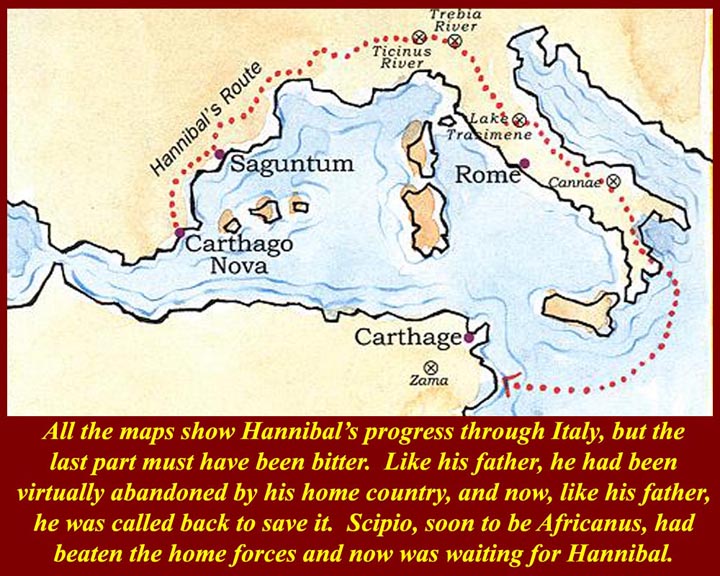
<---Scipio had landed his forces on the western coast south of Carthage and easily defeated local Carthaginian forces. Hannibal was called to defend the capital and the final battle was foughtbsouthwest of the city at Zama. After Zama the victorious Romans allowed Hannibal to be installed a ruler of Carthage -- for a while. But rising public opinion back in Rome soon impelled Hannibal to leave town. He then signed on as a mercenary in the eastern Mediterranean and soon was leading naval forces against Rome.
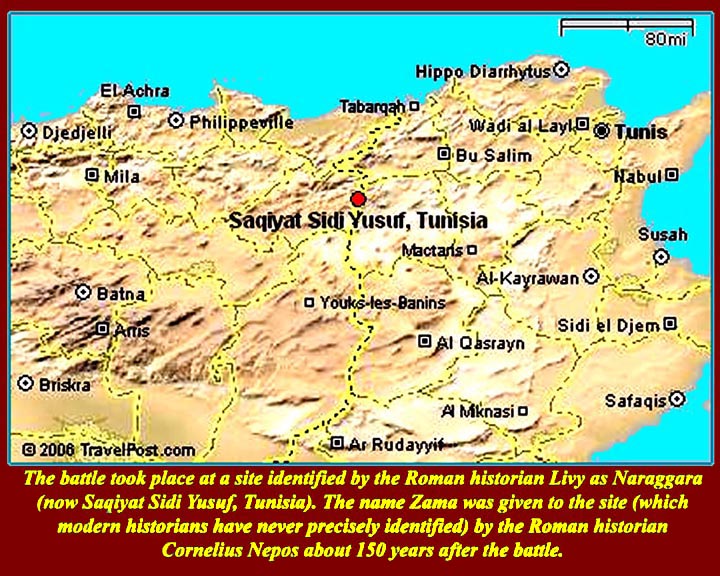
<--- Zama battle locator -- the little red dot at the image horizontal center just above the vertical center. the next imafe is a satellite image of the supposed battle area.
The link below should take you to a battle description.
https://en.wikipedia.org/wiki/Battle_of_Zama
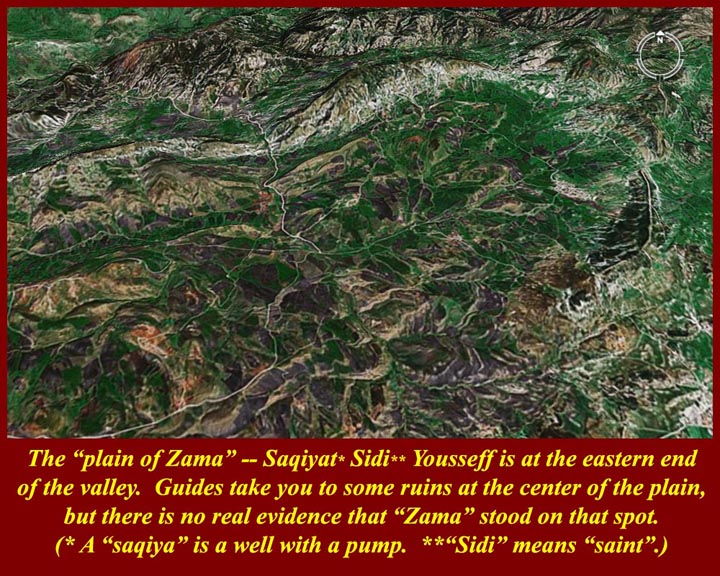
<---Satellite view of Zama battle area.
A 17 minute YouTube
simulation of the Zama battle is at:
https://www.youtube.com/watch?v=HLZ9tSohJ-8&t=97s
https://www.youtube.com/watch?v=HLZ9tSohJ-8&t=97s
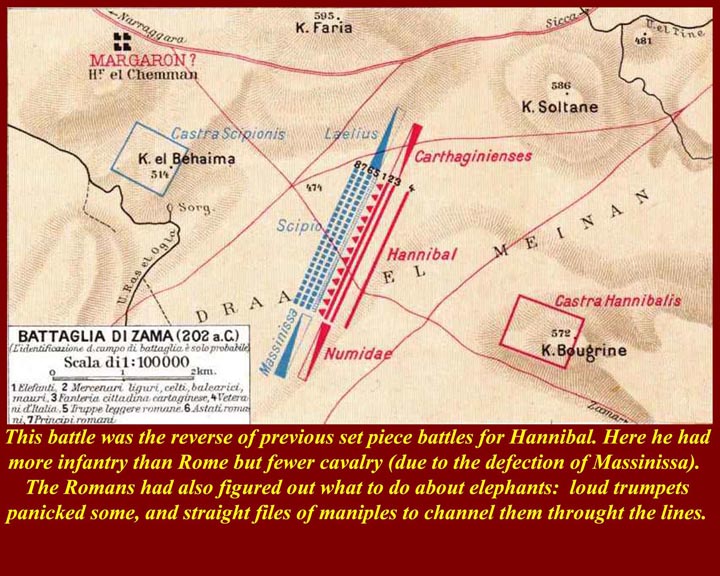
<---A decisive improvement in Scipios forces was the defection of the Numidian leader Massinissa and his cavalry forces from the Carthaginian side to Scipio. Scipio also had figured out how to deal with Hannibals elephants: when the beasts charged, the Roman force opened pathways through their ranks through which the elephants ran in the false belief the pathways were safer. But attacks from their sides led to the death of almost all of them.

<---The Scipio movie is now criticized for actually killing elephants used in the filming -- "realismo".
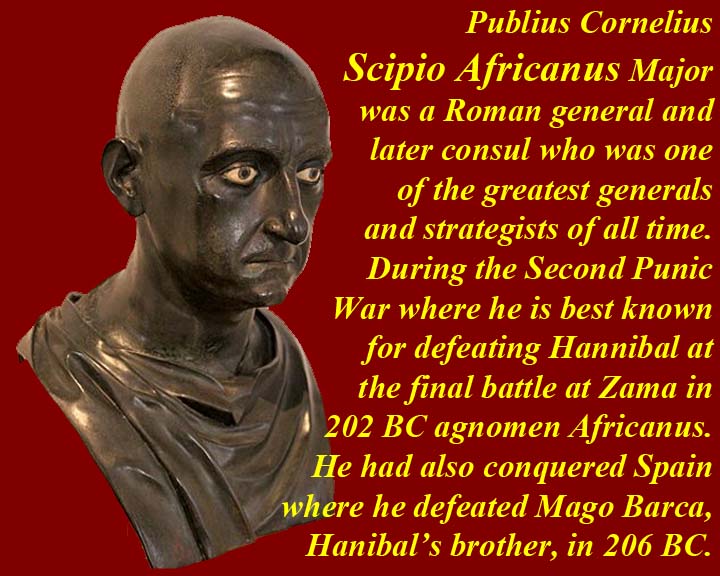
<---Scipio Africanus Major (= the Elder) acquired the "African" agnomen by defeating Hannibal Barca (an agnomen denoting speed -- Barca originally was onomatopoeia for "lightning" just like "blitz" in German. Barca was an inherited agnomen from his father, Hasdrubal Barca who established Barcelona in modern Spain.
Barca is an Arabic word with the same root as the name/title "Barack", which is usually translated into other languages with the meaning "blessed". Its origin was that you had been inspired, sometime literally, by a blessing (like a lightning bolt) from Allah. Another Arabic word/name/title with the same general meaning is "Mubarack".
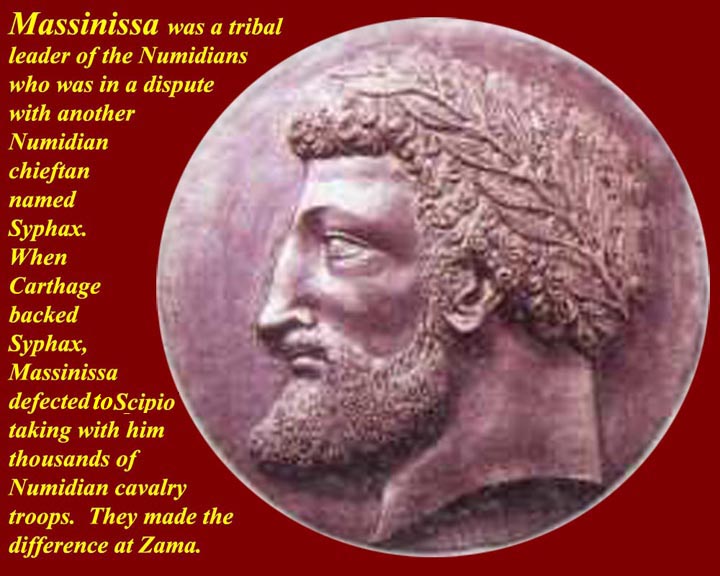
<---The rivalry between the two Numidian leaders was said to be over Sophanisba, an available young Carthaginian noblewoman. According to the legends, she (or the Carthaginian establishment) favored Syphax. Massanissa therfor swithed sides and provided his thousnds of cavalrymen to Scipio for the battle of Zama. His defection is said to have swung the victory to the Roman side.
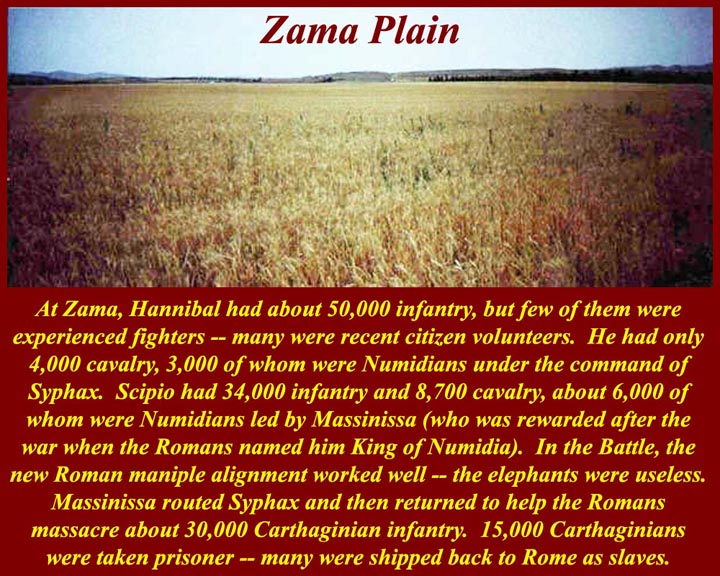
<---Casualties among the Carthaginians on the Zama battlefield were high especially among the recent citizen volunteers. Their lack of battle experience really showed. As noted above, Massanissa's cavalry fighting on the side of Scipio was decisive.
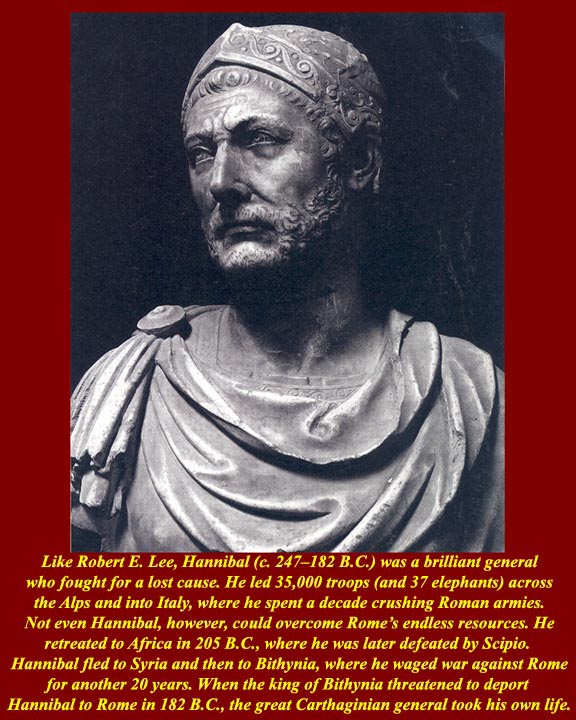
<---Hannibal's defeat at Zama was similar to Lee's at Gettysburg: each was fighting for an already lost cause. Cavalry, lack of it played, played a major part.
At Zama, Scipio hed figured out how to deal with charging elephants: he opened chanels through his maniple, through which the elephants charged allowing them to be slauchter from their sides.
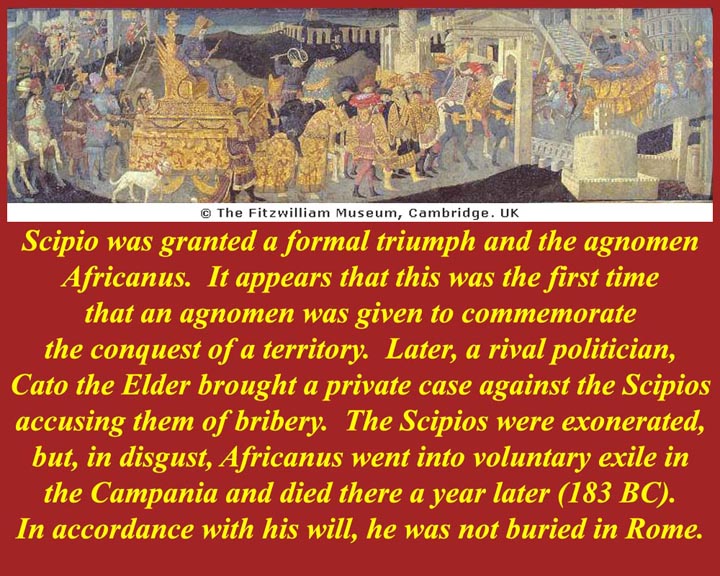
<---After his formal Triumph, Scipio Africanus was maligned bypolitical enemies led by Cato the Elder. In disgust, Scipio left Rome in retirement.

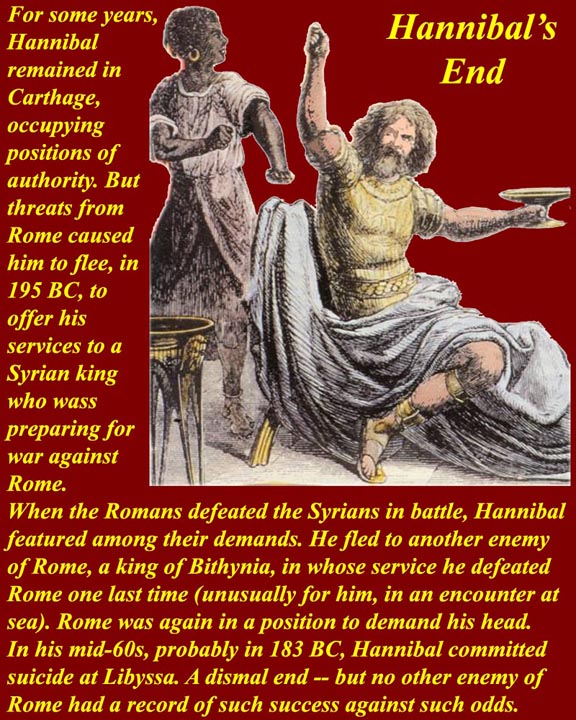
<---Hannibal ended his days as a mercenarry
general/admiral in the service of eastern Mediterranean potentates fightin aginst Roman expansion. When it was obvious that he would be turned over to the victorious RomansHannibal suicided.
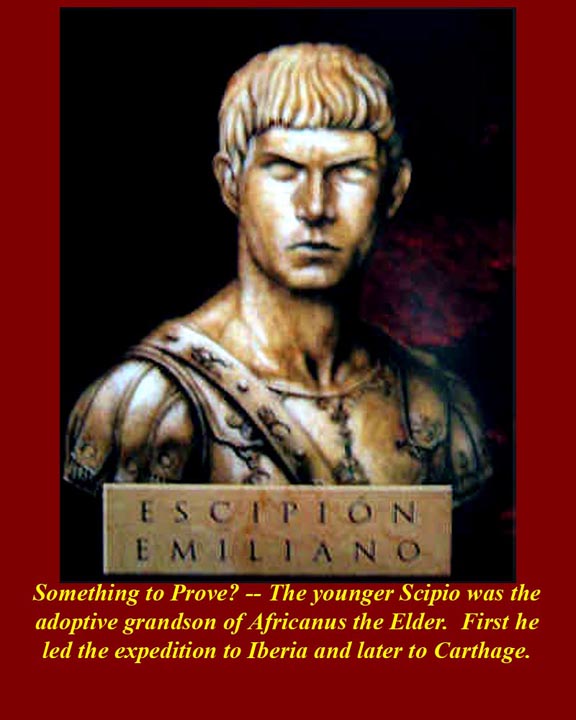
<---Scipio the Younger, the adoptive grandson of Scipio the Elder,became the Commanding General of the Romans in the Third Punic War. AAfter supressing a revolt in Spain, he led the expedition that finally destoyed a secretly re-arming North African Carthage (146 BC).
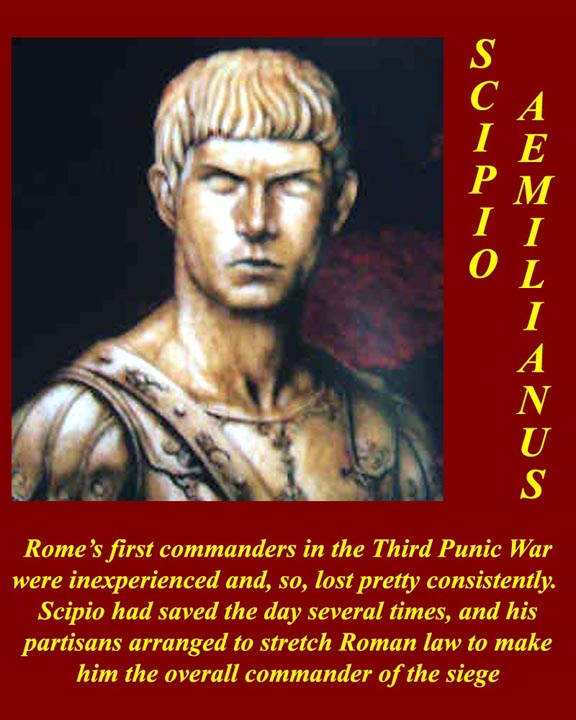
<---The Younger Scipio's political supporters agitated for his appointment as commander in the Third Punic War, and he relieved the previous inept leaders. His success in destroying Carthage is legendary -- although there is no real evidence that the agricultural areas around the city were strewn with salt. (The presence of a sabkha, a seasonal salt flat /salt lake just outside of modern Tunis City probably contributed to that lagend.)
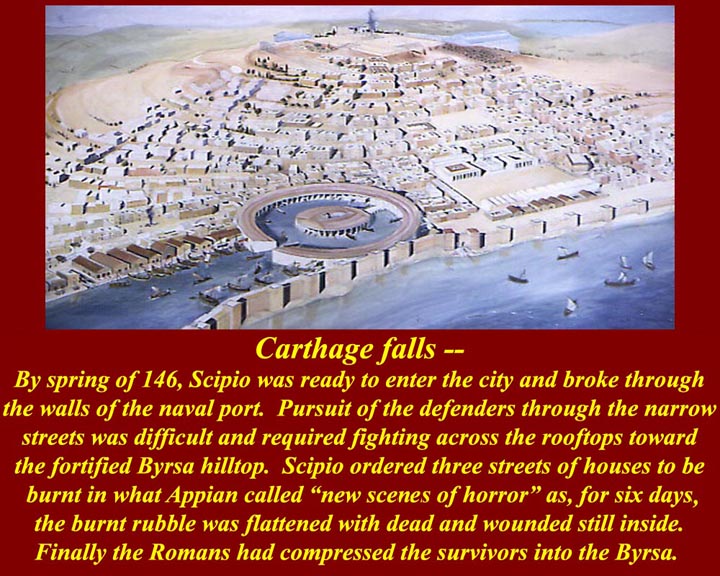
<---Carthage paid off the reparations demanded by Rome after the end of the Second Punic War, and the evidence of Carthaginian rearmament was overwhelming. And that gave Rome reason to attack again after making a final demand that Carthage resisted (i.e., the Romans demanded that the Carthaginian evacuate the city and move inland).
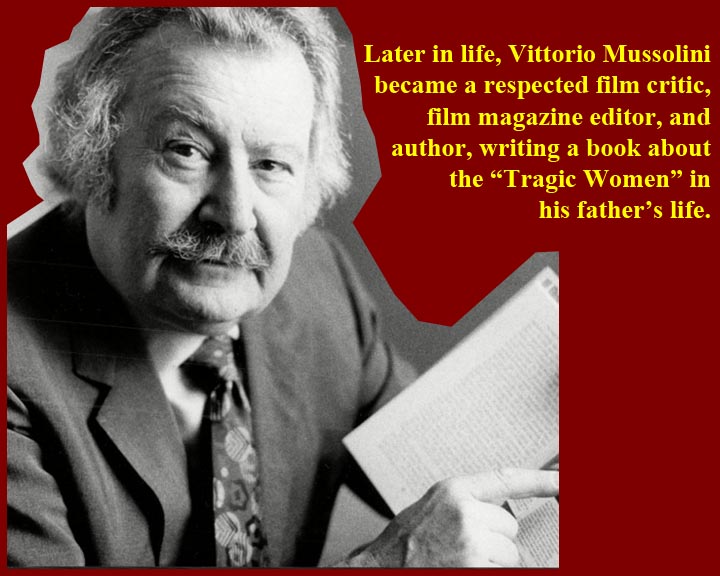
<---Producer Vittorio Mussolini
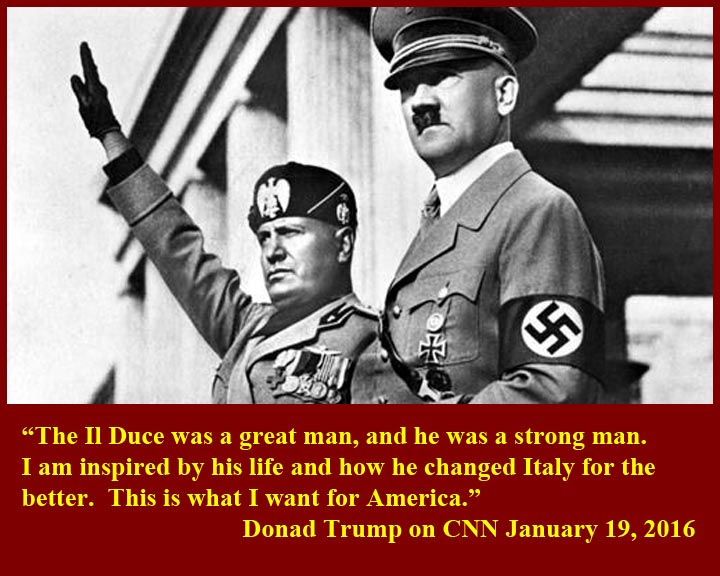
<---An interesting quotation.
<---More information on Second Punic War (Hannibal's War".)